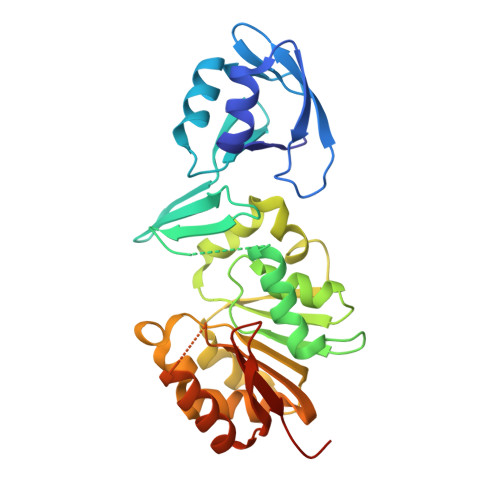
8VYD | pdb_00008vyd

A novel synthase generates m4(2)C to stabilize the archaeal ribosome


Experimental Data Snapshot

  • Method: X-RAY DIFFRACTION
  • Resolution: 1.95 Å
  • R-Value Free: 
    0.287 (Depositor), 0.285 (DCC) 
  • R-Value Work: 
    0.238 (Depositor), 0.251 (DCC) 
  • R-Value Observed: 
    0.240 (Depositor) 

Starting Model: in silico
View more details

wwPDB Validation 3D Report Full Report

Validation slider image for 8VYD

This is version 1.1 of the entry. See complete history. 

Literature

A novel N 4, N 4-dimethylcytidine in the archaeal ribosome enhances hyperthermophily.

Fluke, K.A., Dai, N., Wolf, E.J., Fuchs, R.T., Ho, P.S., Talbott, V., Elkins, L., Tsai, Y.L., Schiltz, J., Febvre, H.P., Czarny, R., Robb, G.B., Correa Jr., I.R., Santangelo, T.J.

(2024) Proc Natl Acad Sci U S A 121: e2405999121-e2405999121

  • DOI: https://doi.org/10.1073/pnas.2405999121
  • Primary Citation Related Structures: 
    8VYD

  • PubMed Abstract: 

    Ribosome structure and activity are challenged at high temperatures, often demanding modifications to ribosomal RNAs (rRNAs) to retain translation fidelity. LC-MS/MS, bisulfite-sequencing, and high-resolution cryo-EM structures of the archaeal ribosome identified an RNA modification, N 4, N 4-dimethylcytidine (m 4 2 C), at the universally conserved C918 in the 16S rRNA helix 31 loop. Here, we characterize and structurally resolve a class of RNA methyltransferase that generates m 4 2 C whose function is critical for hyperthermophilic growth. m 4 2 C is synthesized by the activity of a unique family of RNA methyltransferase containing a Rossman-fold that targets only intact ribosomes. The phylogenetic distribution of the newly identified m 4 2 C synthase family implies that m 4 2 C is biologically relevant in each domain. Resistance of m 4 2 C to bisulfite-driven deamination suggests that efforts to capture m 5 C profiles via bisulfite sequencing are also capturing m 4 2 C.


  • Organizational Affiliation: 
    • Cell and Molecular Biology Graduate Program, Colorado State University, Fort Collins, CO 80523.

Macromolecule Content 

  • Total Structure Weight: 66.03 kDa 
  • Atom Count: 4,489 
  • Modeled Residue Count: 530 
  • Deposited Residue Count: 580 
  • Unique protein chains: 1

Macromolecules

Find similar proteins by:|  3D Structure
Entity ID: 1
MoleculeChains  Sequence LengthOrganismDetailsImage
SAM-dependent methyltransferase, UPF0020 family
A, B
290Thermococcus kodakarensisMutation(s): 0 
Gene Names: TK2045
UniProt
Find proteins for Q5JDR0 (Thermococcus kodakarensis (strain ATCC BAA-918 / JCM 12380 / KOD1))
Explore Q5JDR0 
Go to UniProtKB:  Q5JDR0
Entity Groups
Sequence Clusters30% Identity50% Identity70% Identity90% Identity95% Identity100% Identity
UniProt GroupQ5JDR0
Sequence Annotations
Expand
Reference Sequence

Experimental Data & Validation

Experimental Data

  • Method: X-RAY DIFFRACTION
  • Resolution: 1.95 Å
  • R-Value Free:  0.287 (Depositor), 0.285 (DCC) 
  • R-Value Work:  0.238 (Depositor), 0.251 (DCC) 
  • R-Value Observed: 0.240 (Depositor) 
Space Group: P 1 21 1
Unit Cell:
Length ( Å )Angle ( ˚ )
a = 37.67α = 90
b = 97.28β = 99.642
c = 89.02γ = 90
Software Package:
Software NamePurpose
PHENIXrefinement
HKL-3000data reduction
XSCALEdata scaling
PHENIXphasing

Structure Validation

View Full Validation Report


Entry History 

& Funding Information

Deposition Data


Funding OrganizationLocationGrant Number
National Science Foundation (NSF, United States)United States2022065
National Institutes of Health/National Institute of General Medical Sciences (NIH/NIGMS)United StatesR35-GM143963
National Science Foundation (NSF, United States)United States2124202
National Institutes of Health/National Institute of General Medical Sciences (NIH/NIGMS)United StatesGM132057

Revision History  (Full details and data files)

  • Version 1.0: 2024-11-06
    Type: Initial release
  • Version 1.1: 2025-05-21
    Changes: Database references