Download Mendeley
A novel N 4, N 4-dimethylcytidine in the archaeal ribosome enhances hyperthermophily.
Fluke, K.A., Dai, N., Wolf, E.J., Fuchs, R.T., Ho, P.S., Talbott, V., Elkins, L., Tsai, Y.L., Schiltz, J., Febvre, H.P., Czarny, R., Robb, G.B., Correa Jr., I.R., Santangelo, T.J.(2024) Proc Natl Acad Sci U S A 121: e2405999121-e2405999121
- PubMed: 39471227 Search on PubMedSearch on PubMed Central
- DOI: https://doi.org/10.1073/pnas.2405999121
- Primary Citation Related Structures:
8VYD - PubMed Abstract:
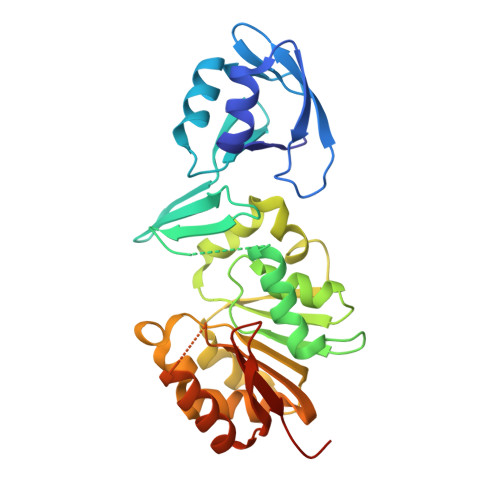
Ribosome structure and activity are challenged at high temperatures, often demanding modifications to ribosomal RNAs (rRNAs) to retain translation fidelity. LC-MS/MS, bisulfite-sequencing, and high-resolution cryo-EM structures of the archaeal ribosome identified an RNA modification, N 4, N 4-dimethylcytidine (m 4 2 C), at the universally conserved C918 in the 16S rRNA helix 31 loop. Here, we characterize and structurally resolve a class of RNA methyltransferase that generates m 4 2 C whose function is critical for hyperthermophilic growth. m 4 2 C is synthesized by the activity of a unique family of RNA methyltransferase containing a Rossman-fold that targets only intact ribosomes. The phylogenetic distribution of the newly identified m 4 2 C synthase family implies that m 4 2 C is biologically relevant in each domain. Resistance of m 4 2 C to bisulfite-driven deamination suggests that efforts to capture m 5 C profiles via bisulfite sequencing are also capturing m 4 2 C.
- Cell and Molecular Biology Graduate Program, Colorado State University, Fort Collins, CO 80523.
Organizational Affiliation: