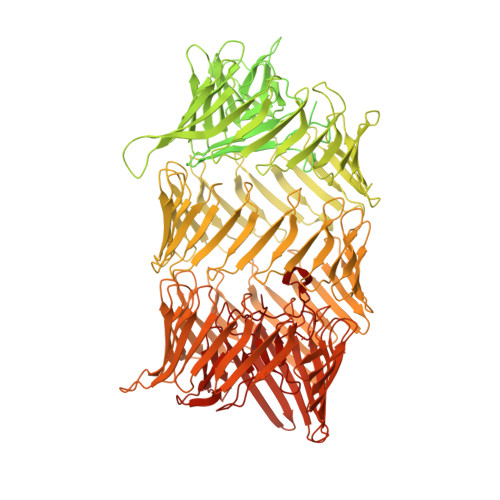
8QJA | pdb_00008qja

T6SS-linked Rhs repeat protein - Advenella mimigardefordensis VgrG-Rhs core


Experimental Data Snapshot

  • Method: X-RAY DIFFRACTION
  • Resolution: 3.36 Å
  • R-Value Free: 
    0.317 (Depositor), 0.314 (DCC) 
  • R-Value Work: 
    0.257 (Depositor), 0.258 (DCC) 
  • R-Value Observed: 
    0.260 (Depositor) 

Starting Model: experimental
View more details

wwPDB Validation   3D Report Full Report


This is version 1.2 of the entry. See complete history


Literature

T6SS-associated Rhs toxin-encapsulating shells: Structural and bioinformatical insights into bacterial weaponry and self-protection.

Kielkopf, C.S.Shneider, M.M.Leiman, P.G.Taylor, N.M.I.

(2024) Structure 32: 2375

  • DOI: https://doi.org/10.1016/j.str.2024.10.008
  • Primary Citation of Related Structures:  
    8QJA, 8QJB, 8QJC, 8QJD

  • PubMed Abstract: 

    Bacteria use the type VI secretion system (T6SS) to secrete toxins into pro- and eukaryotic cells via machinery consisting of a contractile sheath and a rigid tube. Rearrangement hotspot (Rhs) proteins represent one of the most common T6SS effectors. The Rhs C-terminal toxin domain displays great functional diversity, while the Rhs core is characterized by YD repeats. We elucidate the Rhs core structures of PAAR- and VgrG-linked Rhs proteins from Salmonella bongori and Advenella mimigardefordensis, respectively. The Rhs core forms a large shell of β-sheets with a negatively charged interior and encloses a large volume. The S. bongori Rhs toxin does not lead to ordered density in the Rhs shell, suggesting the toxin is unfolded. Together with bioinformatics analysis showing that Rhs toxins predominantly act intracellularly, this suggests that the Rhs core functions two-fold, as a safety feature for the producer cell and as delivery mechanism for the toxin.


  • Organizational Affiliation
    • Structural Biology of Molecular Machines Group, Protein Structure & Function Program, Novo Nordisk Foundation Center for Protein Research, Faculty of Health and Medical Sciences, University of Copenhagen, Blegdamsvej 3B, 2200 Copenhagen, Denmark.

Macromolecules
Find similar proteins by:  (by identity cutoff)  |  3D Structure
Entity ID: 1
MoleculeChains Sequence LengthOrganismDetailsImage
Putative type VI secretion system YD repeat-containing Rhs element Vgr protein
A, B, C, D
1,879Advenella mimigardefordensis DPN7Mutation(s): 0 
Gene Names: MIM_c35070
UniProt
Find proteins for W0PIA9 (Advenella mimigardefordensis (strain DSM 17166 / LMG 22922 / DPN7))
Explore W0PIA9 
Go to UniProtKB:  W0PIA9
Entity Groups  
Sequence Clusters30% Identity50% Identity70% Identity90% Identity95% Identity100% Identity
UniProt GroupW0PIA9
Sequence Annotations
Expand
  • Reference Sequence
Experimental Data & Validation

Experimental Data

  • Method: X-RAY DIFFRACTION
  • Resolution: 3.36 Å
  • R-Value Free:  0.317 (Depositor), 0.314 (DCC) 
  • R-Value Work:  0.257 (Depositor), 0.258 (DCC) 
  • R-Value Observed: 0.260 (Depositor) 
Space Group: P 1
Unit Cell:
Length ( Å )Angle ( ˚ )
a = 66.239α = 85.69
b = 97.783β = 89.99
c = 215.006γ = 76.89
Software Package:
Software NamePurpose
PHENIXrefinement
PHENIXrefinement
Cootmodel building
BUSTERrefinement
XDSdata scaling
XDSdata reduction
PHASERphasing

Structure Validation

View Full Validation Report


Entry History & Funding Information

Deposition Data


Funding OrganizationLocationGrant Number
Swiss National Science FoundationSwitzerland310030_144243

Revision History  (Full details and data files)

  • Version 1.0: 2024-09-25
    Type: Initial release
  • Version 1.1: 2024-11-13
    Changes: Database references, Structure summary
  • Version 1.2: 2024-12-18
    Changes: Database references