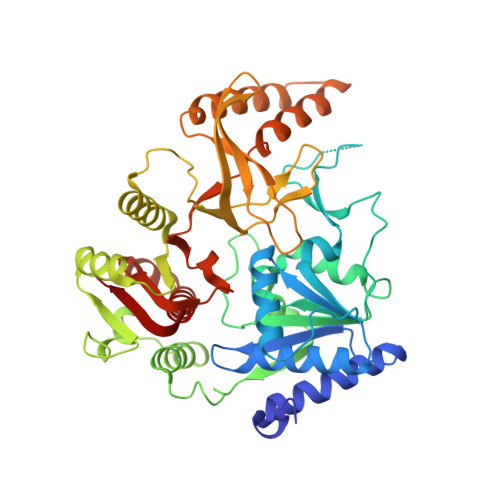
The deep sea, as the largest and maybe most hostile environment on Earth, is still underexplored, especially regarding its genetic repertoire. Yet, previous work has revealed significant habitat-specific deep-sea biodiversity. Here, we present an integrated deep-sea microbial genetic dataset comprising 502 million nonredundant genes from 2,138 samples and 2.4 million predicted structures and use it to link specific protein structures with genetic variants associated with life in the deep sea and to assess their biotechnology potential. Combining global sequence analysis with biophysical and biochemical measurements revealed unprecedented sequence diversity and substantial structural conservation of proteins. Especially, proteins involved in replication, recombination, and repair were identified as being under rapid evolution and with specialized properties. Among these, a structurally divergent helicase exhibited advantages in controlling nanopore sequencing speed. Thus, our work positions the deep sea as an evolutionary engine that generates and hosts genetic diversity and bridges genetic knowledge with biotechnology.
Organizational Affiliation:
BGI Research, Qingdao 266555, China; Institute of Oceanology, Chinese Academy of Sciences, Qingdao 266071, China.
BGI Research, Shenzhen 518083, China; BGI Research, Sanya 572025, China; State Key Laboratory of Genome and Multi-omics Technologies, BGI Research, Shenzhen 518083, China; Hainan Technology Innovation Center for Marine Biological Resources Utilization (Preparatory Period), BGI Research, Sanya 572025, China.
Institute of Oceanology, Chinese Academy of Sciences, Qingdao 266071, China.
State Key Laboratory of Microbial Metabolism, School of Life Sciences and Biotechnology, Shanghai Jiao Tong University, Shanghai 200240, China; International Center for Deep Life Investigation (IC-DLI), Shanghai Jiao Tong University, Shanghai 200240, China.
Institute of Deep-Sea Science and Engineering, Chinese Academy of Sciences, Sanya 572000, China.
BGI Research, Qingdao 266555, China; State Key Laboratory of Genome and Multi-omics Technologies, BGI Research, Shenzhen 518083, China; Qingdao Key Laboratory of Marine Genomics, BGI Research, Qingdao 266555, China.
Guangdong Provincial Key Laboratory of Interdisciplinary Research and Application for Data Science, Beijing Normal-Hong Kong Baptist University, Zhuhai, Guangdong 519087, China.
College of Agriculture, South China Agricultural University, Guangzhou 510642, China.
BGI Research, Shenzhen 518083, China; BGI Research, Sanya 572025, China; College of Life Sciences, University of Chinese Academy of Sciences, Beijing 100049, China.
BGI Research, Sanya 572025, China; Data Science and Analytics Thrust, The HongKong University of Science and Technology (Guangzhou), Guangzhou 511453, China.
Institute of Oceanology, Chinese Academy of Sciences, Qingdao 266071, China; South China Sea Institute of Oceanology, Chinese Academy of Science, Guangzhou 510301, China.
BGI, Shenzhen 518083, China.
BGI Research, Shenzhen 518083, China; Shenzhen Key Laboratory of Environmental Microbial Genomics and Application, BGI Research, Shenzhen 518083, China.
BGI Research, Qingdao 266555, China; State Key Laboratory of Genome and Multi-omics Technologies, BGI Research, Shenzhen 518083, China.
National Key Laboratory of Mariculture Biobreeding and Sustainable Goods, Yellow Sea Fisheries Research Institute, Chinese Academy of Fishery Sciences, Qingdao 266071, Shandong, China.
BGI Research, Shenzhen 518083, China; State Key Laboratory of Genome and Multi-omics Technologies, BGI Research, Shenzhen 518083, China; BGI Cell, Shenzhen 518083, China.
BGI Research, Shenzhen 518083, China; State Key Laboratory of Genome and Multi-omics Technologies, BGI Research, Shenzhen 518083, China; Guangdong Provincial Key Laboratory of Genome Read and Write, BGI Research, Shenzhen 518083, China.
School of Environmental Sciences, University of East Anglia, Norwich Research Park, NR4 7TJ Norwich, UK; College of Environmental Science and Engineering, Ocean University of China, Qingdao 266100, Shandong, China. Electronic address: t.mock@uea.ac.uk.
BGI Research, Qingdao 266555, China; State Key Laboratory of Genome and Multi-omics Technologies, BGI Research, Shenzhen 518083, China; Shenzhen Key Laboratory of Bioenergy, BGI Research, Shenzhen 518083, China. Electronic address: fanguangyi@genomics.cn.
State Key Laboratory of Genome and Multi-omics Technologies, BGI Research, Shenzhen 518083, China; BGI Research, Wuhan 430074, China. Electronic address: liyuxiang@genomics.cn.








 Download Mendeley