8ZHJ | pdb_00008zhj

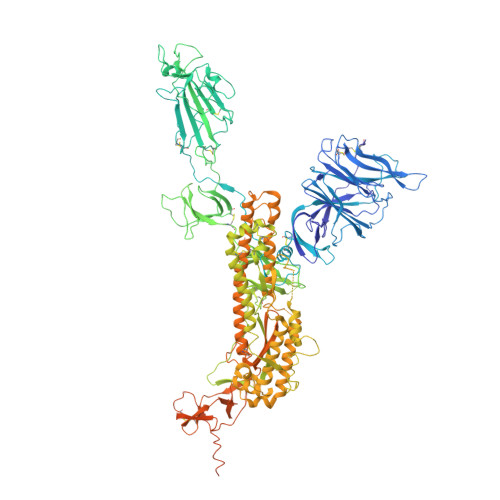
SARS-CoV-2 spike trimer (6P) in complex with three H18 Fabs, head-to-head aggregate (C1 symmetry)


Experimental Data Snapshot

  • Method: ELECTRON MICROSCOPY
  • Resolution: 8.45 Å
  • Aggregation State: PARTICLE 
  • Reconstruction Method: SINGLE PARTICLE 

wwPDB Validation 3D Report Full Report

Validation slider image for 8ZHJ

This is version 1.3 of the entry. See complete history

Literature

Antibodies utilizing VL6-57 light chains target a convergent cryptic epitope on SARS-CoV-2 spike protein and potentially drive the genesis of Omicron variants.

Yan, Q.Gao, X.Liu, B.Hou, R.He, P.Ma, Y.Zhang, Y.Zhang, Y.Li, Z.Chen, Q.Wang, J.Huang, X.Liang, H.Zheng, H.Yao, Y.Chen, X.Niu, X.He, J.Chen, L.Zhao, J.Xiong, X.

(2024) Nat Commun 15: 7585-7585

  • DOI: https://doi.org/10.1038/s41467-024-51770-3
  • Primary Citation Related Structures: 
    8ZHD, 8ZHE, 8ZHF, 8ZHG, 8ZHH, 8ZHI, 8ZHJ, 8ZHK, 8ZHL, 8ZHM, 8ZHN, 8ZHO, 8ZHP

  • PubMed Abstract: 

    Continued evolution of SARS-CoV-2 generates variants to challenge antibody immunity established by infection and vaccination. A connection between population immunity and genesis of virus variants has long been suggested but its molecular basis remains poorly understood. Here, we identify a class of SARS-CoV-2 neutralizing public antibodies defined by their shared usage of VL6-57 light chains. Although heavy chains of diverse genotypes are utilized, convergent HCDR3 rearrangements have been observed among these public antibodies to cooperate with germline VL6-57 LCDRs to target a convergent epitope defined by RBD residues S371-S373-S375. Antibody repertoire analysis identifies that this class of VL6-57 antibodies is present in SARS-CoV-2-naive individuals and is clonally expanded in most COVID-19 patients. We confirm that Omicron-specific substitutions at S371, S373 and S375 mediate escape of antibodies of the VL6-57 class. These findings support that this class of public antibodies constitutes a potential immune pressure promoting the introduction of S371L/F-S373P-S375F in Omicron variants. The results provide further molecular evidence to support that antigenic evolution of SARS-CoV-2 is driven by antibody mediated population immunity.


  • Organizational Affiliation
    • State Key Laboratory of Respiratory Disease, National Clinical Research Center for Respiratory Disease, Guangzhou Institute of Respiratory Health, the First Affiliated Hospital of Guangzhou Medical University, Guangzhou, China.

Macromolecule Content 

  • Total Structure Weight: 1,182.13 kDa 
  • Atom Count: 70,950 
  • Modeled Residue Count: 8,980 
  • Deposited Residue Count: 10,584 
  • Unique protein chains: 3

Macromolecules

Find similar proteins by:|  3D Structure
Entity ID: 1
MoleculeChains  Sequence LengthOrganismDetailsImage
Spike glycoprotein,Fibritin,Expression Tag1,278Severe acute respiratory syndrome coronavirus 2Enterobacteria phage T6synthetic construct
This entity is chimeric
Mutation(s): 2 
Gene Names: S2wacEcT6_00157
UniProt
Find proteins for A0A346FJN8 (Enterobacteria phage T6)
Explore A0A346FJN8 
Go to UniProtKB:  A0A346FJN8
Find proteins for P0DTC2 (Severe acute respiratory syndrome coronavirus 2)
Explore P0DTC2 
Go to UniProtKB:  P0DTC2
Entity Groups
Sequence Clusters30% Identity50% Identity70% Identity90% Identity95% Identity100% Identity
UniProt GroupsP0DTC2A0A346FJN8
Glycosylation
Glycosylation Sites: 15Go to GlyGen: P0DTC2-1
Sequence Annotations
Expand
Reference Sequence
Find similar proteins by:|  3D Structure
Entity ID: 2
MoleculeChains  Sequence LengthOrganismDetailsImage
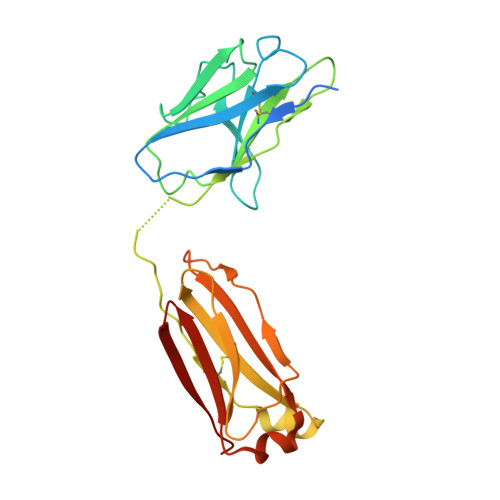
Light chain of H18 Fab243Homo sapiensMutation(s): 0 
Find similar proteins by:|  3D Structure
Entity ID: 3
MoleculeChains  Sequence LengthOrganismDetailsImage
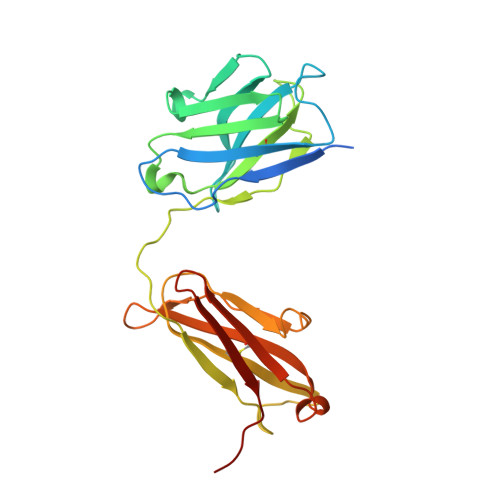
Heavy chain of H18 Fab243Homo sapiensMutation(s): 0 

Oligosaccharides

Help  
Entity ID: 4
MoleculeChains Length2D Diagram GlycosylationD Interactions
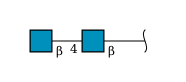
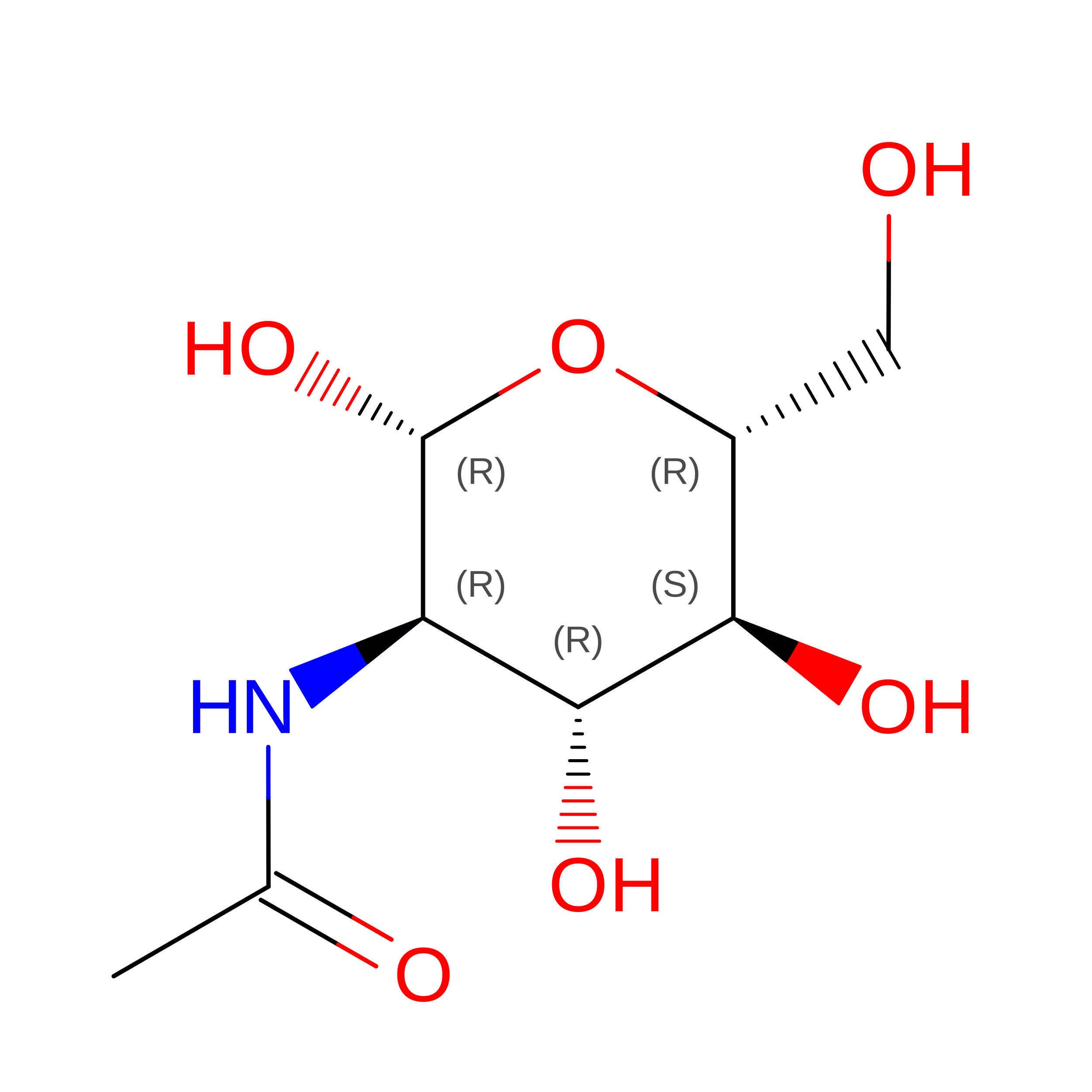
2-acetamido-2-deoxy-beta-D-glucopyranose-(1-4)-2-acetamido-2-deoxy-beta-D-glucopyranose
AA [auth a],
BA [auth b],
CA [auth c],
DA [auth d],
EA [auth e],
AA [auth a],
BA [auth b],
CA [auth c],
DA [auth d],
EA [auth e],
FA [auth f],
GA [auth g],
HA [auth h],
IA [auth i],
JA [auth j],
KA [auth k],
LA [auth l],
MA [auth m],
NA [auth n],
OA [auth o],
PA [auth p],
S,
T,
U,
V,
W,
X,
Y,
Z
2N-Glycosylation
Glycosylation Resources
GlyTouCan: G42666HT
GlyCosmos: G42666HT
GlyGen: G42666HT

Small Molecules

Ligands 1 Unique
IDChains Name / Formula / InChI Key2D Diagram3D Interactions
NAG

Query on NAG


Download:Ideal Coordinates CCD File
AB [auth A]
AC [auth G]
AD [auth I]
BB [auth B]
BC [auth G]
AB [auth A],
AC [auth G],
AD [auth I],
BB [auth B],
BC [auth G],
BD [auth I],
CB [auth B],
CC [auth G],
CD [auth I],
DB [auth B],
DC [auth G],
DD [auth I],
EB [auth B],
EC [auth G],
FB [auth B],
FC [auth G],
GB [auth B],
GC [auth G],
HB [auth B],
HC [auth G],
IB [auth B],
IC [auth H],
JB [auth B],
JC [auth H],
KB [auth B],
KC [auth H],
LB [auth B],
LC [auth H],
MB [auth C],
MC [auth H],
NB [auth C],
NC [auth H],
OB [auth C],
OC [auth H],
PB [auth C],
PC [auth H],
QA [auth A],
QB [auth C],
QC [auth H],
RA [auth A],
RB [auth C],
RC [auth H],
SA [auth A],
SB [auth C],
SC [auth H],
TA [auth A],
TB [auth C],
TC [auth I],
UA [auth A],
UB [auth C],
UC [auth I],
VA [auth A],
VB [auth C],
VC [auth I],
WA [auth A],
WB [auth C],
WC [auth I],
XA [auth A],
XB [auth G],
XC [auth I],
YA [auth A],
YB [auth G],
YC [auth I],
ZA [auth A],
ZB [auth G],
ZC [auth I]
2-acetamido-2-deoxy-beta-D-glucopyranose
C8 H15 N O6
OVRNDRQMDRJTHS-FMDGEEDCSA-N

Experimental Data & Validation

Experimental Data

  • Method: ELECTRON MICROSCOPY
  • Resolution: 8.45 Å
  • Aggregation State: PARTICLE 
  • Reconstruction Method: SINGLE PARTICLE 
EM Software:
TaskSoftware PackageVersion
MODEL REFINEMENTPHENIX
RECONSTRUCTIONcryoSPARC

Structure Validation

View Full Validation Report


Entry History 

& Funding Information

Deposition Data


Funding OrganizationLocationGrant Number
Other governmentChina2021A1515011289
Other governmentChinaSRPG22-002
Other governmentChinaEKPG21-06

Revision History  (Full details and data files)

  • Version 1.0: 2024-08-21
    Type: Initial release
  • Version 1.1: 2024-10-23
    Changes: Data collection, Database references, Structure summary
  • Version 1.2: 2024-11-13
    Changes: Data collection
  • Version 1.3: 2025-07-16
    Changes: Data collection