Download Mendeley
Inherent symmetry and flexibility in hepatitis B virus subviral particles.
Wang, Q., Wang, T., Cao, L., Mu, A., Fu, S., Wang, P., Gao, Y., Ji, W., Liu, Z., Du, Z., Guddat, L.W., Zhang, W., Li, S., Li, X., Lou, Z., Wang, X., Hu, Z., Rao, Z.(2024) Science 385: 1217-1224
- PubMed: 39264996 Search on PubMed
- DOI: https://doi.org/10.1126/science.adp1453
- Primary Citation Related Structures:
8YMJ, 8YMK - PubMed Abstract:
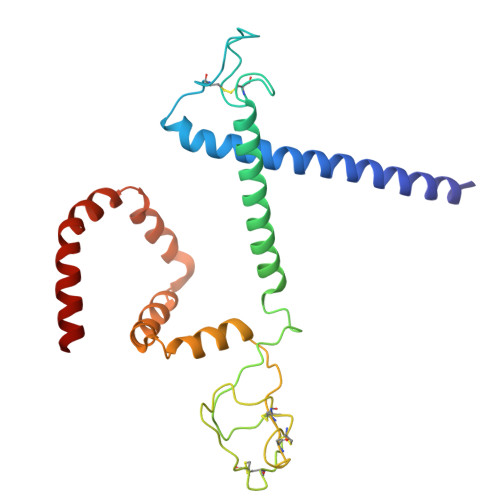
Chronic hepatitis B virus (HBV) infection poses a major global health challenge with massive morbidity and mortality. Despite a preventive vaccine, current treatments provide limited virus clearance, necessitating lifelong commitment. The HBV surface antigen (HBsAg) is crucial for diagnosis and prognosis, yet its high-resolution structure and assembly on the virus envelope remain elusive. Utilizing extensive datasets and advanced cryo-electron microscopy analysis, we present structural insights into HBsAg at a near-atomic resolution of 3.7 angstroms. HBsAg homodimers assemble into subviral particles with D 2 - and D 4 -like quasisymmetry, elucidating the dense-packing rules and structural adaptability of HBsAg. These findings provide insights into how HBsAg assembles into higher-order filaments and interacts with the capsid to form virions.
- Shanghai Institute for Advanced Immunochemical Studies and School of Life Science and Technology, ShanghaiTech University, Shanghai, China.
Organizational Affiliation: