Download Mendeley
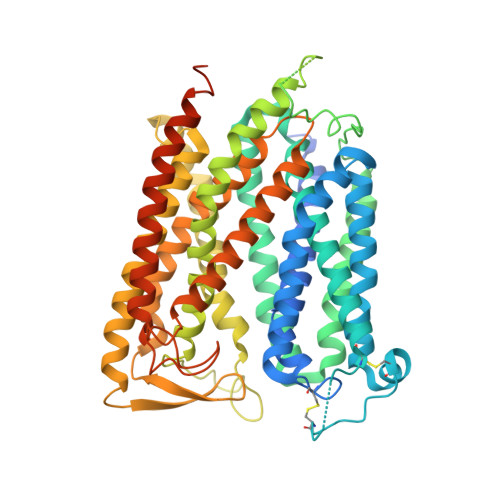
The structures of the peptide transporters SLC15A3 and SLC15A4 reveal the recognition mechanisms for substrate and TASL.
Zhang, Z., Kasai, S., Sakaniwa, K., Fujimura, A., Ohto, U., Shimizu, T.(2025) Structure 33: 330
- PubMed: 39719710 Search on PubMed
- DOI: https://doi.org/10.1016/j.str.2024.11.019
- Primary Citation Related Structures:
8WX1, 8WX2, 8WX3, 8WX4, 8WX5 - PubMed Abstract:
The solute carrier family 15 members 3 and 4 (SLC15A3 and SLC15A4) are closely related endolysosomal peptide transporters that transport free histidine and certain dipeptides from the lumen to cytosol. Besides, SLC15A4 also functions as a scaffold protein for the recruitment of the adapter TASL for interferon regulatory factor 5 (IRF5) activation downstream of innate immune TLR7-9 signaling. However, the molecular basis for the substrate recognition and TASL recruitment by these membrane proteins is not well understood. Here, we report the cryoelectron microscopy (cryo-EM) structure of apo SLC15A3 and structures of SLC15A4 in the absence or presence of the substrate, revealing the specific dipeptide recognition mechanism. Each SLC15A3 and SLC15A4 protomer adopts an outward-facing conformation. Furthermore, we also present the cryo-EM structure of a SLC15A4-TASL complex. The N terminal region of TASL forms a helical structure that inserts deeply into the inward-facing cavity of SLC15A4.
- Graduate School of Pharmaceutical Sciences, The University of Tokyo, 7-3-1 Hongo, Bunkyo-ku, Tokyo 113-0033, Japan.
Organizational Affiliation: