8VQA | pdb_00008vqa

Prefusion stabilized structure of the SARS-CoV-2 fusion machinery


Experimental Data Snapshot

  • Method: ELECTRON MICROSCOPY
  • Resolution: 3.50 Å
  • Aggregation State: PARTICLE 
  • Reconstruction Method: SINGLE PARTICLE 

wwPDB Validation 3D Report Full Report

Validation slider image for 8VQA

This is version 1.2 of the entry. See complete history. 

Literature

A broadly generalizable stabilization strategy for sarbecovirus fusion machinery vaccines.

Lee, J., Stewart, C., Schafer, A., Leaf, E.M., Park, Y.J., Asarnow, D., Powers, J.M., Treichel, C., Sprouse, K.R., Corti, D., Baric, R., King, N.P., Veesler, D.

(2024) Nat Commun 15: 5496-5496

  • DOI: https://doi.org/10.1038/s41467-024-49656-5
  • Primary Citation Related Structures: 
    8VQ9, 8VQA, 8VQB

  • PubMed Abstract: 

    Evolution of SARS-CoV-2 alters the antigenicity of the immunodominant spike (S) receptor-binding domain and N-terminal domain, undermining the efficacy of vaccines and antibody therapies. To overcome this challenge, we set out to develop a vaccine focusing antibody responses on the highly conserved but metastable S 2 subunit, which folds as a spring-loaded fusion machinery. We describe a strategy for prefusion-stabilization and high yield recombinant production of SARS-CoV-2 S 2 trimers with native structure and antigenicity. We demonstrate that our design strategy is broadly generalizable to sarbecoviruses, as exemplified with the SARS-CoV-1 (clade 1a) and PRD-0038 (clade 3) S 2 subunits. Immunization of mice with a prefusion-stabilized SARS-CoV-2 S 2 trimer elicits broadly reactive sarbecovirus antibodies and neutralizing antibody titers of comparable magnitude against Wuhan-Hu-1 and the immune evasive XBB.1.5 variant. Vaccinated mice were protected from weight loss and disease upon challenge with XBB.1.5, providing proof-of-principle for fusion machinery sarbecovirus vaccines.


  • Organizational Affiliation: 
    • Department of Biochemistry, University of Washington, Seattle, Washington, USA.

Macromolecule Content 

  • Total Structure Weight: 211.41 kDa 
  • Atom Count: 9,495 
  • Modeled Residue Count: 1,290 
  • Deposited Residue Count: 1,872 
  • Unique protein chains: 1

Macromolecules

Find similar proteins by:|  3D Structure
Entity ID: 1
MoleculeChains  Sequence LengthOrganismDetailsImage
Spike protein S2
A, B, C
624SarbecovirusMutation(s): 0 
Gene Names: S, 2
UniProt
Find proteins for P0DTC2 (Severe acute respiratory syndrome coronavirus 2)
Explore P0DTC2 
Go to UniProtKB:  P0DTC2
Entity Groups
Sequence Clusters30% Identity50% Identity70% Identity90% Identity95% Identity100% Identity
UniProt GroupP0DTC2
Glycosylation
Glycosylation Sites: 6Go to GlyGen: P0DTC2-1
Sequence Annotations
Expand
Reference Sequence

Oligosaccharides

Help  
Entity ID: 2
MoleculeChains Length2D Diagram GlycosylationD Interactions
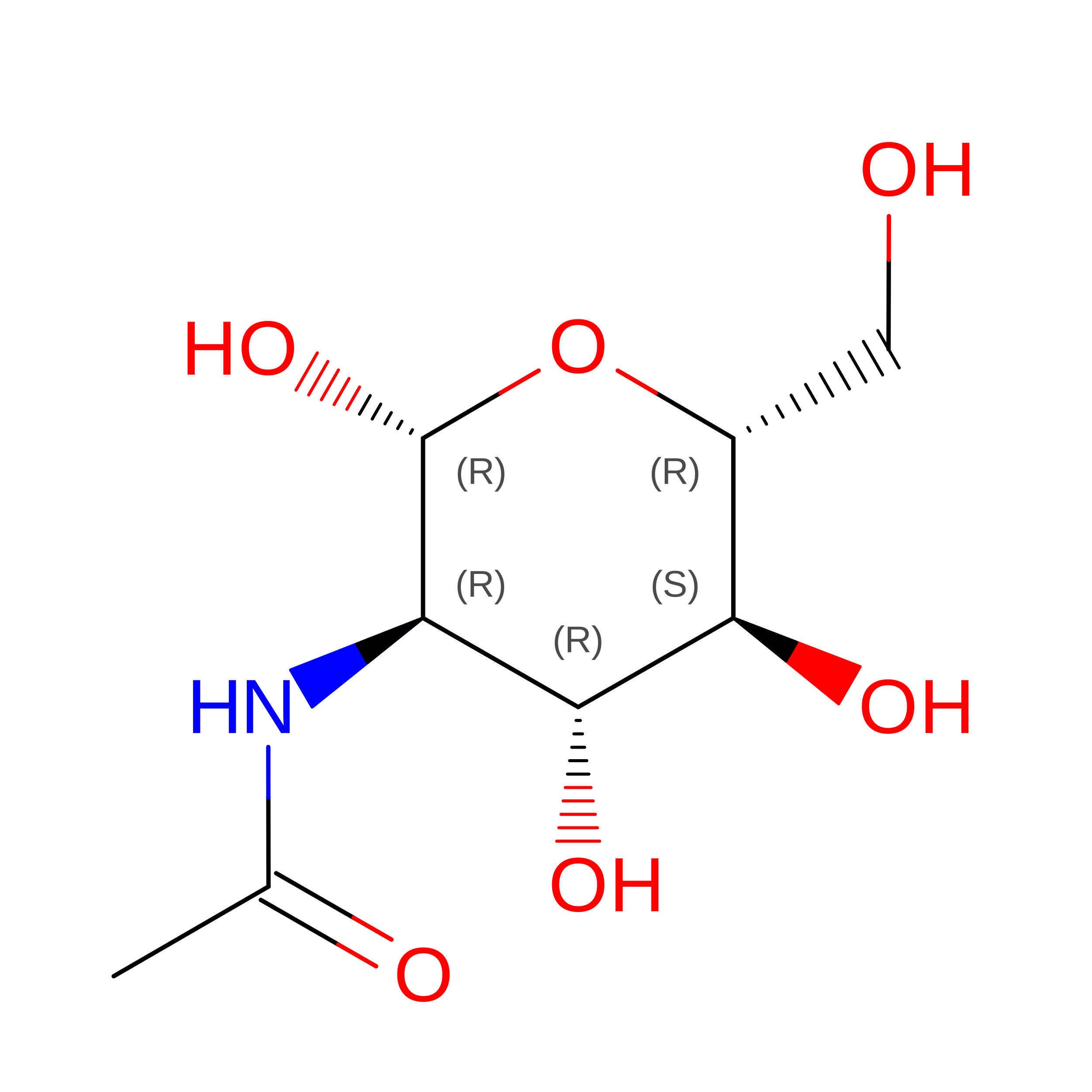
2-acetamido-2-deoxy-beta-D-glucopyranose-(1-4)-2-acetamido-2-deoxy-beta-D-glucopyranose
D, E, F, G, H
D, E, F, G, H, I, J, K, L, M, N, O
2N-Glycosylation
Glycosylation Resources
GlyTouCan: G42666HT
GlyCosmos: G42666HT
GlyGen: G42666HT

Experimental Data & Validation

Experimental Data

  • Method: ELECTRON MICROSCOPY
  • Resolution: 3.50 Å
  • Aggregation State: PARTICLE 
  • Reconstruction Method: SINGLE PARTICLE 
EM Software:
TaskSoftware PackageVersion
RECONSTRUCTIONcryoSPARC

Structure Validation

View Full Validation Report


Entry History 

& Funding Information

Deposition Data


Funding OrganizationLocationGrant Number
National Institutes of Health/National Institute Of Allergy and Infectious Diseases (NIH/NIAID)United StatesAI158186

Revision History  (Full details and data files)

  • Version 1.0: 2024-07-24
    Type: Initial release
  • Version 1.1: 2024-10-23
    Changes: Data collection, Structure summary
  • Version 1.2: 2024-11-27
    Changes: Data collection, Other