Download Mendeley
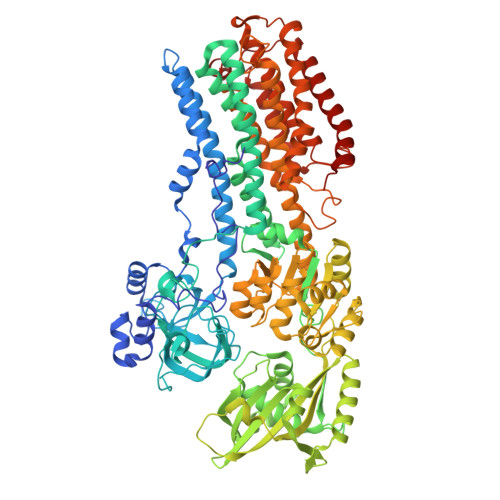
P-type ATPase magnesium transporter MgtA acts as a dimer.
Zeinert, R., Zhou, F., Franco, P., Zoller, J., Madni, Z.K., Lessen, H., Aravind, L., Langer, J.D., Sodt, A.J., Storz, G., Matthies, D.(2025) Nat Struct Mol Biol 32: 1633-1643
- PubMed: 40550995 Search on PubMedSearch on PubMed Central
- DOI: https://doi.org/10.1038/s41594-025-01593-7
- Primary Citation Related Structures:
8UY7, 8UY8, 8UY9, 8UYA, 8UYB, 8UYC - PubMed Abstract:
Magnesium (Mg 2+ ) uptake systems are present in all domains of life, consistent with the vital role of this ion. P-type ATPase Mg 2+ importers are required for bacterial growth when Mg 2+ is limiting or during pathogenesis. However, insights into their mechanisms of action are missing. Here we solved the cryo-EM structure of the Mg 2+ transporter MgtA from Escherichia coli. We obtained high-resolution structures of both homodimeric (2.9 Å) and monomeric (3.6 Å) forms. The dimer structure is formed by multiple contacts between residues in adjacent soluble N and P subdomains. Our structures revealed an ion, assigned as Mg 2+ , in the transmembrane segment. Moreover, we detected two cytoplasmic ion-binding sites and determined the structure of the N-terminal tail. Sequence conservation, mutagenesis and ATPase assays indicate dimerization, the ion-binding sites and the N-terminal tail facilitate cation transport or serve regulatory roles.
- Division of Molecular and Cellular Biology, Eunice Kennedy Shriver National Institute of Child Health and Human Development, National Institutes of Health, Bethesda, MD, USA.
Organizational Affiliation: