8UTD | pdb_00008utd

CryoEM Structure of HCA2-Gi1 in complex with MK-1903


Experimental Data Snapshot

  • Method: ELECTRON MICROSCOPY
  • Resolution: 3.24 Å
  • Aggregation State: PARTICLE 
  • Reconstruction Method: SINGLE PARTICLE 

wwPDB Validation 3D Report Full Report

Validation slider image for 8UTD

This is version 1.1 of the entry. See complete history. 

Literature

Structure-guided design of a peripherally restricted chemogenetic system.

Kang, H.J., Krumm, B.E., Tassou, A., Geron, M., DiBerto, J.F., Kapolka, N.J., Gumpper, R.H., Sakamoto, K., Dewran Kocak, D., Olsen, R.H.J., Huang, X.P., Zhang, S., Huang, K.L., Zaidi, S.A., Nguyen, M.T., Jo, M.J., Katritch, V., Fay, J.F., Scherrer, G., Roth, B.L.

(2024) Cell 187: 7433-7449.e20

  • DOI: https://doi.org/10.1016/j.cell.2024.11.001
  • Primary Citation Related Structures: 
    8UTD, 8UUJ, 9CIB

  • PubMed Abstract: 

    Designer receptors exclusively activated by designer drugs (DREADDs) are chemogenetic tools for remotely controlling cellular signaling, neural activity, behavior, and physiology. Using a structure-guided approach, we provide a peripherally restricted Gi-DREADD, hydroxycarboxylic acid receptor DREADD (HCAD), whose native receptor is minimally expressed in the brain, and a chemical actuator that does not cross the blood-brain barrier (BBB). This was accomplished by combined mutagenesis, analoging via an ultra-large make-on-demand library, structural determination of the designed DREADD receptor via cryoelectron microscopy (cryo-EM), and validation of HCAD function. Expression and activation of HCAD in dorsal root ganglion (DRG) neurons inhibit action potential (AP) firing and reduce both acute and tissue-injury-induced inflammatory pain. The HCAD chemogenetic system expands the possibilities for studying numerous peripheral systems with little adverse effects on the central nervous system (CNS). The structure-guided approach used to generate HCAD also has the potential to accelerate the development of emerging chemogenetic tools for basic and translational sciences.


  • Organizational Affiliation: 
    • Department of Biotechnology, College of Life Science and Biotechnology, Yonsei University, Seoul, South Korea.

Macromolecule Content 

  • Total Structure Weight: 158.86 kDa 
  • Atom Count: 8,872 
  • Modeled Residue Count: 1,138 
  • Deposited Residue Count: 1,418 
  • Unique protein chains: 5

Macromolecules

Find similar proteins by:|  3D Structure
Entity ID: 1
MoleculeChains  Sequence LengthOrganismDetailsImage
Hydroxycarboxylic acid receptor 2A [auth R]368Homo sapiensMutation(s): 1 
Gene Names: HCAR2
Membrane Entity: Yes 
UniProt & NIH Common Fund Data Resources
Find proteins for Q8TDS4 (Homo sapiens)
Explore Q8TDS4 
Go to UniProtKB:  Q8TDS4
PHAROS:  Q8TDS4
GTEx:  ENSG00000182782 
Entity Groups
Sequence Clusters30% Identity50% Identity70% Identity90% Identity95% Identity100% Identity
UniProt GroupQ8TDS4
Sequence Annotations
Expand
Reference Sequence
Find similar proteins by:|  3D Structure
Entity ID: 2
MoleculeChains  Sequence LengthOrganismDetailsImage
scFv16B [auth D]267Lama glamaMutation(s): 0 
Entity Groups
Sequence Clusters30% Identity50% Identity70% Identity90% Identity95% Identity100% Identity
Sequence Annotations
Expand
Reference Sequence
Find similar proteins by:|  3D Structure
Entity ID: 3
MoleculeChains  Sequence LengthOrganismDetailsImage
Guanine nucleotide-binding protein G(i) subunit alpha-1C [auth A]354Homo sapiensMutation(s): 2 
Gene Names: GNAI1
EC: 3.6.5
Membrane Entity: Yes 
UniProt & NIH Common Fund Data Resources
Find proteins for P63096 (Homo sapiens)
Explore P63096 
Go to UniProtKB:  P63096
PHAROS:  P63096
GTEx:  ENSG00000127955 
Entity Groups
Sequence Clusters30% Identity50% Identity70% Identity90% Identity95% Identity100% Identity
UniProt GroupP63096
Sequence Annotations
Expand
Reference Sequence
Find similar proteins by:|  3D Structure
Entity ID: 4
MoleculeChains  Sequence LengthOrganismDetailsImage
Guanine nucleotide-binding protein G(I)/G(S)/G(T) subunit beta-1D [auth B]358Homo sapiensMutation(s): 0 
Gene Names: GNB1
UniProt & NIH Common Fund Data Resources
Find proteins for P62873 (Homo sapiens)
Explore P62873 
Go to UniProtKB:  P62873
PHAROS:  P62873
GTEx:  ENSG00000078369 
Entity Groups
Sequence Clusters30% Identity50% Identity70% Identity90% Identity95% Identity100% Identity
UniProt GroupP62873
Sequence Annotations
Expand
Reference Sequence
Find similar proteins by:|  3D Structure
Entity ID: 5
MoleculeChains  Sequence LengthOrganismDetailsImage
Guanine nucleotide-binding protein G(I)/G(S)/G(O) subunit gamma-2E [auth C]71Homo sapiensMutation(s): 0 
Gene Names: GNG2
Membrane Entity: Yes 
UniProt & NIH Common Fund Data Resources
Find proteins for P59768 (Homo sapiens)
Explore P59768 
Go to UniProtKB:  P59768
PHAROS:  P59768
GTEx:  ENSG00000186469 
Entity Groups
Sequence Clusters30% Identity50% Identity70% Identity90% Identity95% Identity100% Identity
UniProt GroupP59768
Sequence Annotations
Expand
Reference Sequence

Small Molecules

Ligands 1 Unique
IDChains Name / Formula / InChI Key2D Diagram3D Interactions
XOT
(Subject of Investigation/LOI)

Query on XOT


Download:Ideal Coordinates CCD File
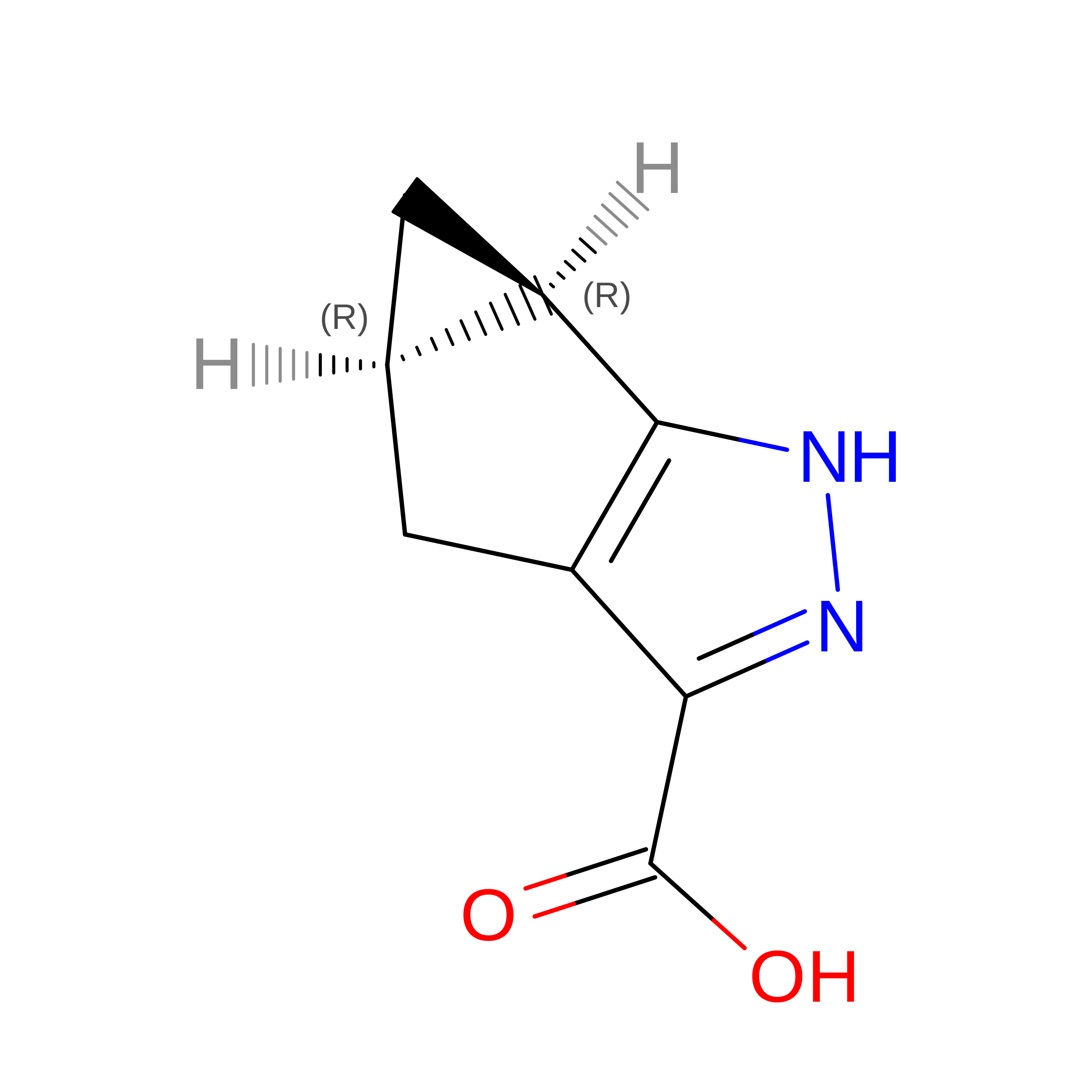
F [auth R](4aR,5aR)-4,4a,5,5a-tetrahydro-1H-cyclopropa[4,5]cyclopenta[1,2-c]pyrazole-3-carboxylic acid
C8 H8 N2 O2
CUTZNERBKDMLAP-QWWZWVQMSA-N

Experimental Data & Validation

Experimental Data

  • Method: ELECTRON MICROSCOPY
  • Resolution: 3.24 Å
  • Aggregation State: PARTICLE 
  • Reconstruction Method: SINGLE PARTICLE 
EM Software:
TaskSoftware PackageVersion
MODEL REFINEMENTPHENIX

Structure Validation

View Full Validation Report


Entry History 

& Funding Information

Deposition Data


Funding OrganizationLocationGrant Number
National Institutes of Health/National Institute of Mental Health (NIH/NIMH)United States5R01MH112205

Revision History  (Full details and data files)

  • Version 1.0: 2025-02-26
    Type: Initial release
  • Version 1.1: 2025-05-14
    Changes: Data collection