8RTN | pdb_00008rtn

Human thrombin in complex with a trivalent inhibitor


Experimental Data Snapshot

  • Method: X-RAY DIFFRACTION
  • Resolution: 2.51 Å
  • R-Value Free: 
    0.213 (Depositor), 0.210 (DCC) 
  • R-Value Work: 
    0.168 (Depositor), 0.166 (DCC) 
  • R-Value Observed: 
    0.171 (Depositor) 

Starting Model: experimental
View more details

wwPDB Validation   3D Report Full Report


Ligand Structure Quality Assessment 


This is version 1.3 of the entry. See complete history


Literature

Engineering ultrapotent trivalent anticoagulants through hybridisation of salivary peptides from multiple haematophagous organisms.

Maxwell, J.W.C.Ripoll-Rozada, J.Mackay, A.S.Alwis, I.Ford, D.J.Trought, C.B.J.Santos, J.A.Smythe, R.E.Liu, J.S.T.Zuccolotto, Z.Schoenwaelder, S.M.Jackson, S.P.Pereira, P.J.B.Payne, R.J.

(2025) Chem Sci 16: 18660-18672

  • DOI: https://doi.org/10.1039/d5sc04734j
  • Primary Citation of Related Structures:  
    8RTN

  • PubMed Abstract: 

    Haematophagous organisms are a rich source of salivary anticoagulant polypeptides that exert their activity by blocking the catalytic site and one of two positively charged exosites on the host protease thrombin. Here, we describe a molecular engineering approach to hybridise post-translationally sulfated polypeptides from different blood-feeding organisms to enhance anticoagulant activity. This led to the discovery of a triply sulfated hybrid anticoagulant, XChimera, possessing fragments from flea, leech, and fly salivary polypeptides that exhibits femtomolar inhibitory activity against thrombin. The crystallographic structure of a complex of XChimera with thrombin shows that it displays a trivalent binding mode in which it simultaneously blocks three functional sites of the protease, the active site and exosites I and II. This trivalent chimera exhibited ultrapotent anticoagulant activity in a suite of in vitro clotting assays and was also shown to possess potent in vivo antithrombotic activity in a murine model of thrombosis.


  • Organizational Affiliation
    • School of Chemistry, Faculty of Science, The University of Sydney NSW Australia richard.payne@sydney.edu.au.

Macromolecules
Find similar proteins by:  (by identity cutoff)  |  3D Structure
Entity ID: 1
MoleculeChains Sequence LengthOrganismDetailsImage
ProthrombinA [auth L],
B [auth H]
622Homo sapiensMutation(s): 0 
EC: 3.4.21.5
UniProt & NIH Common Fund Data Resources
Find proteins for P00734 (Homo sapiens)
Explore P00734 
Go to UniProtKB:  P00734
PHAROS:  P00734
GTEx:  ENSG00000180210 
Entity Groups  
Sequence Clusters30% Identity50% Identity70% Identity90% Identity95% Identity100% Identity
UniProt GroupP00734
Glycosylation
Glycosylation Sites: 1Go to GlyGen: P00734-1
Sequence Annotations
Expand
  • Reference Sequence
Find similar proteins by:  (by identity cutoff)  |  3D Structure
Entity ID: 2
MoleculeChains Sequence LengthOrganismDetailsImage
Synthetic trivalent inhibitorC [auth I]48Glossina morsitans morsitansMutation(s): 0 
Entity Groups  
Sequence Clusters30% Identity50% Identity70% Identity90% Identity95% Identity100% Identity
Sequence Annotations
Expand
  • Reference Sequence
Small Molecules
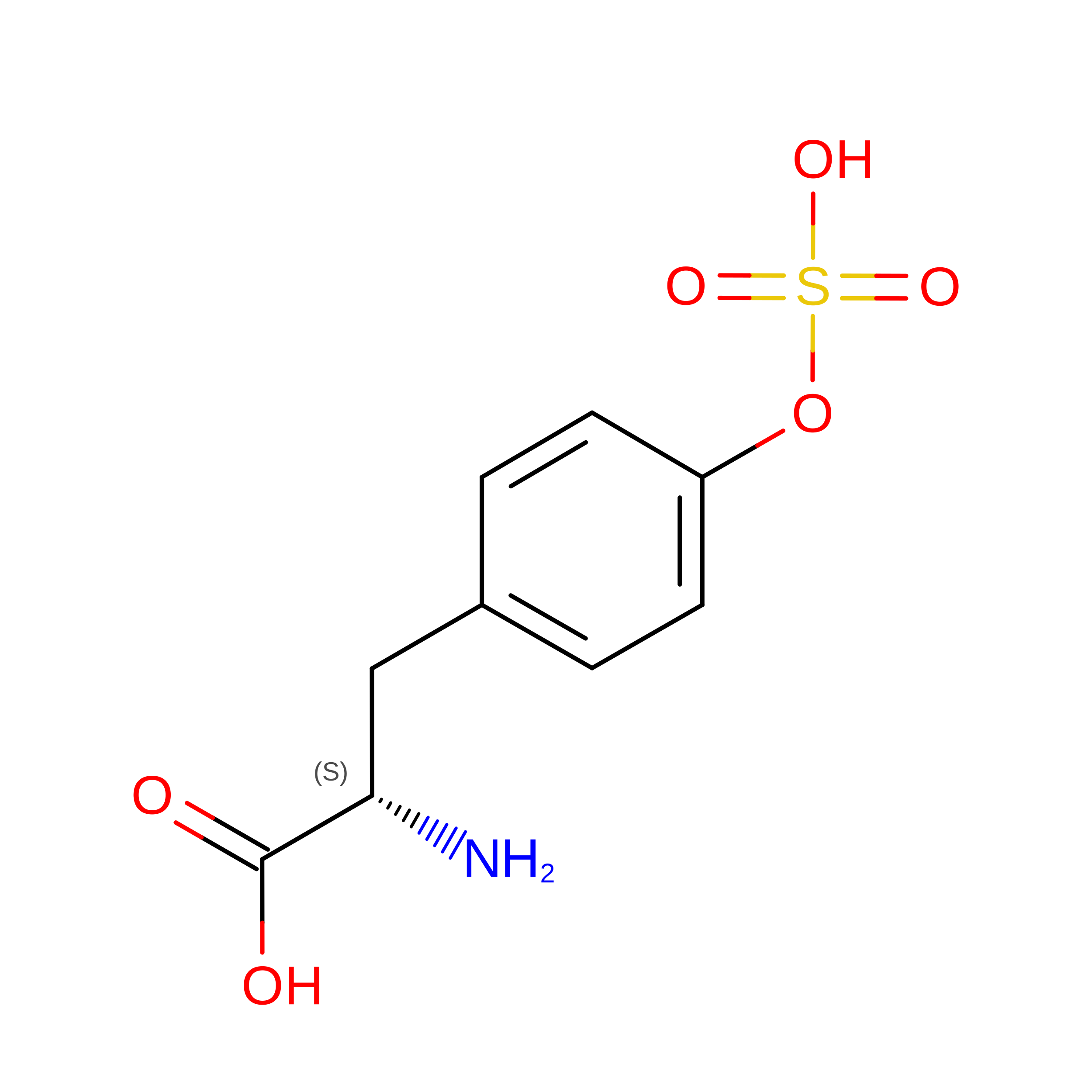
Modified Residues  1 Unique
IDChains TypeFormula2D DiagramParent
TYS
Query on TYS
C [auth I]L-PEPTIDE LINKINGC9 H11 N O6 STYR
Experimental Data & Validation

Experimental Data

  • Method: X-RAY DIFFRACTION
  • Resolution: 2.51 Å
  • R-Value Free:  0.213 (Depositor), 0.210 (DCC) 
  • R-Value Work:  0.168 (Depositor), 0.166 (DCC) 
  • R-Value Observed: 0.171 (Depositor) 
Space Group: H 3 2
Unit Cell:
Length ( Å )Angle ( ˚ )
a = 82.188α = 90
b = 82.188β = 90
c = 271.964γ = 120
Software Package:
Software NamePurpose
PHENIXrefinement
PHENIXrefinement
XDSdata reduction
Aimlessdata scaling
PHASERphasing

Structure Validation

View Full Validation Report


Ligand Structure Quality Assessment 


Entry History & Funding Information

Deposition Data


Funding OrganizationLocationGrant Number
Foundation for Science and Technology (FCT)PortugalPTDC/BIA-BQM/2494/2020

Revision History  (Full details and data files)

  • Version 1.0: 2025-02-12
    Type: Initial release
  • Version 1.1: 2025-09-10
    Changes: Database references
  • Version 1.2: 2025-10-01
    Changes: Database references
  • Version 1.3: 2025-10-22
    Changes: Database references