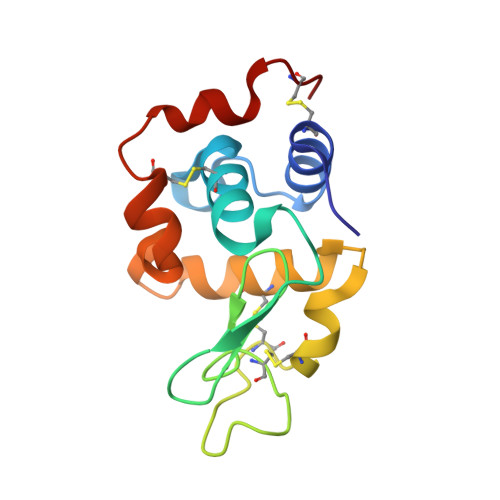
8RPM | pdb_00008rpm

Lysozyme structure based on automated real-time serial crystallography data processing using CrystFEL

  • Classification: HYDROLASE
  • Organism(s): Gallus
  • Mutation(s): No 

  • Deposited: 2024-01-16 Released: 2024-02-21 
  • Deposition Author(s): White, T.A., Oberthuer, D., Henkel, A.
  • Funding Organization(s): H2020 Marie Curie Actions of the European Commission

Experimental Data Snapshot

  • Method: X-RAY DIFFRACTION
  • Resolution: 1.80 Å
  • R-Value Free: 
    0.222 (Depositor), 0.240 (DCC) 
  • R-Value Work: 
    0.185 (Depositor), 0.190 (DCC) 
  • R-Value Observed: 
    0.187 (Depositor) 

Starting Model: experimental
View more details

wwPDB Validation   3D Report Full Report


This is version 1.3 of the entry. See complete history


Literature

Real-time data processing for serial crystallography experiments.

White, T.Schoof, T.Yakubov, S.Tolstikova, A.Middendorf, P.Karnevskiy, M.Mariani, V.Henkel, A.Klopprogge, B.Hannappel, J.Oberthuer, D.De Gennaro Aquino, I.Egorov, D.Munke, A.Sprenger, J.Pompidor, G.Taberman, H.Gruzinov, A.Meyer, J.Hakanpaa, J.Gasthuber, M.

(2025) IUCrJ 12: 97-108

  • DOI: https://doi.org/10.1107/S2052252524011837
  • Primary Citation of Related Structures:  
    8RPM

  • PubMed Abstract: 

    We report the use of streaming data interfaces to perform fully online data processing for serial crystallography experiments, without storing intermediate data on disk. The system produces Bragg reflection intensity measurements suitable for scaling and merging, with a latency of less than 1 s per frame. Our system uses the CrystFEL software in combination with the ASAP::O data framework. In a series of user experiments at PETRA III, frames from a 16 megapixel Dectris EIGER2 X detector were searched for peaks, indexed and integrated at the maximum full-frame readout speed of 133 frames per second. The computational resources required depend on various factors, most significantly the fraction of non-blank frames (`hits'). The average single-thread processing time per frame was 242 ms for blank frames and 455 ms for hits, meaning that a single 96-core computing node was sufficient to keep up with the data, with ample headroom for unexpected throughput reductions. Further significant improvements are expected, for example by binning pixel intensities together to reduce the pixel count. We discuss the implications of real-time data processing on the `data deluge' problem from recent and future photon-science experiments, in particular on calibration requirements, computing access patterns and the need for the preservation of raw data.


  • Organizational Affiliation
    • Center for Data and Computing in Natural Science CDCS, Deutsches Elektronen-Synchrotron DESY, Hamburg, Germany.

Macromolecules
Find similar proteins by:  (by identity cutoff)  |  3D Structure
Entity ID: 1
MoleculeChains Sequence LengthOrganismDetailsImage
Lysozyme C129GallusMutation(s): 0 
EC: 3.2.1.17
UniProt
Find proteins for P00698 (Gallus gallus)
Explore P00698 
Go to UniProtKB:  P00698
Entity Groups  
Sequence Clusters30% Identity50% Identity70% Identity90% Identity95% Identity100% Identity
UniProt GroupP00698
Sequence Annotations
Expand
  • Reference Sequence
Experimental Data & Validation

Experimental Data

  • Method: X-RAY DIFFRACTION
  • Resolution: 1.80 Å
  • R-Value Free:  0.222 (Depositor), 0.240 (DCC) 
  • R-Value Work:  0.185 (Depositor), 0.190 (DCC) 
  • R-Value Observed: 0.187 (Depositor) 
Space Group: P 43 21 2
Unit Cell:
Length ( Å )Angle ( ˚ )
a = 79.2α = 90
b = 79.2β = 90
c = 38γ = 90
Software Package:
Software NamePurpose
REFMACrefinement
PHENIXrefinement
PDB-REDOrefinement
CrystFELdata reduction
CrystFELdata scaling
PHENIXphasing

Structure Validation

View Full Validation Report


Entry History & Funding Information

Deposition Data


Funding OrganizationLocationGrant Number
H2020 Marie Curie Actions of the European CommissionEuropean Union85764

Revision History  (Full details and data files)

  • Version 1.0: 2024-02-21
    Type: Initial release
  • Version 1.1: 2024-10-23
    Changes: Structure summary
  • Version 1.2: 2025-01-15
    Changes: Database references
  • Version 1.3: 2025-01-22
    Changes: Database references