8R3X | pdb_00008r3x

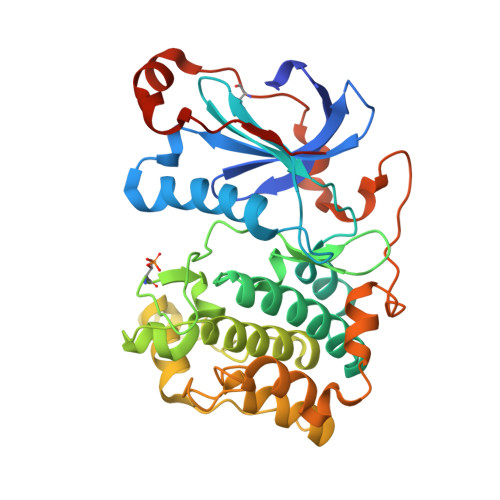
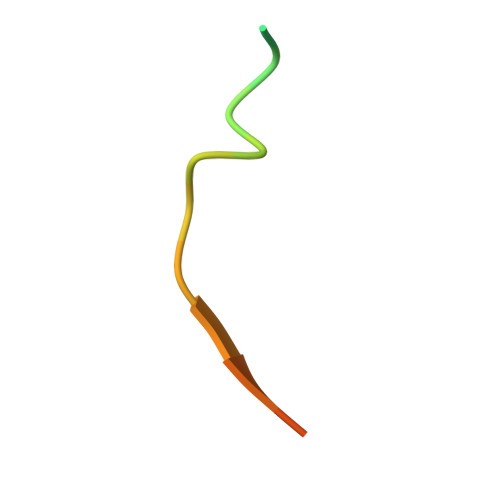
Crystal structure of aPKC Iota kinase domain with LLGL2 peptide


Experimental Data Snapshot

  • Method: X-RAY DIFFRACTION
  • Resolution: 2.59 Å
  • R-Value Free: 
    0.269 (Depositor), 0.269 (DCC) 
  • R-Value Work: 
    0.232 (Depositor), 0.232 (DCC) 

Starting Model: experimental
View more details

wwPDB Validation   3D Report Full Report


This is version 1.2 of the entry. See complete history


Literature

Capture, mutual inhibition and release mechanism for aPKC-Par6 and its multisite polarity substrate Lgl.

Earl, C.P.Cobbaut, M.Barros-Carvalho, A.Ivanova, M.E.Briggs, D.C.Morais-de-Sa, E.Parker, P.J.McDonald, N.Q.

(2025) Nat Struct Mol Biol 32: 729-739

  • DOI: https://doi.org/10.1038/s41594-024-01425-0
  • Primary Citation of Related Structures:  
    8R3X, 8R3Y

  • PubMed Abstract: 

    The mutually antagonistic relationship of atypical protein kinase C (aPKC) and partitioning-defective protein 6 (Par6) with the substrate lethal (2) giant larvae (Lgl) is essential for regulating polarity across many cell types. Although aPKC-Par6 phosphorylates Lgl at three serine sites to exclude it from the apical domain, aPKC-Par6 and Lgl paradoxically form a stable kinase-substrate complex, with conflicting roles proposed for Par6. We report the structure of human aPKCι-Par6α bound to full-length Llgl1, captured through an aPKCι docking site and a Par6 PDZ contact. This complex traps a phospho-S663 Llgl1 intermediate bridging between aPKC and Par6, impeding phosphorylation progression. Thus, aPKCι is effectively inhibited by Llgl1 pS663 while Llgl1 is captured by aPKCι-Par6. Mutational disruption of the Lgl-aPKC interaction impedes complex assembly and Lgl phosphorylation, whereas disrupting the Lgl-Par6 PDZ contact promotes complex dissociation and Lgl phosphorylation. We demonstrate a Par6 PDZ -regulated substrate capture-and-release model requiring binding by active Cdc42 and the apical partner Crumbs to drive complex disassembly. Our results suggest a mechanism for mutual regulation and spatial control of aPKC-Par6 and Lgl activities.


  • Organizational Affiliation
    • Signalling and Structural Biology Laboratory, Francis Crick Institute, London, UK.

Macromolecules
Find similar proteins by:  (by identity cutoff)  |  3D Structure
Entity ID: 1
MoleculeChains Sequence LengthOrganismDetailsImage
Protein kinase C iota type
A, B
356Homo sapiensMutation(s): 0 
Gene Names: PRKCIDXS1179E
EC: 2.7.11.13
UniProt & NIH Common Fund Data Resources
Find proteins for P41743 (Homo sapiens)
Explore P41743 
Go to UniProtKB:  P41743
PHAROS:  P41743
GTEx:  ENSG00000163558 
Entity Groups  
Sequence Clusters30% Identity50% Identity70% Identity90% Identity95% Identity100% Identity
UniProt GroupP41743
Sequence Annotations
Expand
  • Reference Sequence

Find similar proteins by:  Sequence   |   3D Structure  

Entity ID: 2
MoleculeChains Sequence LengthOrganismDetailsImage
LLGL scribble cell polarity complex component 2
C, D
20Homo sapiensMutation(s): 0 
UniProt & NIH Common Fund Data Resources
Find proteins for Q6P1M3 (Homo sapiens)
Explore Q6P1M3 
Go to UniProtKB:  Q6P1M3
PHAROS:  Q6P1M3
GTEx:  ENSG00000073350 
Entity Groups  
Sequence Clusters30% Identity50% Identity70% Identity90% Identity95% Identity100% Identity
UniProt GroupQ6P1M3
Sequence Annotations
Expand
  • Reference Sequence
Small Molecules
Modified Residues  1 Unique
IDChains TypeFormula2D DiagramParent
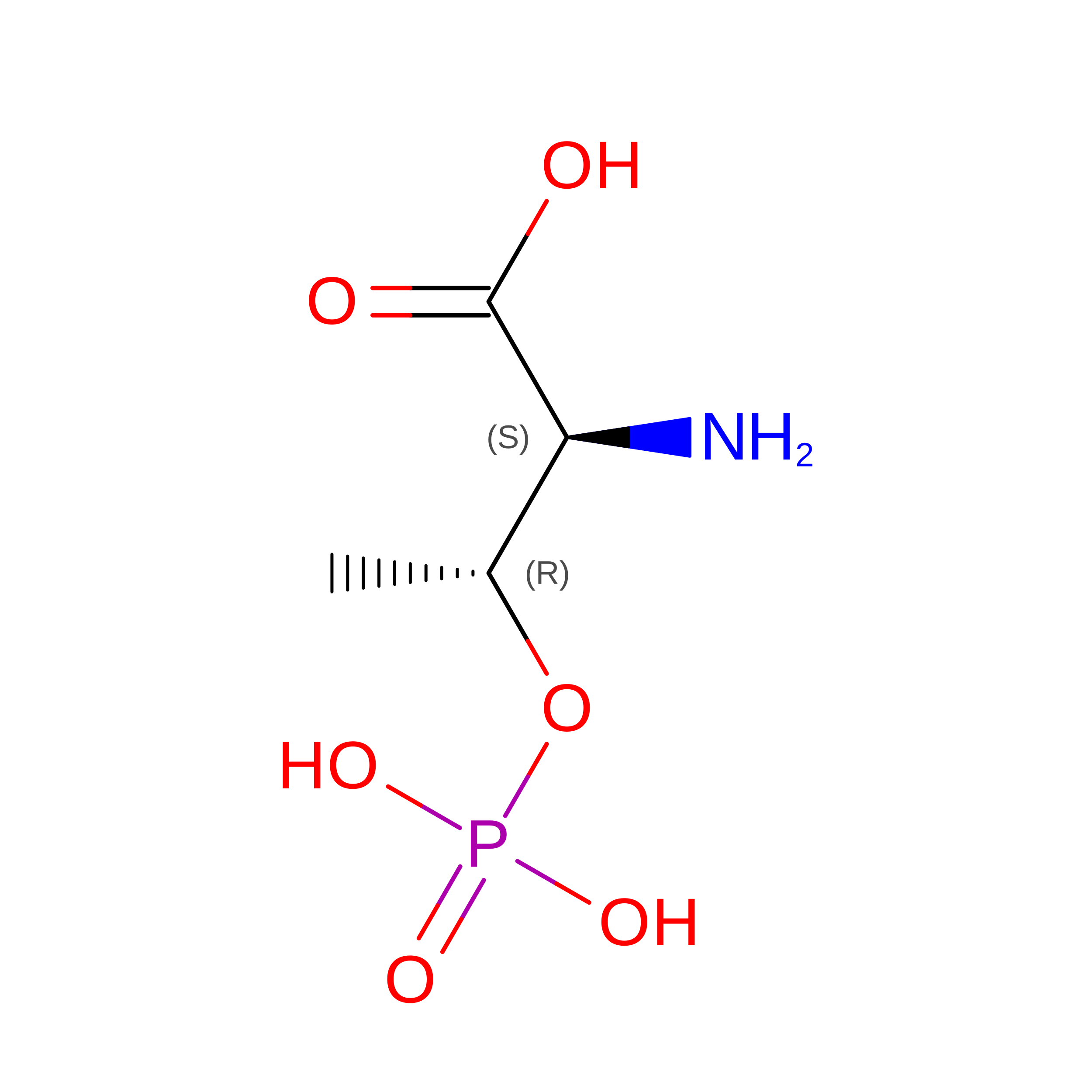
TPO
Query on TPO
A, B
L-PEPTIDE LINKINGC4 H10 N O6 PTHR
Experimental Data & Validation

Experimental Data

  • Method: X-RAY DIFFRACTION
  • Resolution: 2.59 Å
  • R-Value Free:  0.269 (Depositor), 0.269 (DCC) 
  • R-Value Work:  0.232 (Depositor), 0.232 (DCC) 
Space Group: P 21 21 21
Unit Cell:
Length ( Å )Angle ( ˚ )
a = 78.418α = 90
b = 86.324β = 90
c = 114.803γ = 90
Software Package:
Software NamePurpose
REFMACrefinement
xia2data reduction
DIALSdata scaling
PHASERphasing

Structure Validation

View Full Validation Report


Entry History & Funding Information

Deposition Data


Funding OrganizationLocationGrant Number
Wellcome TrustUnited KingdomCC2068
Cancer Research UKUnited KingdomCC2026
Medical Research Council (MRC, United Kingdom)United KingdomCC2068

Revision History  (Full details and data files)

  • Version 1.0: 2024-11-20
    Type: Initial release
  • Version 1.1: 2025-01-15
    Changes: Database references
  • Version 1.2: 2025-04-23
    Changes: Database references