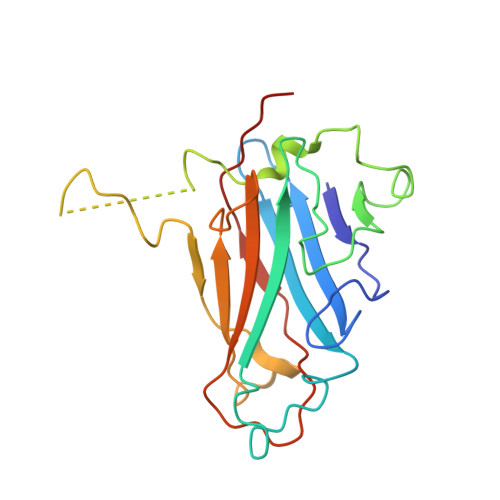
8OFP | pdb_00008ofp

Human adenovirus type 24 fiber-knob protein


Experimental Data Snapshot

  • Method: X-RAY DIFFRACTION
  • Resolution: 3.10 Å
  • R-Value Free: 
    0.337 (Depositor), 0.330 (DCC) 
  • R-Value Work: 
    0.234 (Depositor), 0.233 (DCC) 
  • R-Value Observed: 
    0.239 (Depositor) 

Starting Model: experimental
View more details

wwPDB Validation 3D Report Full Report

Validation slider image for 8OFP

This is version 1.3 of the entry. See complete history

Literature

Broad sialic acid usage amongst species D human adenovirus.

Mundy, R.M.Baker, A.T.Bates, E.A.Cunliffe, T.G.Teijeira-Crespo, A.Moses, E.Rizkallah, P.J.Parker, A.L.

(2023) Npj Viruses 1: 1-1

  • DOI: https://doi.org/10.1038/s44298-023-00001-5
  • Primary Citation Related Structures: 
    8OFP, 8OFQ, 8OFR, 8OFS, 8OFT, 8OFU, 8OFV

  • PubMed Abstract: 

    Human adenoviruses (HAdV) are widespread pathogens causing usually mild infections. The Species D (HAdV-D) cause gastrointestinal tract infections and epidemic keratoconjunctivitis (EKC). Despite being significant pathogens, knowledge around HAdV-D mechanism of cell infection is lacking. Sialic acid (SA) usage has been proposed as a cell infection mechanism for EKC causing HAdV-D. Here we highlight an important role for SA engagement by many HAdV-D. We provide apo state crystal structures of 7 previously undetermined HAdV-D fiber-knob proteins, and structures of HAdV-D25, D29, D30 and D53 fiber-knob proteins in complex with SA. Biologically, we demonstrate that removal of cell surface SA reduced infectivity of HAdV-C5 vectors pseudotyped with HAdV-D fiber-knob proteins, whilst engagement of the classical HAdV receptor CAR was variable. Our data indicates variable usage of SA and CAR across HAdV-D. Better defining these interactions will enable improved development of antivirals and engineering of the viruses into refined therapeutic vectors.


  • Organizational Affiliation
    • Division of Cancer & Genetics, Cardiff University School of Medicine, Cardiff, CF14 4XN UK.

Macromolecule Content 

  • Total Structure Weight: 132.75 kDa 
  • Atom Count: 8,946 
  • Modeled Residue Count: 1,127 
  • Deposited Residue Count: 1,176 
  • Unique protein chains: 1

Macromolecules

Find similar proteins by:|  3D Structure
Entity ID: 1
MoleculeChains  Sequence LengthOrganismDetailsImage
Fiber
A, B, C, D, E
A, B, C, D, E, F
196Human adenovirus 24Mutation(s): 0 
Gene Names: L5
UniProt
Find proteins for M0QUI2 (Human adenovirus 24)
Explore M0QUI2 
Go to UniProtKB:  M0QUI2
Entity Groups
Sequence Clusters30% Identity50% Identity70% Identity90% Identity95% Identity100% Identity
UniProt GroupM0QUI2
Sequence Annotations
Expand
Reference Sequence

Experimental Data & Validation

Experimental Data

  • Method: X-RAY DIFFRACTION
  • Resolution: 3.10 Å
  • R-Value Free:  0.337 (Depositor), 0.330 (DCC) 
  • R-Value Work:  0.234 (Depositor), 0.233 (DCC) 
  • R-Value Observed: 0.239 (Depositor) 
Space Group: P 1 21 1
Unit Cell:
Length ( Å )Angle ( ˚ )
a = 51.259α = 90
b = 99.619β = 100.26
c = 113.549γ = 90
Software Package:
Software NamePurpose
REFMACrefinement
Aimlessdata scaling
xia2data reduction
PHASERphasing

Structure Validation

View Full Validation Report


Entry History 

& Funding Information

Deposition Data


Funding OrganizationLocationGrant Number
Medical Research Council (MRC, United Kingdom)United KingdomMR/N013941/1
Wellcome TrustUnited Kingdom517732

Revision History  (Full details and data files)

  • Version 1.0: 2023-09-20
    Type: Initial release
  • Version 1.1: 2023-10-11
    Changes: Database references
  • Version 1.2: 2024-05-08
    Changes: Database references
  • Version 1.3: 2024-10-23
    Changes: Structure summary