8K3K | pdb_00008k3k

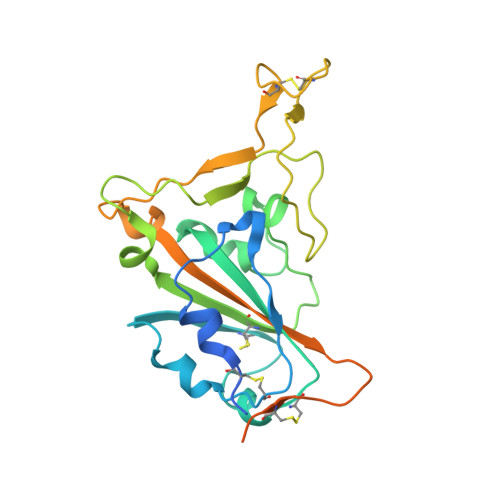
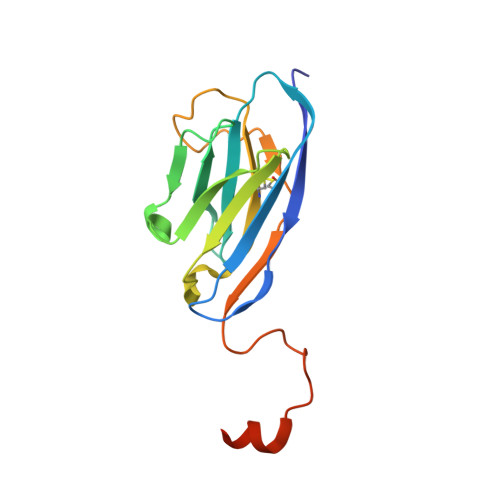
The crystal structure of nanobody Nb4 in complex with receptor binding domain (RBD) of BA.1 Spike protein


Experimental Data Snapshot

  • Method: X-RAY DIFFRACTION
  • Resolution: 2.43 Å
  • R-Value Free: 
    0.269 (Depositor), 0.269 (DCC) 
  • R-Value Work: 
    0.224 (Depositor), 0.225 (DCC) 
  • R-Value Observed: 
    0.229 (Depositor) 

Starting Models: experimental
View more details

wwPDB Validation 3D Report Full Report

Validation slider image for 8K3K

This is version 1.1 of the entry. See complete history

Literature

A potent and broad-spectrum neutralizing nanobody for SARS-CoV-2 viruses, including all major Omicron strains.

Yao, H.Wang, H.Zhang, Z.Lu, Y.Zhang, Z.Zhang, Y.Xiong, X.Wang, Y.Wang, Z.Yang, H.Zhao, J.Xu, W.

(2023) MedComm (2020) 4: e397-e397

  • DOI: https://doi.org/10.1002/mco2.397
  • Primary Citation Related Structures: 
    8K3K, 8K45, 8K46, 8K47

  • PubMed Abstract: 

    SARS-CoV-2 viruses are highly transmissible and immune evasive. It is critical to develop broad-spectrum prophylactic and therapeutic antibodies for potential future pandemics. Here, we used the phage display method to discover nanobodies (Nbs) for neutralizing SARS-CoV-2 viruses especially Omicron strains. The leading nanobody (Nb), namely, Nb4, with excellent physicochemical properties, can neutralize Delta and Omicron subtypes, including BA.1, BA.1.1 (BA.1 + R346K), BA.2, BA.5, BQ.1, and XBB.1. The crystal structure of Nb4 in complex with the receptor-binding domain (RBD) of BA.1 Spike protein reveals that Nb4 interacts with an epitope on the RBD overlapping with the receptor-binding motif, and thus competes with angiotensin-converting enzyme 2 (ACE2) binding. Nb4 is expected to be effective for neutralizing most recent Omicron variants, since the epitopes are evolutionarily conserved among them. Indeed, trivalent Nb4 interacts with the XBB1.5 Spike protein with low nM affinity and competes for ACE2 binding. Prophylactic and therapeutic experiments in mice indicated that Nb4 could reduce the Omicron virus loads in the lung. In particular, in prophylactic experiments, intranasal administration of multivalent Nb4 completely protected mice from Omicron infection. Taken together, these results demonstrated that Nb4 could serve as a potent and broad-spectrum prophylactic and therapeutic Nb for COVID-19.


  • Organizational Affiliation
    • School of Life Science and Technology ShanghaiTech University Shanghai China.

Macromolecule Content 

  • Total Structure Weight: 45.39 kDa 
  • Atom Count: 2,696 
  • Modeled Residue Count: 337 
  • Deposited Residue Count: 401 
  • Unique protein chains: 2

Macromolecules

Find similar proteins by:|  3D Structure
Entity ID: 1
MoleculeChains  Sequence LengthOrganismDetailsImage
Spike protein S1A [auth E]248Severe acute respiratory syndrome coronavirus 2Mutation(s): 15 
Gene Names: S2
UniProt
Find proteins for P0DTC2 (Severe acute respiratory syndrome coronavirus 2)
Explore P0DTC2 
Go to UniProtKB:  P0DTC2
Entity Groups
Sequence Clusters30% Identity50% Identity70% Identity90% Identity95% Identity100% Identity
UniProt GroupP0DTC2
Sequence Annotations
Expand
Reference Sequence
Find similar proteins by:|  3D Structure
Entity ID: 2
MoleculeChains  Sequence LengthOrganismDetailsImage
Nanobody Nb4B [auth D]153synthetic constructMutation(s): 0 

Experimental Data & Validation

Experimental Data

  • Method: X-RAY DIFFRACTION
  • Resolution: 2.43 Å
  • R-Value Free:  0.269 (Depositor), 0.269 (DCC) 
  • R-Value Work:  0.224 (Depositor), 0.225 (DCC) 
  • R-Value Observed: 0.229 (Depositor) 
Space Group: P 61 2 2
Unit Cell:
Length ( Å )Angle ( ˚ )
a = 76.11α = 90
b = 76.11β = 90
c = 251.45γ = 120
Software Package:
Software NamePurpose
PHENIXrefinement
AUTOMARdata reduction
xia2data scaling
PHENIXphasing

Structure Validation

View Full Validation Report


Entry History 

& Funding Information

Deposition Data


Funding OrganizationLocationGrant Number
Other governmentChinastart-up fund from the ShanghaiTech University

Revision History  (Full details and data files)

  • Version 1.0: 2024-01-24
    Type: Initial release
  • Version 1.1: 2024-10-16
    Changes: Structure summary