Find PDB structures and Computed Structure Models (CSM) by combining queries from tools in this suite: Attribute Search, Sequence Similarity, Sequence Motif, 3D Similarity, and 3D Motif with 'AND' logic.
Funding Organization(s): Japan Agency for Medical Research and Development (AMED), Japan Science and Technology, Japan Society for the Promotion of Science (JSPS)
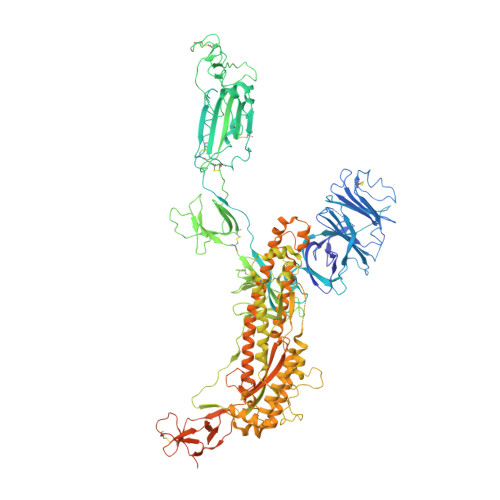
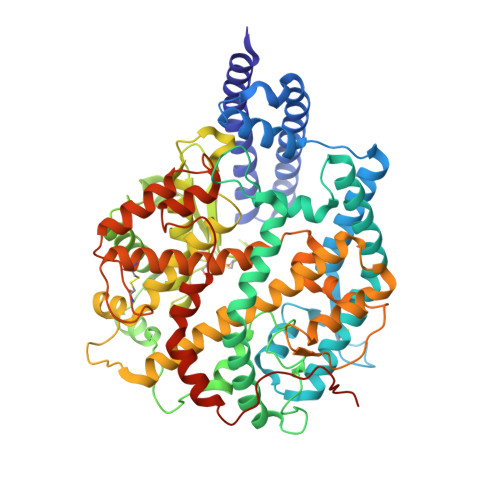
Circulation of SARS-CoV-2 Omicron XBB has resulted in the emergence of XBB.1.5, a new Variant of Interest. Our phylogenetic analysis suggests that XBB.1.5 evolved from XBB.1 by acquiring the S486P spike (S) mutation, subsequent to the acquisition of a nonsense mutation in ORF8. Neutralization assays showed similar abilities of immune escape between XBB.1.5 and XBB.1. We determine the structural basis for the interaction between human ACE2 and the S protein of XBB.1.5, showing similar overall structures between the S proteins of XBB.1 and XBB.1.5. We provide the intrinsic pathogenicity of XBB.1 and XBB.1.5 in hamsters. Importantly, we find that the ORF8 nonsense mutation of XBB.1.5 resulted in impairment of MHC suppression. In vivo experiments using recombinant viruses reveal that the XBB.1.5 mutations are involved with reduced virulence of XBB.1.5. Together, our study identifies the two viral functions defined the difference between XBB.1 and XBB.1.5.
Organizational Affiliation:
Department of Microbiology and Immunology, Faculty of Medicine, Hokkaido University, Sapporo, Japan.
Graduate School of Medicine, Hokkaido University, Sapporo, Japan.
School of Medicine, Hokkaido University, Sapporo, Japan.
Institute for the Advancement of Higher Education, Hokkaido University, Sapporo, Japan.
Institute for Vaccine Research and Development (IVReD), Hokkaido University, Sapporo, Japan.
One Health Research Center, Hokkaido University, Sapporo, Japan.
Graduate School of Biomedical and Health Sciences, Hiroshima University, Hiroshima, Japan.
Center for iPS Cell Research and Application (CiRA), Kyoto University, Kyoto, Japan.
Laboratory of Medical Virology, Institute for Life and Medical Sciences, Kyoto University, Kyoto, Japan.
Department of Cancer Pathology, Faculty of Medicine, Hokkaido University, Sapporo, Japan.
Institute for Chemical Reaction Design and Discovery (WPI-ICReDD), Hokkaido University, Sapporo, Japan.
Division of Molecular Virology and Genetics, Joint Research Center for Human Retrovirus Infection, Kumamoto University, Kumamoto, Japan.
Department of Clinical Pathology, Faculty of Medicine, Suez Canal University, Ismailia, Egypt.
Division of Risk Analysis and Management, International Institute for Zoonosis Control, Hokkaido University, Sapporo, Japan.
Division of Systems Virology, Department of Microbiology and Immunology, The Institute of Medical Science, The University of Tokyo, Tokyo, Japan.
Graduate School of Medicine, The University of Tokyo, Tokyo, Japan.
Institute for Genetic Medicine, Hokkaido University, Sapporo, Japan.
Department of Veterinary Science, Faculty of Agriculture, University of Miyazaki, Miyazaki, Japan.
Graduate School of Medicine and Veterinary Medicine, University of Miyazaki, Miyazaki, Japan.
Laboratory of Biomolecular Science and Center for Research and Education on Drug Discovery, Faculty of Pharmaceutical Sciences, Hokkaido University, Sapporo, Japan.
Department of Medicinal Sciences, Graduate School of Pharmaceutical Sciences, Kyushu University, Fukuoka, Japan.
Division of Pathogen Structure, International Institute for Zoonosis Control, Hokkaido University, Sapporo, Japan.
Global Station for Biosurfaces and Drug Discovery, Hokkaido University, Sapporo, Japan.
Division of International Research Promotion, International Institute for Zoonosis Control, Hokkaido University, Sapporo, Japan.
Center for Animal Disease Control, University of Miyazaki, Miyazaki, Japan.
International Collaboration Unit, International Institute for Zoonosis Control, Hokkaido University, Sapporo, Japan.
International Research Center for Infectious Diseases, The Institute of Medical Science, The University of Tokyo, Tokyo, Japan.
Department of Cancer Pathology, Faculty of Medicine, Hokkaido University, Sapporo, Japan. tanaka@med.hokudai.ac.jp.
Institute for Chemical Reaction Design and Discovery (WPI-ICReDD), Hokkaido University, Sapporo, Japan. tanaka@med.hokudai.ac.jp.
Division of Systems Virology, Department of Microbiology and Immunology, The Institute of Medical Science, The University of Tokyo, Tokyo, Japan. keisato@g.ecc.u-tokyo.ac.jp.
Graduate School of Medicine, The University of Tokyo, Tokyo, Japan. keisato@g.ecc.u-tokyo.ac.jp.
International Research Center for Infectious Diseases, The Institute of Medical Science, The University of Tokyo, Tokyo, Japan. keisato@g.ecc.u-tokyo.ac.jp.
Graduate School of Frontier Sciences, The University of Tokyo, Kashiwa, Japan. keisato@g.ecc.u-tokyo.ac.jp.
CREST, Japan Science and Technology Agency, Kawaguchi, Japan. keisato@g.ecc.u-tokyo.ac.jp.
International Vaccine Design Center, The Institute of Medical Science, The University of Tokyo, Tokyo, Japan. keisato@g.ecc.u-tokyo.ac.jp.
Collaboration Unit for Infection, Joint Research Center for Human Retrovirus Infection, Kumamoto University, Kumamoto, Japan. keisato@g.ecc.u-tokyo.ac.jp.
Laboratory of Medical Virology, Institute for Life and Medical Sciences, Kyoto University, Kyoto, Japan. hashiguchi.takao.1a@kyoto-u.ac.jp.
Graduate School of Frontier Sciences, The University of Tokyo, Kashiwa, Japan. hashiguchi.takao.1a@kyoto-u.ac.jp.
Kyoto University Immunomonitoring Center, Kyoto University, Kyoto, Japan. hashiguchi.takao.1a@kyoto-u.ac.jp.
Center for iPS Cell Research and Application (CiRA), Kyoto University, Kyoto, Japan. kazuo.takayama@cira.kyoto-u.ac.jp.
AMED-CREST, Japan Agency for Medical Research and Development (AMED), Tokyo, Japan. kazuo.takayama@cira.kyoto-u.ac.jp.
Department of Microbiology and Immunology, Faculty of Medicine, Hokkaido University, Sapporo, Japan. fukut@pop.med.hokudai.ac.jp.
Graduate School of Medicine, Hokkaido University, Sapporo, Japan. fukut@pop.med.hokudai.ac.jp.
School of Medicine, Hokkaido University, Sapporo, Japan. fukut@pop.med.hokudai.ac.jp.
Institute for the Advancement of Higher Education, Hokkaido University, Sapporo, Japan. fukut@pop.med.hokudai.ac.jp.
Institute for Vaccine Research and Development (IVReD), Hokkaido University, Sapporo, Japan. fukut@pop.med.hokudai.ac.jp.
One Health Research Center, Hokkaido University, Sapporo, Japan. fukut@pop.med.hokudai.ac.jp.
Kyoto University Immunomonitoring Center, Kyoto University, Kyoto, Japan. fukut@pop.med.hokudai.ac.jp.
Laboratory of Virus Control, Research Institute for Microbial Diseases, Osaka University, Suita, Japan. fukut@pop.med.hokudai.ac.jp.
AA [auth A] AB [auth C] BA [auth A] BB [auth C] CA [auth A]
AA [auth A], AB [auth C], BA [auth A], BB [auth C], CA [auth A], CB [auth E], DA [auth A], DB [auth E], EA [auth A], EB [auth E], FA [auth B], FB [auth D], GA [auth B], GB [auth D], HA [auth B], HB [auth D], IA [auth B], JA [auth B], KA [auth B], LA [auth B], MA [auth B], NA [auth B], OA [auth B], PA [auth B], QA [auth B], RA [auth C], S [auth A], SA [auth C], T [auth A], TA [auth C], U [auth A], UA [auth C], V [auth A], VA [auth C], W [auth A], WA [auth C], X [auth A], XA [auth C], Y [auth A], YA [auth C], Z [auth A], ZA [auth C]
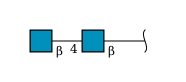
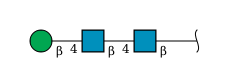
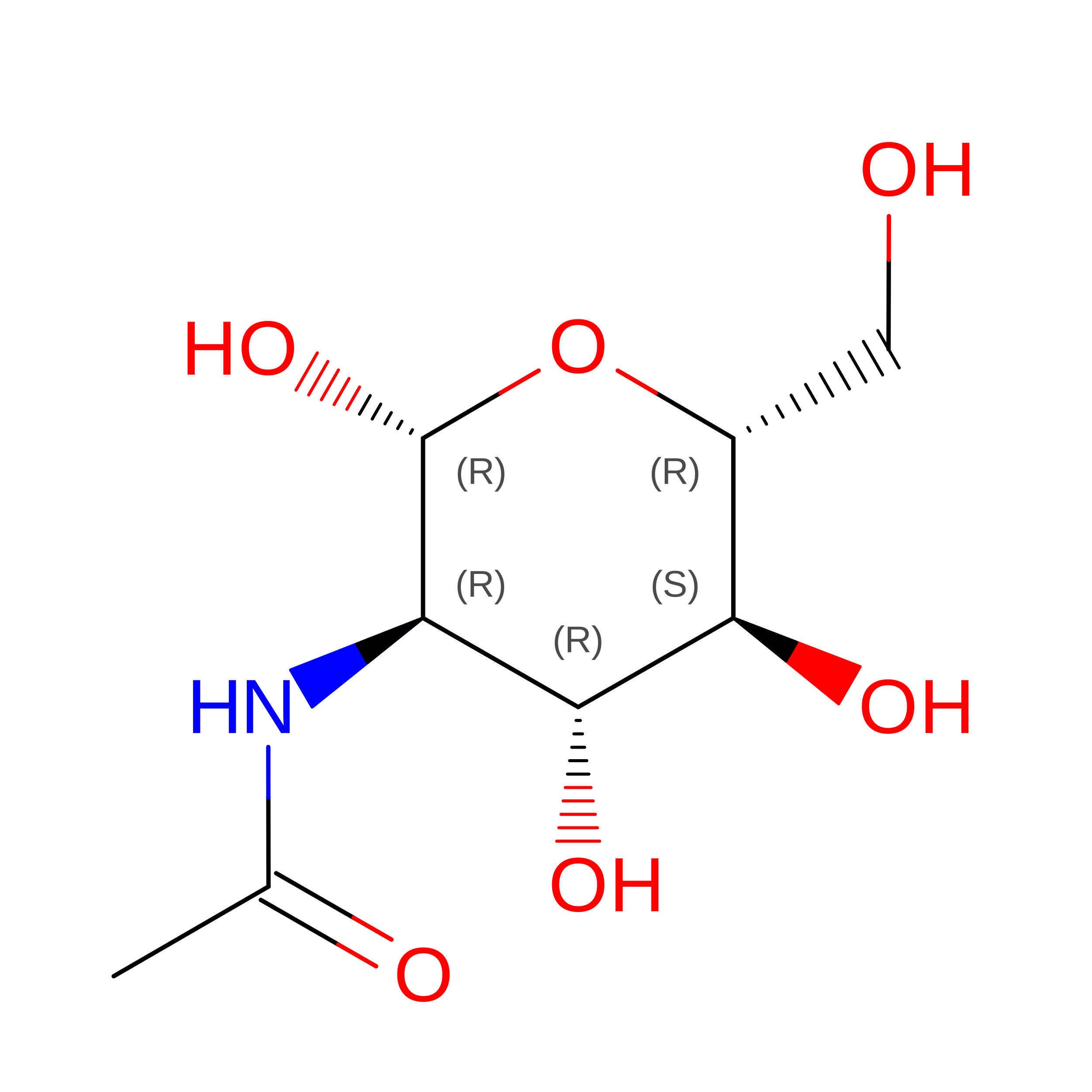
2-acetamido-2-deoxy-beta-D-glucopyranose C8 H15 N O6 OVRNDRQMDRJTHS-FMDGEEDCSA-N

 Download Mendeley