8JVA | pdb_00008jva

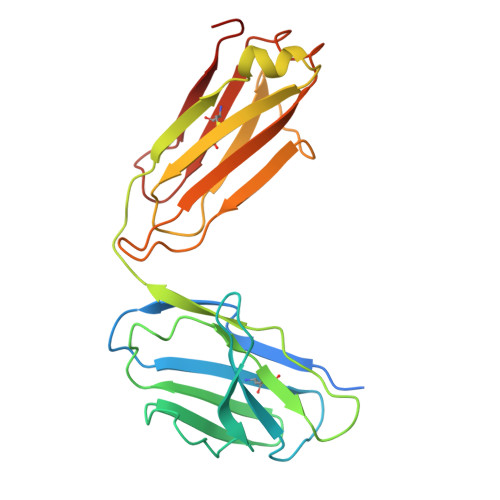
Cryo-EM structure of the N-terminal domain of Omicron BA.1 in complex with nanobody N235 and S2L20 Fab


Experimental Data Snapshot

  • Method: ELECTRON MICROSCOPY
  • Resolution: 2.81 Å
  • Aggregation State: PARTICLE 
  • Reconstruction Method: SINGLE PARTICLE 

wwPDB Validation 3D Report Full Report

Validation slider image for 8JVA

This is version 1.2 of the entry. See complete history

Literature

Enhanced potency of an IgM-like nanobody targeting conserved epitope in SARS-CoV-2 spike N-terminal domain.

Liu, B.Liu, H.Han, P.Wang, X.Wang, C.Yan, X.Lei, W.Xu, K.Zhou, J.Qi, J.Fan, R.Wu, G.Tian, W.X.Gao, G.F.Wang, Q.

(2024) Signal Transduct Target Ther 9: 131-131

  • DOI: https://doi.org/10.1038/s41392-024-01847-8
  • Primary Citation Related Structures: 
    8JVA

  • PubMed Abstract: 

    Almost all the neutralizing antibodies targeting the receptor-binding domain (RBD) of spike (S) protein show weakened or lost efficacy against severe acute respiratory syndrome coronavirus 2 (SARS-CoV-2) emerged or emerging variants, such as Omicron and its sub-variants. This suggests that highly conserved epitopes are crucial for the development of neutralizing antibodies. Here, we present one nanobody, N235, displaying broad neutralization against the SARS-CoV-2 prototype and multiple variants, including the newly emerged Omicron and its sub-variants. Cryo-electron microscopy demonstrates N235 binds a novel, conserved, cryptic epitope in the N-terminal domain (NTD) of the S protein, which interferes with the RBD in the neighboring S protein. The neutralization mechanism interpreted via flow cytometry and Western blot shows that N235 appears to induce the S1 subunit shedding from the trimeric S complex. Furthermore, a nano-IgM construct (MN235), engineered by fusing N235 with the human IgM Fc region, displays prevention via inducing S1 shedding and cross-linking virus particles. Compared to N235, MN235 exhibits varied enhancement in neutralization against pseudotyped and authentic viruses in vitro. The intranasal administration of MN235 in low doses can effectively prevent the infection of Omicron sub-variant BA.1 and XBB in vivo, suggesting that it can be developed as a promising prophylactic antibody to cope with the ongoing and future infection.


  • Organizational Affiliation
    • College of Veterinary Medicine, Shanxi Agricultural University, 030801, Jinzhong, China.

Macromolecule Content 

  • Total Structure Weight: 127.21 kDa 
  • Atom Count: 6,071 
  • Modeled Residue Count: 769 
  • Deposited Residue Count: 1,135 
  • Unique protein chains: 4

Macromolecules

Find similar proteins by:|  3D Structure
Entity ID: 1
MoleculeChains  Sequence LengthOrganismDetailsImage
nanobody N235A [auth D]126Vicugna pacosMutation(s): 0 
Find similar proteins by:|  3D Structure
Entity ID: 2
MoleculeChains  Sequence LengthOrganismDetailsImage
S2L20 light chainB [auth A]236Homo sapiensMutation(s): 0 
Find similar proteins by:|  3D Structure
Entity ID: 3
MoleculeChains  Sequence LengthOrganismDetailsImage
S2L20 heavy chainC [auth B]473Homo sapiensMutation(s): 0 
Find similar proteins by:|  3D Structure
Entity ID: 4
MoleculeChains  Sequence LengthOrganismDetailsImage
Spike protein S2'D [auth F]300Severe acute respiratory syndrome coronavirus 2Mutation(s): 4 
Gene Names: S2
UniProt
Find proteins for P0DTC2 (Severe acute respiratory syndrome coronavirus 2)
Explore P0DTC2 
Go to UniProtKB:  P0DTC2
Entity Groups
Sequence Clusters30% Identity50% Identity70% Identity90% Identity95% Identity100% Identity
UniProt GroupP0DTC2
Glycosylation
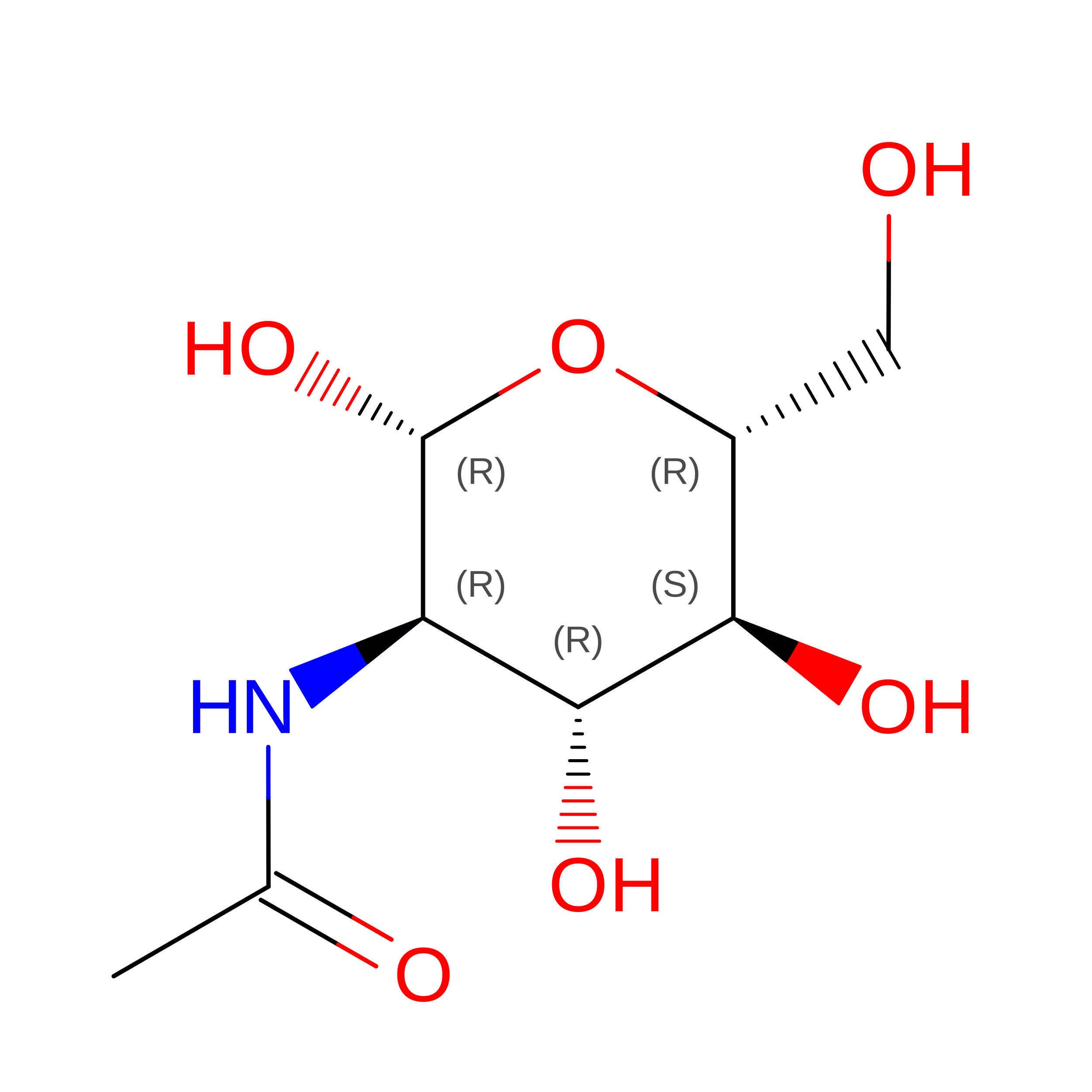
Glycosylation Sites: 5Go to GlyGen: P0DTC2-1
Sequence Annotations
Expand
Reference Sequence

Experimental Data & Validation

Experimental Data

  • Method: ELECTRON MICROSCOPY
  • Resolution: 2.81 Å
  • Aggregation State: PARTICLE 
  • Reconstruction Method: SINGLE PARTICLE 
EM Software:
TaskSoftware PackageVersion
MODEL REFINEMENTPHENIX

Structure Validation

View Full Validation Report


Entry History 

& Funding Information

Deposition Data


Funding OrganizationLocationGrant Number
National Science Foundation (NSF, China)China82225021

Revision History  (Full details and data files)

  • Version 1.0: 2024-05-22
    Type: Initial release
  • Version 1.1: 2024-11-20
    Changes: Data collection, Structure summary
  • Version 1.2: 2025-07-16
    Changes: Data collection