Download Mendeley
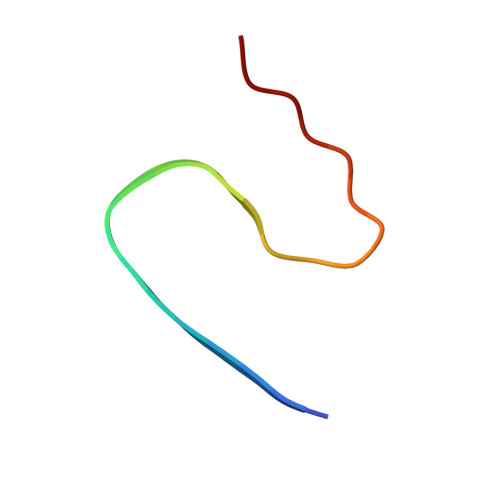
The structure of mouse RIPK1 RHIM-containing domain as a homo-amyloid and in RIPK1/RIPK3 complex.
Liu, J., Wu, X.L., Zhang, J., Li, B., Wang, H.Y., Wang, J., Lu, J.X.(2024) Nat Commun 15: 6975-6975
- PubMed: 39143113 Search on PubMedSearch on PubMed Central
- DOI: https://doi.org/10.1038/s41467-024-51303-y
- Primary Citation Related Structures:
8IB0 - PubMed Abstract:
Receptor-interacting protein kinase 1 (RIPK1) is a therapeutic target in treating neurodegenerative diseases and cancers. RIPK1 has three distinct functional domains, with the center domain containing a receptor-interacting protein homotypic interaction motif (RHIM), which mediates amyloid formation. The functional amyloid formed by RIPK1 and/or RIPK3 is a crucial intermediate in regulating cell necroptosis. In this study, the amyloid structure of mouse RIPK1, formed by an 82-residue sequence centered at RHIM, is presented. It reveals the "N"-shaped folding of the protein subunit in the fibril with four β-strands. The folding pattern is shared by several amyloid structures formed by proteins with RHIM, with the central β-strand formed by the most conserved tetrad sequence I/VQI/VG. However, the solid-state NMR results indicate a structural difference between mouse RIPK1 and mouse RIPK3. A change in the structural rigidity is also suggested by the observation of weakened signals for mouse RIPK3 upon mixing with RIPK1 to form the RIPK1/RIPK3 complex fibrils. Our results provide vital information to understand the interactions between different proteins with RHIM, which will help us further comprehend the regulation mechanism in cell necroptosis.
- School of Life Science and Technology, ShanghaiTech University, Shanghai, 201210, China.
Organizational Affiliation: