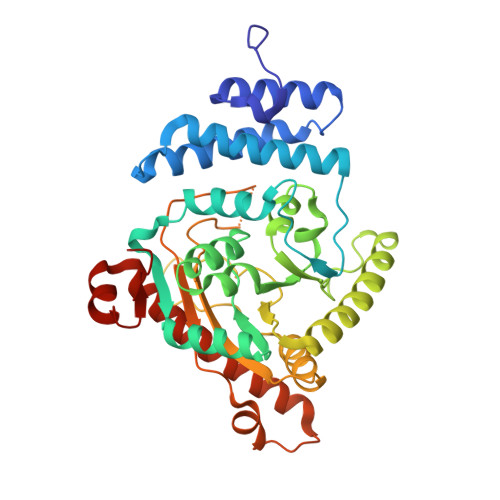
8IA1 | pdb_00008ia1

plastidial glycerol-3-phosphate acyltransferases (GPAT) from the green alga Myrmecia incisa

  • Classification: TRANSFERASE
  • Organism(s): Lobosphaera incisa
  • Expression System: Escherichia coli
  • Mutation(s): No 

  • Deposited: 2023-02-07 Released: 2024-02-07 
  • Deposition Author(s): Song, X.
  • Funding Organization(s): National Natural Science Foundation of China (NSFC)

Experimental Data Snapshot

  • Method: X-RAY DIFFRACTION
  • Resolution: 2.31 Å
  • R-Value Free: 
    0.242 (Depositor), 0.240 (DCC) 
  • R-Value Work: 
    0.183 (Depositor), 0.180 (DCC) 
  • R-Value Observed: 
    0.186 (Depositor) 

Starting Model: experimental
View more details

wwPDB Validation   3D Report Full Report


This is version 1.1 of the entry. See complete history


Literature

Unique recognition of the microalgal plastidial glycerol-3-phosphate acyltransferase for acyl-ACP.

Li, X.Yang, M.Sun, D.Shi, J.Yang, M.Feng, Y.Xue, S.

(2023) Plant Sci 332: 111725-111725

  • DOI: https://doi.org/10.1016/j.plantsci.2023.111725
  • Primary Citation of Related Structures:  
    8IA1

  • PubMed Abstract: 

    Plastidial glycerol-3-phosphate acyltransferases (GPATs) catalyze acyl-ACP and glycerol-3-phosphate to synthesize lysophosphatidic acid in vivo, which initiates the formation of various glycerolipids. Although the physiological substrates of plastidial GPATs are acyl-ACPs, acyl-CoAs have been commonly studied on the GPATs in vitro. However, little is known whether there are any distinct features of GPATs towards acyl-ACP and acyl-CoA. In this study, the results showed that the microalgal plastidial GPATs preferred acyl-ACP to acyl-CoA, while surprisingly, the plant-derived plastidial GPATs showed no obvious preferences towards these two acyl carriers. The key residues responsible for the distinct feature of microalgal plastidial GPATs were compared with plant-derived plastidial GPATs in their efficiency to catalyze acyl-ACP and acyl-CoA. Microalgal plastidial GPATs uniquely recognized acyl-ACP as compared to with other acyltransferases. The structure of the acyltransferases-ACP complex highlights only the involvement of the large structural domain in ACP in microalgal plastidial GPAT while in the other acyltransferases, both large and small structural domains were involved in the recognition process. The interaction sites on the plastidial GPAT from the green alga Myrmecia incisa (MiGPAT1) with ACP turned out to be K204, R212 and R266. A unique recognition between the microalgal plastidial GPAT and ACP was elucidated.


  • Organizational Affiliation
    • School of Bioengineering, Dalian University of Technology, Dalian 116024, China.

Macromolecules
Find similar proteins by:  (by identity cutoff)  |  3D Structure
Entity ID: 1
MoleculeChains Sequence LengthOrganismDetailsImage
Glycerol-3-phosphate acyltransferase, chloroplastic
A, B, C
372Lobosphaera incisaMutation(s): 0 
Gene Names: GPAT
EC: 2.3.1.15
UniProt
Find proteins for A0A0B5EHP8 (Lobosphaera incisa)
Explore A0A0B5EHP8 
Go to UniProtKB:  A0A0B5EHP8
Entity Groups  
Sequence Clusters30% Identity50% Identity70% Identity90% Identity95% Identity100% Identity
UniProt GroupA0A0B5EHP8
Sequence Annotations
Expand
  • Reference Sequence
Experimental Data & Validation

Experimental Data

  • Method: X-RAY DIFFRACTION
  • Resolution: 2.31 Å
  • R-Value Free:  0.242 (Depositor), 0.240 (DCC) 
  • R-Value Work:  0.183 (Depositor), 0.180 (DCC) 
  • R-Value Observed: 0.186 (Depositor) 
Space Group: P 1
Unit Cell:
Length ( Å )Angle ( ˚ )
a = 51.093α = 110.847
b = 81.553β = 106.79
c = 88.489γ = 99.932
Software Package:
Software NamePurpose
PHENIXrefinement
HKL-2000data reduction
HKL-2000data scaling
PHENIXphasing

Structure Validation

View Full Validation Report


Entry History & Funding Information

Deposition Data

  • Released Date: 2024-02-07 
  • Deposition Author(s): Song, X.

Funding OrganizationLocationGrant Number
National Natural Science Foundation of China (NSFC)China21877110

Revision History  (Full details and data files)

  • Version 1.0: 2024-02-07
    Type: Initial release
  • Version 1.1: 2025-02-19
    Changes: Database references, Structure summary