Download Mendeley
Spectroscopy and crystallography define carotenoid oxygenases as a new subclass of mononuclear non-heme Fe II enzymes.
DeWeese, D.E., Everett, M.P., Babicz Jr., J.T., Daruwalla, A., Solomon, E.I., Kiser, P.D.(2025) J Biol Chem : 108444-108444
- PubMed: 40147775 Search on PubMedSearch on PubMed Central
- DOI: https://doi.org/10.1016/j.jbc.2025.108444
- Primary Citation Related Structures:
7T8P, 7T8Q, 8FU2, 8FU5, 8SRL - PubMed Abstract:
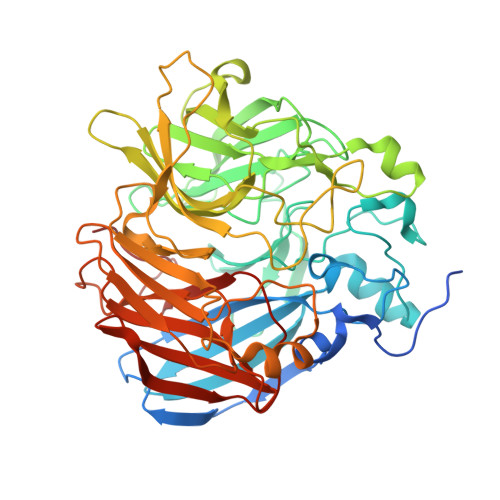
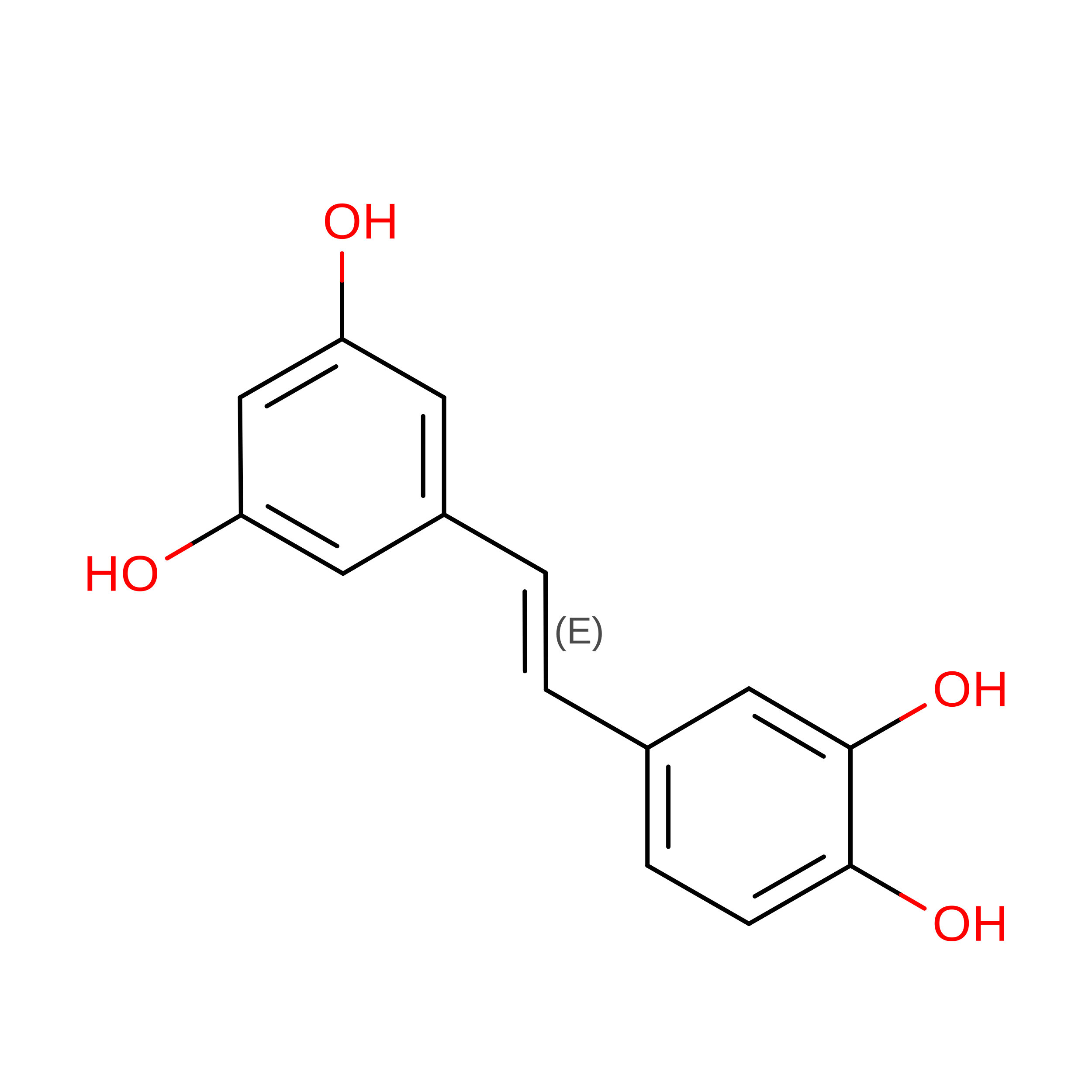
Carotenoid cleavage dioxygenases (CCDs) are non-heme Fe II enzymes that catalyze the oxidative cleavage of alkene bonds in carotenoids, stilbenoids, and related compounds. How these enzymes control the reaction of dioxygen (O 2 ) with their alkene substrates is unclear. Here, we apply spectroscopy in conjunction with X-ray crystallography to define the iron coordination geometry of a model CCD, CAO1 (Neurospora crassa carotenoid oxygenase 1), in its resting state and following substrate binding and coordination sphere substitutions. Resting CAO1 exhibits a five-coordinate (5C), square pyramidal Fe II center that undergoes steric distortion toward a trigonal bipyramidal geometry in the presence of piceatannol. Titrations with the O 2 -analog, nitric oxide, show a >100-fold increase in iron-nitric oxide affinity upon substrate binding, defining a crucial role for the substrate in activating the Fe II site for O 2 reactivity. The importance of the 5C Fe II structure for reactivity was probed through mutagenesis of the second-sphere Thr151 residue of CAO1, which occludes ligand binding at the sixth coordination position. A T151G substitution resulted in the conversion of the iron center to a six-coordinate state and a 135-fold reduction in apparent catalytic efficiency toward piceatannol compared with the wildtype enzyme. Substrate complexation resulted in partial six-coordinate to 5C conversion, indicating solvent dissociation from the iron center. Additional substitutions at this site demonstrated a general functional importance of the occluding residue within the CCD superfamily. Taken together, these data suggest an ordered mechanism of CCD catalysis occurring via substrate-promoted solvent replacement by O 2 . CCDs thus represent a new class of mononuclear non-heme Fe II enzymes.
- Department of Chemistry, Stanford University, Stanford, California, USA.
Organizational Affiliation: