8ETY | pdb_00008ety

Ancestral PETase 35_442


Experimental Data Snapshot

  • Method: X-RAY DIFFRACTION
  • Resolution: 1.54 Å
  • R-Value Free: 
    0.199 (Depositor), 0.200 (DCC) 
  • R-Value Work: 
    0.169 (Depositor), 0.170 (DCC) 
  • R-Value Observed: 
    0.171 (Depositor) 

wwPDB Validation   3D Report Full Report


This is version 1.2 of the entry. See complete history


Literature

Ancestral reconstruction of polyethylene terephthalate degrading cutinases reveals a rugged and unexplored sequence-fitness landscape.

Vongsouthi, V.Georgelin, R.Matthews, D.S.Saunders, J.Lee, B.M.Ton, J.Damry, A.M.Frkic, R.L.Spence, M.A.Jackson, C.J.

(2025) Sci Adv 11: eads8318-eads8318

  • DOI: https://doi.org/10.1126/sciadv.ads8318
  • Primary Citation of Related Structures:  
    8ETX, 8ETY

  • PubMed Abstract: 

    The use of protein engineering to generate enzymes for the degradation of polyethylene terephthalate (PET) is a promising route for plastic recycling, yet traditional engineering approaches often fail to explore protein sequence space for optimal enzymes. In this work, we use multiplexed ancestral sequence reconstruction (mASR) to address this, exploring the evolutionary sequence space of PET-degrading cutinases. Using 20 statistically equivalent phylogenies of the bacterial cutinase family, we generated 48 ancestral sequences revealing a wide range of PETase activities, highlighting the value of mASR in uncovering functional variants. Our findings show PETase activity can evolve through multiple pathways involving mutations remote from the active site. Moreover, analyzing the PETase fitness landscape with local ancestral sequence embedding (LASE) revealed that LASE can capture sequence features linked to PETase activity. This work highlights mASR's potential in exploration of sequence space and underscores the use of LASE in readily mapping the protein fitness landscapes.


  • Organizational Affiliation
    • Research School of Chemistry, Australian National University, Canberra, ACT 2601, Australia.

Macromolecules
Find similar proteins by:  (by identity cutoff)  |  3D Structure
Entity ID: 1
MoleculeChains Sequence LengthOrganismDetailsImage
Polyethylene terephthalate hydrolase282synthetic constructMutation(s): 0 
Entity Groups  
Sequence Clusters30% Identity50% Identity70% Identity90% Identity95% Identity100% Identity
Sequence Annotations
Expand
  • Reference Sequence
Small Molecules
Ligands 6 Unique
IDChains Name / Formula / InChI Key2D Diagram3D Interactions
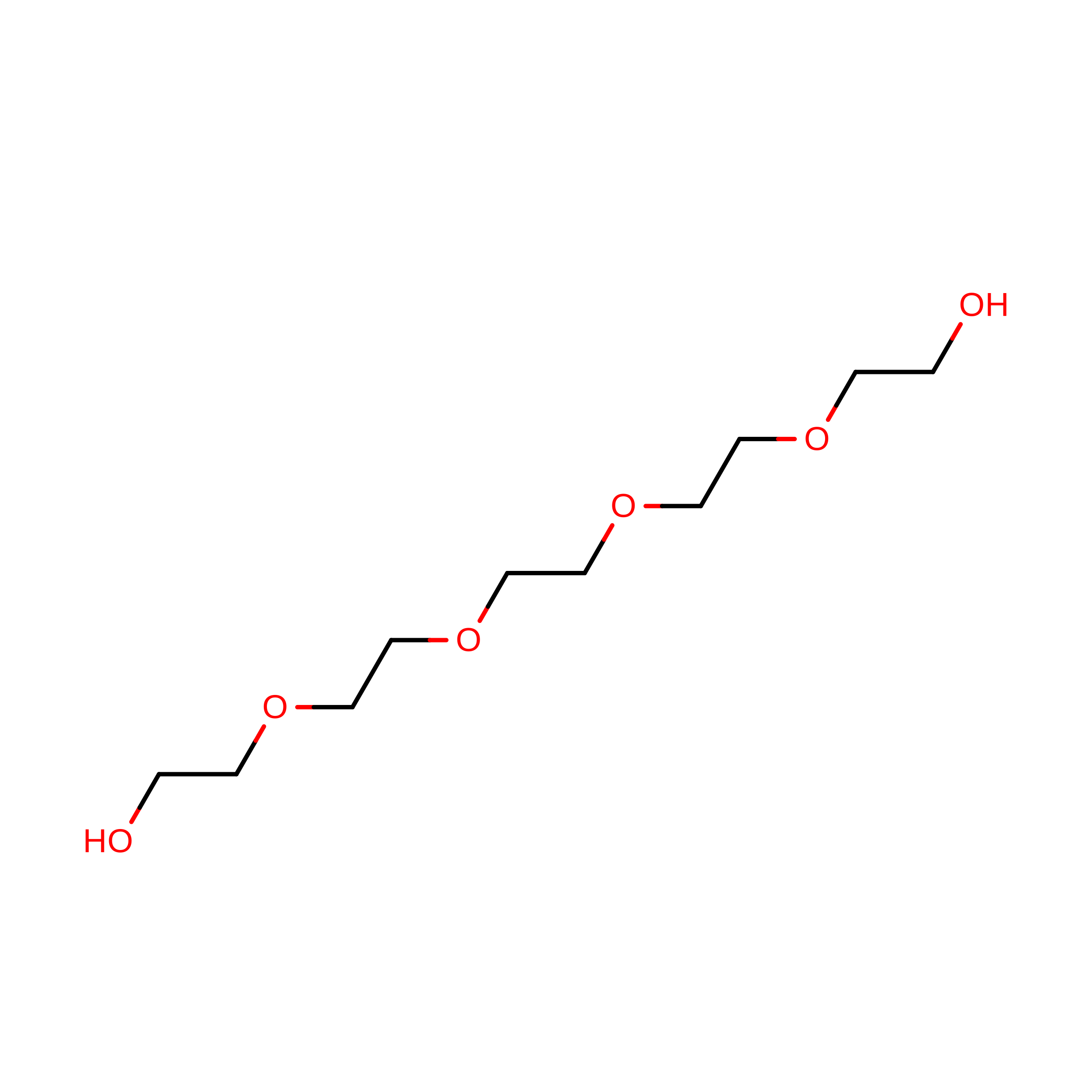
1PE
Query on 1PE

Download Ideal Coordinates CCD File 
F [auth A]PENTAETHYLENE GLYCOL
C10 H22 O6
JLFNLZLINWHATN-UHFFFAOYSA-N
PEG
Query on PEG

Download Ideal Coordinates CCD File 
C [auth A],
D [auth A]
DI(HYDROXYETHYL)ETHER
C4 H10 O3
MTHSVFCYNBDYFN-UHFFFAOYSA-N
SO4
Query on SO4

Download Ideal Coordinates CCD File 
K [auth A]SULFATE ION
O4 S
QAOWNCQODCNURD-UHFFFAOYSA-L
GOL
Query on GOL

Download Ideal Coordinates CCD File 
G [auth A]GLYCEROL
C3 H8 O3
PEDCQBHIVMGVHV-UHFFFAOYSA-N
EDO
Query on EDO

Download Ideal Coordinates CCD File 
E [auth A]
H [auth A]
I [auth A]
J [auth A]
L [auth A]
E [auth A],
H [auth A],
I [auth A],
J [auth A],
L [auth A],
M [auth A],
N [auth A],
O [auth A]
1,2-ETHANEDIOL
C2 H6 O2
LYCAIKOWRPUZTN-UHFFFAOYSA-N
NA
Query on NA

Download Ideal Coordinates CCD File 
B [auth A]SODIUM ION
Na
FKNQFGJONOIPTF-UHFFFAOYSA-N
Experimental Data & Validation

Experimental Data

  • Method: X-RAY DIFFRACTION
  • Resolution: 1.54 Å
  • R-Value Free:  0.199 (Depositor), 0.200 (DCC) 
  • R-Value Work:  0.169 (Depositor), 0.170 (DCC) 
  • R-Value Observed: 0.171 (Depositor) 
Space Group: C 2 2 2
Unit Cell:
Length ( Å )Angle ( ˚ )
a = 69.759α = 90
b = 148.498β = 90
c = 55.554γ = 90
Software Package:
Software NamePurpose
PHENIXrefinement
Aimlessdata scaling
PDB_EXTRACTdata extraction
xia2data reduction
PHASERphasing

Structure Validation

View Full Validation Report


Entry History & Funding Information

Deposition Data


Funding OrganizationLocationGrant Number
Not funded--

Revision History  (Full details and data files)

  • Version 1.0: 2023-11-01
    Type: Initial release
  • Version 1.1: 2024-11-20
    Changes: Structure summary
  • Version 1.2: 2025-06-04
    Changes: Database references