Download Mendeley
Reversible switching between two common protein folds in a designed system using only temperature.
Solomon, T.L., He, Y., Sari, N., Chen, Y., Gallagher, D.T., Bryan, P.N., Orban, J.(2023) Proc Natl Acad Sci U S A 120: e2215418120-e2215418120
- PubMed: 36669114 Search on PubMedSearch on PubMed Central
- DOI: https://doi.org/10.1073/pnas.2215418120
- Primary Citation Related Structures:
8E6Y - PubMed Abstract:
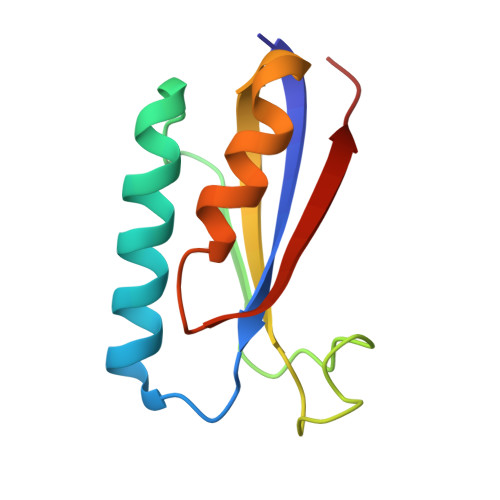
Naturally occurring metamorphic proteins have the ability to interconvert from one folded state to another through either a limited set of mutations or by way of a change in the local environment. Here, we show in a designed system that it is possible to switch reversibly between two of the most common monomeric folds employing only temperature changes. We demonstrate that a latent 3α state can be unmasked from an α/β-plait topology with a single V90T amino acid substitution, populating both forms simultaneously. The equilibrium between these two states exhibits temperature dependence, such that the 3α state is predominant (>90%) at 5 °C, while the α/β-plait fold is the major species (>90%) at 30 °C. We describe the structure and dynamics of these topologies, how mutational changes affect the temperature dependence, and the energetics and kinetics of interconversion. Additionally, we demonstrate how ligand-binding function can be tightly regulated by large amplitude changes in protein structure over a relatively narrow temperature range that is relevant to biology. The 3α/αβ switch thus represents a potentially useful approach for designing proteins that alter their fold topologies in response to environmental triggers. It may also serve as a model for computational studies of temperature-dependent protein stability and fold switching.
- W. M. Keck Laboratory for Structural Biology, University of Maryland Institute for Bioscience and Biotechnology Research, Rockville, MD 20850.
Organizational Affiliation: