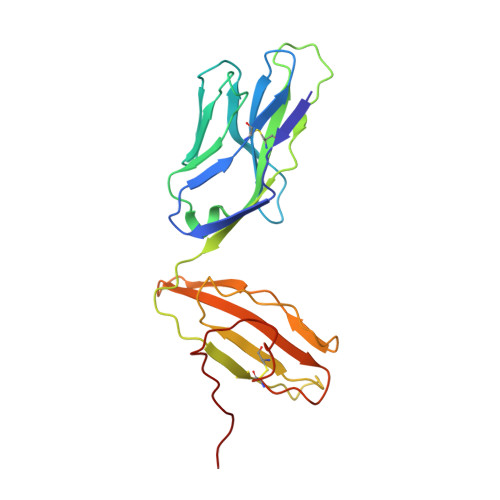
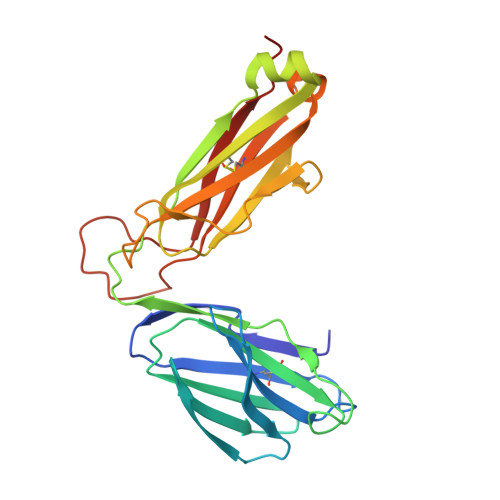
8D5P | pdb_00008d5p

Mouse TCR TG6

  • Classification: IMMUNE SYSTEM
  • Organism(s): Mus musculus
  • Expression System: Escherichia coli
  • Mutation(s): No 

  • Deposited: 2022-06-05 Released: 2022-09-14 
  • Deposition Author(s): Wang, Y., Dai, S.
  • Funding Organization(s): National Institutes of Health/National Institute of Environmental Health Sciences (NIH/NIEHS)

Experimental Data Snapshot

  • Method: X-RAY DIFFRACTION
  • Resolution: 2.75 Å
  • R-Value Free: 
    0.301 (Depositor), 0.274 (DCC) 
  • R-Value Work: 
    0.224 (Depositor) 

Starting Model: experimental
View more details

wwPDB Validation 3D Report Full Report

Validation slider image for 8D5P

This is version 1.2 of the entry. See complete history. 

Literature

Peptide Centric V beta Specific Germline Contacts Shape a Specialist T Cell Response.

Wang, Y., Tsitsiklis, A., Devoe, S., Gao, W., Chu, H.H., Zhang, Y., Li, W., Wong, W.K., Deane, C.M., Neau, D., Slansky, J.E., Thomas, P.G., Robey, E.A., Dai, S.

(2022) Front Immunol 13: 847092-847092

  • DOI: https://doi.org/10.3389/fimmu.2022.847092
  • Primary Citation Related Structures: 
    8D5N, 8D5P, 8D5Q

  • PubMed Abstract: 

    Certain CD8 T cell responses are particularly effective at controlling infection, as exemplified by elite control of HIV in individuals harboring HLA-B57. To understand the structural features that contribute to CD8 T cell elite control, we focused on a strongly protective CD8 T cell response directed against a parasite-derived peptide (HF10) presented by an atypical MHC-I molecule, H-2Ld. This response exhibits a focused TCR repertoire dominated by Vβ2, and a representative TCR (TG6) in complex with Ld-HF10 reveals an unusual structure in which both MHC and TCR contribute extensively to peptide specificity, along with a parallel footprint of TCR on its pMHC ligand. The parallel footprint is a common feature of Vβ2-containing TCRs and correlates with an unusual Vα-Vβ interface, CDR loop conformations, and Vβ2-specific germline contacts with peptides. Vβ2 and Ld may represent "specialist" components for antigen recognition that allows for particularly strong and focused T cell responses.


  • Organizational Affiliation: 
    • Department of Pharmaceutical Sciences, University of Colorado School of Pharmacy, Aurora, CO, United States.

Macromolecule Content 

  • Total Structure Weight: 102.18 kDa 
  • Atom Count: 7,152 
  • Modeled Residue Count: 898 
  • Deposited Residue Count: 906 
  • Unique protein chains: 2

Macromolecules

Find similar proteins by:|  3D Structure
Entity ID: 1
MoleculeChains  Sequence LengthOrganismDetailsImage
TCR-alpha
A, C
209Mus musculusMutation(s): 0 
Entity Groups
Sequence Clusters30% Identity50% Identity70% Identity90% Identity95% Identity100% Identity
Sequence Annotations
Expand
Reference Sequence
Find similar proteins by:|  3D Structure
Entity ID: 2
MoleculeChains  Sequence LengthOrganismDetailsImage
TCR-beta
B, D
244Mus musculusMutation(s): 0 
Entity Groups
Sequence Clusters30% Identity50% Identity70% Identity90% Identity95% Identity100% Identity
Sequence Annotations
Expand
Reference Sequence

Experimental Data & Validation

Experimental Data

  • Method: X-RAY DIFFRACTION
  • Resolution: 2.75 Å
  • R-Value Free:  0.301 (Depositor), 0.274 (DCC) 
  • R-Value Work:  0.224 (Depositor) 
Space Group: P 21 21 2
Unit Cell:
Length ( Å )Angle ( ˚ )
a = 86.16α = 90
b = 196.331β = 90
c = 63.112γ = 90
Software Package:
Software NamePurpose
REFMACrefinement
HKL-2000data reduction
HKL-2000data scaling
PHASERphasing

Structure Validation

View Full Validation Report


Entry History 

& Funding Information

Deposition Data


Funding OrganizationLocationGrant Number
National Institutes of Health/National Institute of Environmental Health Sciences (NIH/NIEHS)United States--

Revision History  (Full details and data files)

  • Version 1.0: 2022-09-14
    Type: Initial release
  • Version 1.1: 2023-10-18
    Changes: Data collection, Refinement description
  • Version 1.2: 2024-11-06
    Changes: Structure summary