8BLZ | pdb_00008blz

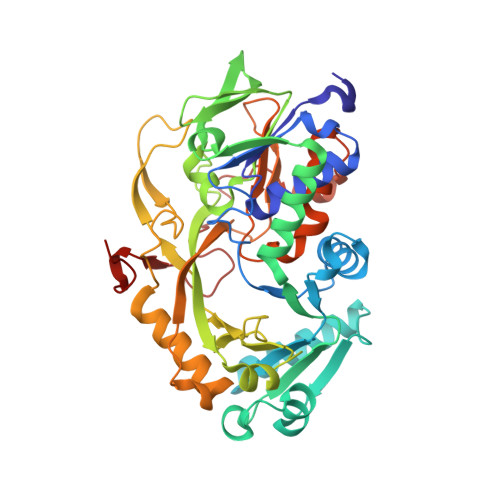
Engineered Fructosyl Peptide Oxidase - D02 mutant


Experimental Data Snapshot

  • Method: X-RAY DIFFRACTION
  • Resolution: 1.70 Å
  • R-Value Free: 
    0.194 (Depositor), 0.203 (DCC) 
  • R-Value Work: 
    0.168 (Depositor), 0.180 (DCC) 
  • R-Value Observed: 
    0.169 (Depositor) 

Starting Model: experimental
View more details

wwPDB Validation 3D Report Full Report

Validation slider image for 8BLZ

This is version 1.1 of the entry. See complete history

Literature

Tailoring FPOX enzymes for enhanced stability and expanded substrate recognition.

Estiri, H.Bhattacharya, S.Buitrago, J.A.R.Castagna, R.Legzdina, L.Casucci, G.Ricci, A.Parisini, E.Gautieri, A.

(2023) Sci Rep 13: 18610-18610

  • DOI: https://doi.org/10.1038/s41598-023-45428-1
  • Primary Citation Related Structures: 
    8BJY, 8BLX, 8BLZ, 8BMU

  • PubMed Abstract: 

    Fructosyl peptide oxidases (FPOX) are deglycating enzymes that find application as key enzymatic components in diabetes monitoring devices. Indeed, their use with blood samples can provide a measurement of the concentration of glycated hemoglobin and glycated albumin, two well-known diabetes markers. However, the FPOX currently employed in enzymatic assays cannot directly detect whole glycated proteins, making it necessary to perform a preliminary proteolytic treatment of the target protein to generate small glycated peptides that can act as viable substrates for the enzyme. This is a costly and time consuming step. In this work, we used an in silico protein engineering approach to enhance the overall thermal stability of the enzyme and to improve its catalytic activity toward large substrates. The final design shows a marked improvement in thermal stability relative to the wild type enzyme, a distinct widening of its access tunnel and significant enzymatic activity towards a range of glycated substrates.


  • Organizational Affiliation
    • Department of Biotechnology, Latvian Institute of Organic Synthesis, Aizkraukles 21, Riga, 1006, Latvia.

Macromolecule Content 

  • Total Structure Weight: 48.68 kDa 
  • Atom Count: 3,729 
  • Modeled Residue Count: 424 
  • Deposited Residue Count: 424 
  • Unique protein chains: 1

Macromolecules

Find similar proteins by:|  3D Structure
Entity ID: 1
MoleculeChains  Sequence LengthOrganismDetailsImage
Fructosyl Peptide Oxidase mutant (D02)A [auth C]424Parastagonospora nodorum SN15Mutation(s): 0 
Gene Names: SNOG_08398
UniProt
Find proteins for Q0UIL6 (Phaeosphaeria nodorum (strain SN15 / ATCC MYA-4574 / FGSC 10173))
Explore Q0UIL6 
Go to UniProtKB:  Q0UIL6
Entity Groups
Sequence Clusters30% Identity50% Identity70% Identity90% Identity95% Identity100% Identity
UniProt GroupQ0UIL6
Sequence Annotations
Expand
Reference Sequence

Small Molecules

Ligands 3 Unique
IDChains Name / Formula / InChI Key2D Diagram3D Interactions
FAD
(Subject of Investigation/LOI)

Query on FAD


Download:Ideal Coordinates CCD File
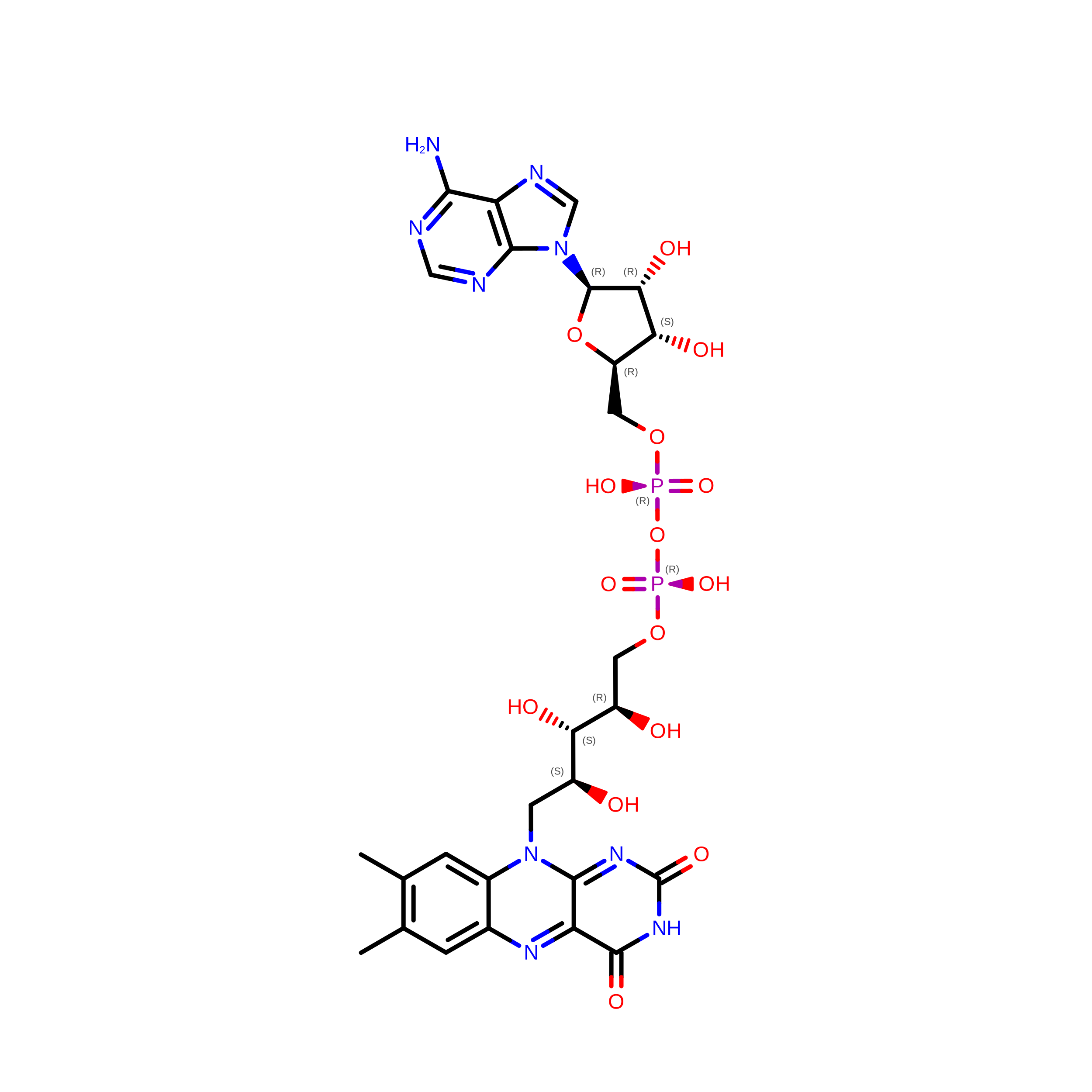
B [auth C]FLAVIN-ADENINE DINUCLEOTIDE
C27 H33 N9 O15 P2
VWWQXMAJTJZDQX-UYBVJOGSSA-N
SO4

Query on SO4


Download:Ideal Coordinates CCD File
I [auth C],
J [auth C]
SULFATE ION
O4 S
QAOWNCQODCNURD-UHFFFAOYSA-L
GOL

Query on GOL


Download:Ideal Coordinates CCD File
C
D [auth C]
E [auth C]
F [auth C]
G [auth C]
C,
D [auth C],
E [auth C],
F [auth C],
G [auth C],
H [auth C]
GLYCEROL
C3 H8 O3
PEDCQBHIVMGVHV-UHFFFAOYSA-N

Experimental Data & Validation

Experimental Data

  • Method: X-RAY DIFFRACTION
  • Resolution: 1.70 Å
  • R-Value Free:  0.194 (Depositor), 0.203 (DCC) 
  • R-Value Work:  0.168 (Depositor), 0.180 (DCC) 
  • R-Value Observed: 0.169 (Depositor) 
Space Group: C 2 2 21
Unit Cell:
Length ( Å )Angle ( ˚ )
a = 91.096α = 90
b = 129.493β = 90
c = 86.78γ = 90
Software Package:
Software NamePurpose
REFMACrefinement
DIALSdata reduction
Aimlessdata scaling
Cootmodel building
MOLREPphasing

Structure Validation

View Full Validation Report


Entry History 

& Funding Information

Deposition Data


Funding OrganizationLocationGrant Number
Other governmentlzp-2020/2-0013

Revision History  (Full details and data files)

  • Version 1.0: 2023-11-22
    Type: Initial release
  • Version 1.1: 2024-06-05
    Changes: Database references