8BJP | pdb_00008bjp

The N288D mutant cytoplasmic PAS domain of Geobacillus thermodenitrificans histidine kinase CitA


Experimental Data Snapshot

  • Method: X-RAY DIFFRACTION
  • Resolution: 2.10 Å
  • R-Value Free: 
    0.233 (Depositor), 0.240 (DCC) 
  • R-Value Work: 
    0.195 (Depositor), 0.200 (DCC) 

wwPDB Validation   3D Report Full Report


This is version 1.2 of the entry. See complete history


Literature

Mechanism of sensor kinase CitA transmembrane signaling.

Zhang, X.C.Xue, K.Salvi, M.Schomburg, B.Mehrens, J.Giller, K.Stopp, M.Weisenburger, S.Boning, D.Sandoghdar, V.Unden, G.Becker, S.Andreas, L.B.Griesinger, C.

(2025) Nat Commun 16: 935-935

  • DOI: https://doi.org/10.1038/s41467-024-55671-3
  • Primary Citation of Related Structures:  
    8BGB, 8BIY, 8BJP

  • PubMed Abstract: 

    Membrane bound histidine kinases (HKs) are ubiquitous sensors of extracellular stimuli in bacteria. However, a uniform structural model is still missing for their transmembrane signaling mechanism. Here, we used solid-state NMR in conjunction with crystallography, solution NMR and distance measurements to investigate the transmembrane signaling mechanism of a paradigmatic citrate sensing membrane embedded HK, CitA. Citrate binding in the sensory extracytoplasmic PAS domain (PASp) causes the linker to transmembrane helix 2 (TM2) to adopt a helical conformation. This triggers a piston-like pulling of TM2 and a quaternary structure rearrangement in the cytosolic PAS domain (PASc). Crystal structures of PASc reveal both anti-parallel and parallel dimer conformations. An anti-parallel to parallel transition upon citrate binding agrees with interdimer distances measured in the lipid embedded protein using a site-specific 19 F label in PASc. These data show how Angstrom scale structural changes in the sensor domain are transmitted across the membrane to be converted and amplified into a nm scale shift in the linker to the phosphorylation subdomain of the kinase.


  • Organizational Affiliation
    • NMR-based Structural Biology, Max Planck Institute for Multidisciplinary Sciences, Göttingen, Germany.

Macromolecules
Find similar proteins by:  (by identity cutoff)  |  3D Structure
Entity ID: 1
MoleculeChains Sequence LengthOrganismDetailsImage
cytoplasmic PAS domain of CitA from Geobacillus thermodenitrificansA [auth AAA],
B [auth BBB]
112Geobacillus thermodenitrificansMutation(s): 1 
Entity Groups  
Sequence Clusters30% Identity50% Identity70% Identity90% Identity95% Identity100% Identity
Sequence Annotations
Expand
  • Reference Sequence
Small Molecules
Ligands 1 Unique
IDChains Name / Formula / InChI Key2D Diagram3D Interactions
MG
Query on MG

Download Ideal Coordinates CCD File 
C [auth AAA]MAGNESIUM ION
Mg
JLVVSXFLKOJNIY-UHFFFAOYSA-N
Modified Residues  1 Unique
IDChains TypeFormula2D DiagramParent
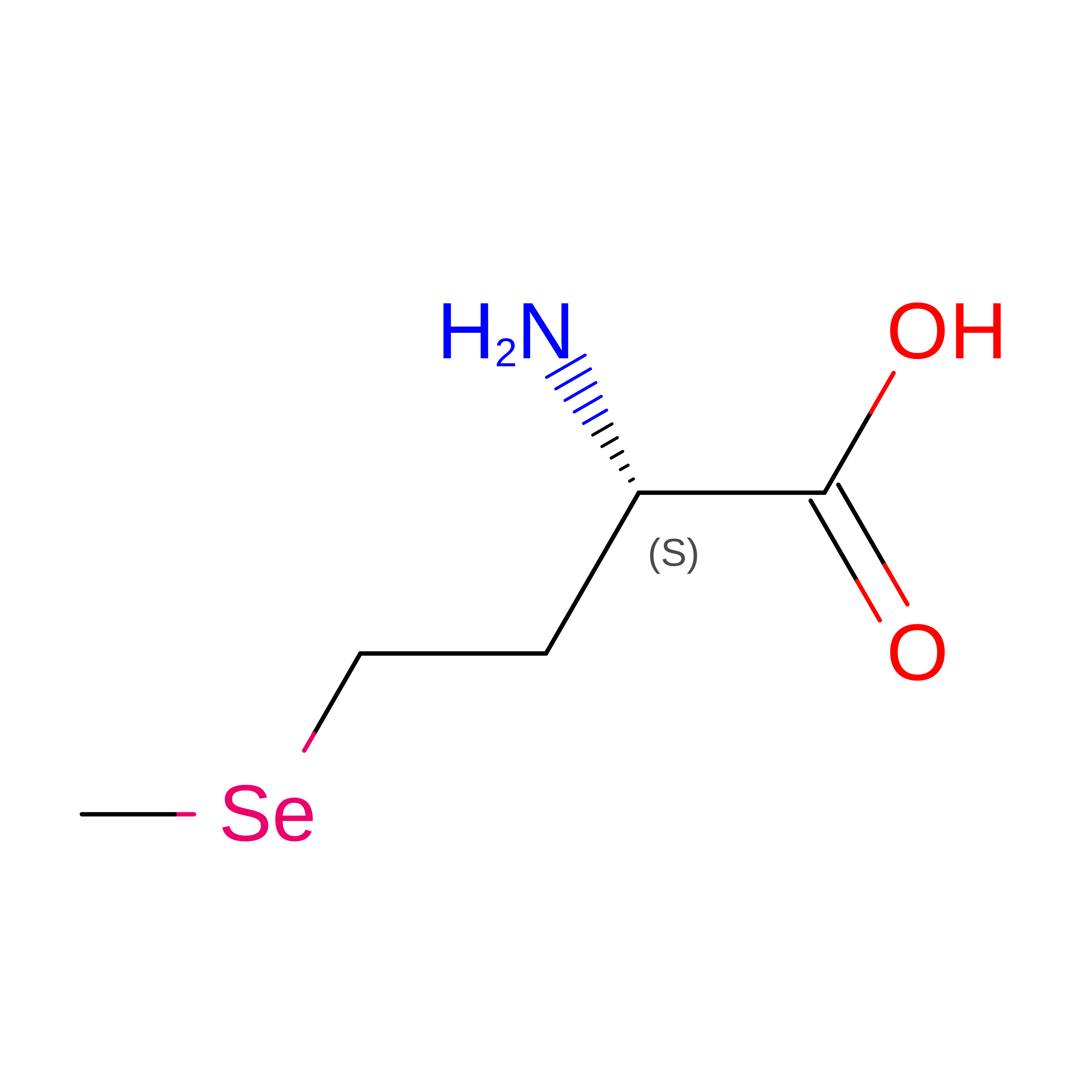
MSE
Query on MSE
A [auth AAA],
B [auth BBB]
L-PEPTIDE LINKINGC5 H11 N O2 SeMET
Experimental Data & Validation

Experimental Data

  • Method: X-RAY DIFFRACTION
  • Resolution: 2.10 Å
  • R-Value Free:  0.233 (Depositor), 0.240 (DCC) 
  • R-Value Work:  0.195 (Depositor), 0.200 (DCC) 
Space Group: P 21 21 21
Unit Cell:
Length ( Å )Angle ( ˚ )
a = 49.166α = 90
b = 49.295β = 90
c = 92.199γ = 90
Software Package:
Software NamePurpose
REFMACrefinement
XDSdata reduction
SADABSdata scaling
SHELXDEphasing

Structure Validation

View Full Validation Report


Entry History & Funding Information

Deposition Data

  • Released Date: 2023-11-15 
  • Deposition Author(s): Becker, S.

Funding OrganizationLocationGrant Number
Max Planck SocietyGermany--

Revision History  (Full details and data files)

  • Version 1.0: 2023-11-15
    Type: Initial release
  • Version 1.1: 2024-10-23
    Changes: Structure summary
  • Version 1.2: 2025-05-21
    Changes: Database references