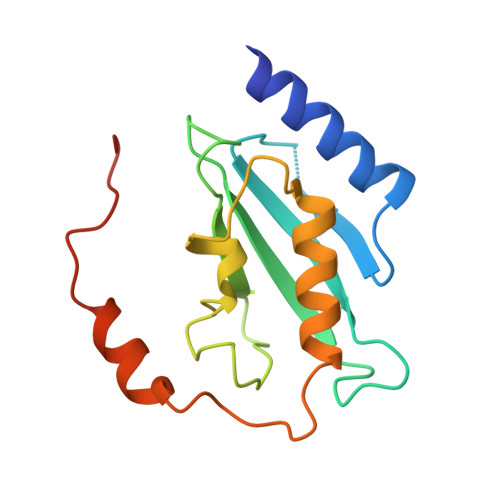
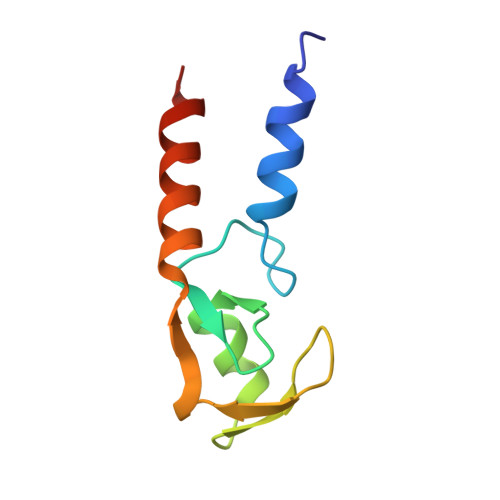
8A58 | pdb_00008a58

X-ray structure of TRIM21 RING E3 ligase in complex with E2 enzyme Ube2W


Experimental Data Snapshot

  • Method: X-RAY DIFFRACTION
  • Resolution: 2.25 Å
  • R-Value Free: 
    0.259 (Depositor), 0.261 (DCC) 
  • R-Value Work: 
    0.215 (Depositor), 0.226 (DCC) 
  • R-Value Observed: 
    0.217 (Depositor) 

Starting Model: experimental
View more details

wwPDB Validation 3D Report Full Report

Validation slider image for 8A58

This is version 1.1 of the entry. See complete history. 

Literature

Trim-Away ubiquitinates and degrades lysine-less and N-terminally acetylated substrates.

Kiss, L., Rhinesmith, T., Luptak, J., Dickson, C.F., Weidenhausen, J., Smyly, S., Yang, J.C., Maslen, S.L., Sinning, I., Neuhaus, D., Clift, D., James, L.C.

(2023) Nat Commun 14: 2160-2160

  • DOI: https://doi.org/10.1038/s41467-023-37504-x
  • Primary Citation Related Structures: 
    8A58

  • PubMed Abstract: 

    TRIM proteins are the largest family of E3 ligases in mammals. They include the intracellular antibody receptor TRIM21, which is responsible for mediating targeted protein degradation during Trim-Away. Despite their importance, the ubiquitination mechanism of TRIM ligases has remained elusive. Here we show that while Trim-Away activation results in ubiquitination of both ligase and substrate, ligase ubiquitination is not required for substrate degradation. N-terminal TRIM21 RING ubiquitination by the E2 Ube2W can be inhibited by N-terminal acetylation, but this doesn't prevent substrate ubiquitination nor degradation. Instead, uncoupling ligase and substrate degradation prevents ligase recycling and extends functional persistence in cells. Further, Trim-Away degrades substrates irrespective of whether they contain lysines or are N-terminally acetylated, which may explain the ability of TRIM21 to counteract fast-evolving pathogens and degrade diverse substrates.


  • Organizational Affiliation: 
    • MRC Laboratory of Molecular Biology, Francis Crick Avenue, Cambridge, CB2 0QH, UK. lkiss@biochem.mpg.de.

Macromolecule Content 

  • Total Structure Weight: 54.51 kDa 
  • Atom Count: 3,513 
  • Modeled Residue Count: 451 
  • Deposited Residue Count: 476 
  • Unique protein chains: 2

Macromolecules

Find similar proteins by:|  3D Structure
Entity ID: 1
MoleculeChains  Sequence LengthOrganismDetailsImage
Ubiquitin-conjugating enzyme E2 WA,
D [auth B]
153Homo sapiensMutation(s): 0 
Gene Names: UBE2W, UBC16
EC: 2.3.2.23 (PDB Primary Data), 2.3.2.25 (PDB Primary Data)
UniProt & NIH Common Fund Data Resources
Find proteins for Q96B02 (Homo sapiens)
Explore Q96B02 
Go to UniProtKB:  Q96B02
PHAROS:  Q96B02
GTEx:  ENSG00000104343 
Entity Groups
Sequence Clusters30% Identity50% Identity70% Identity90% Identity95% Identity100% Identity
UniProt GroupQ96B02
Sequence Annotations
Expand
Reference Sequence
Find similar proteins by:|  3D Structure
Entity ID: 2
MoleculeChains  Sequence LengthOrganismDetailsImage
E3 ubiquitin-protein ligase TRIM21B [auth C],
C [auth D]
85Homo sapiensMutation(s): 0 
Gene Names: TRIM21, RNF81, RO52, SSA1
EC: 2.3.2.27
UniProt & NIH Common Fund Data Resources
Find proteins for P19474 (Homo sapiens)
Explore P19474 
Go to UniProtKB:  P19474
PHAROS:  P19474
GTEx:  ENSG00000132109 
Entity Groups
Sequence Clusters30% Identity50% Identity70% Identity90% Identity95% Identity100% Identity
UniProt GroupP19474
Sequence Annotations
Expand
Reference Sequence

Experimental Data & Validation

Experimental Data

  • Method: X-RAY DIFFRACTION
  • Resolution: 2.25 Å
  • R-Value Free:  0.259 (Depositor), 0.261 (DCC) 
  • R-Value Work:  0.215 (Depositor), 0.226 (DCC) 
  • R-Value Observed: 0.217 (Depositor) 
Space Group: P 1 21 1
Unit Cell:
Length ( Å )Angle ( ˚ )
a = 62.82α = 90
b = 75.482β = 119.31
c = 63.835γ = 90
Software Package:
Software NamePurpose
PHENIXrefinement
XDSdata reduction
XDSdata scaling
PHASERphasing

Structure Validation

View Full Validation Report


Entry History 

& Funding Information

Deposition Data


Funding OrganizationLocationGrant Number
Medical Research Council (MRC, United Kingdom)United Kingdom--

Revision History  (Full details and data files)

  • Version 1.0: 2023-04-26
    Type: Initial release
  • Version 1.1: 2024-02-07
    Changes: Data collection, Refinement description