7UGS | pdb_00007ugs

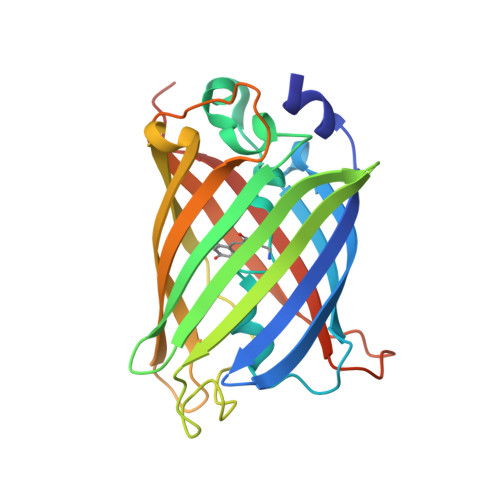
Crystal structure of monomeric hyperfolder YFP (K206V mutant)


Experimental Data Snapshot

  • Method: X-RAY DIFFRACTION
  • Resolution: 1.63 Å
  • R-Value Free: 
    0.188 (Depositor), 0.188 (DCC) 
  • R-Value Work: 
    0.150 (Depositor), 0.152 (DCC) 
  • R-Value Observed: 
    0.152 (Depositor) 

Starting Model: experimental
View more details

wwPDB Validation 3D Report Full Report

Validation slider image for 7UGS

This is version 2.0 of the entry. See complete history

Literature

Chemically stable fluorescent proteins for advanced microscopy.

Campbell, B.C.Paez-Segala, M.G.Looger, L.L.Petsko, G.A.Liu, C.F.

(2022) Nat Methods 19: 1612-1621

  • DOI: https://doi.org/10.1038/s41592-022-01660-7
  • Primary Citation Related Structures: 
    7UGR, 7UGS, 7UGT

  • PubMed Abstract: 

    We report the rational engineering of a remarkably stable yellow fluorescent protein (YFP), 'hyperfolder YFP' (hfYFP), that withstands chaotropic conditions that denature most biological structures within seconds, including superfolder green fluorescent protein (GFP). hfYFP contains no cysteines, is chloride insensitive and tolerates aldehyde and osmium tetroxide fixation better than common fluorescent proteins, enabling its use in expansion and electron microscopies. We solved crystal structures of hfYFP (to 1.7-Å resolution), a monomeric variant, monomeric hyperfolder YFP (1.6 Å) and an mGreenLantern mutant (1.2 Å), and then rationally engineered highly stable 405-nm-excitable GFPs, large Stokes shift (LSS) monomeric GFP (LSSmGFP) and LSSA12 from these structures. Lastly, we directly exploited the chemical stability of hfYFP and LSSmGFP by devising a fluorescence-assisted protein purification strategy enabling all steps of denaturing affinity chromatography to be visualized using ultraviolet or blue light. hfYFP and LSSmGFP represent a new generation of robustly stable fluorescent proteins developed for advanced biotechnological applications.


  • Organizational Affiliation
    • Helen and Robert Appel Alzheimer's Disease Research Institute, Weill Cornell Medicine, New York, NY, USA. ben.campbell@protonmail.com.

Macromolecule Content 

  • Total Structure Weight: 26.95 kDa 
  • Atom Count: 2,061 
  • Modeled Residue Count: 227 
  • Deposited Residue Count: 237 
  • Unique protein chains: 1

Macromolecules

Find similar proteins by:|  3D Structure
Entity ID: 1
MoleculeChains  Sequence LengthOrganismDetailsImage
Hyperfolder yellow fluorescent protein237Aequorea victoriaMutation(s): 0 
UniProt
Find proteins for A0A059PIR9 (Aequorea victoria)
Explore A0A059PIR9 
Go to UniProtKB:  A0A059PIR9
Entity Groups
Sequence Clusters30% Identity50% Identity70% Identity90% Identity95% Identity100% Identity
UniProt GroupA0A059PIR9
Sequence Annotations
Expand
Reference Sequence

Small Molecules

Modified Residues  1 Unique
IDChains TypeFormula2D DiagramParent
CR2
Query on CR2
A
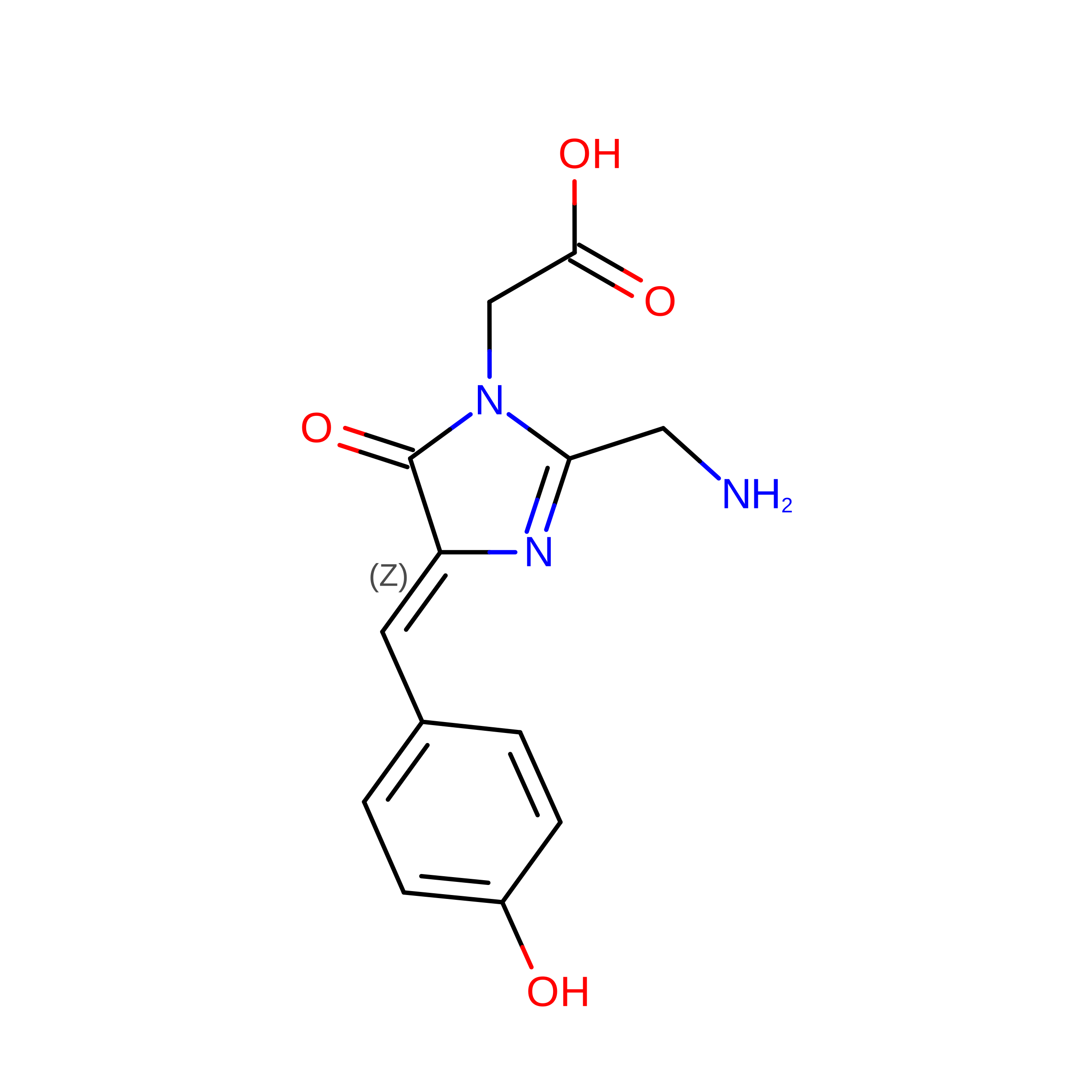
L-PEPTIDE LINKINGC13 H13 N3 O4GLY, TYR, GLY

Experimental Data & Validation

Experimental Data

  • Method: X-RAY DIFFRACTION
  • Resolution: 1.63 Å
  • R-Value Free:  0.188 (Depositor), 0.188 (DCC) 
  • R-Value Work:  0.150 (Depositor), 0.152 (DCC) 
  • R-Value Observed: 0.152 (Depositor) 
Space Group: C 2 2 21
Unit Cell:
Length ( Å )Angle ( ˚ )
a = 52.347α = 90
b = 66.659β = 90
c = 142.465γ = 90
Software Package:
Software NamePurpose
PHENIXrefinement
XDSdata reduction
XDSdata scaling
PHENIXphasing

Structure Validation

View Full Validation Report


Entry History 

& Funding Information

Deposition Data


Funding OrganizationLocationGrant Number
Other privateUnited States--

Revision History  (Full details and data files)

  • Version 1.0: 2022-10-26
    Type: Initial release
  • Version 1.1: 2022-11-16
    Changes: Database references
  • Version 1.2: 2022-11-23
    Changes: Database references
  • Version 1.3: 2022-12-14
    Changes: Database references
  • Version 1.4: 2023-10-25
    Changes: Data collection, Refinement description
  • Version 1.5: 2023-11-15
    Changes: Data collection
  • Version 1.6: 2024-11-13
    Changes: Structure summary
  • Version 2.0: 2026-03-18
    Changes: Polymer sequence