7N62 | pdb_00007n62

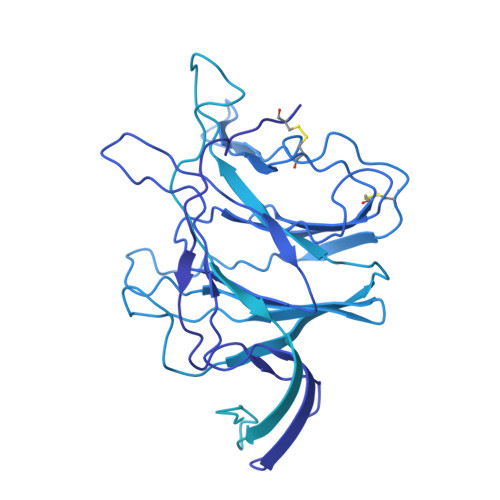
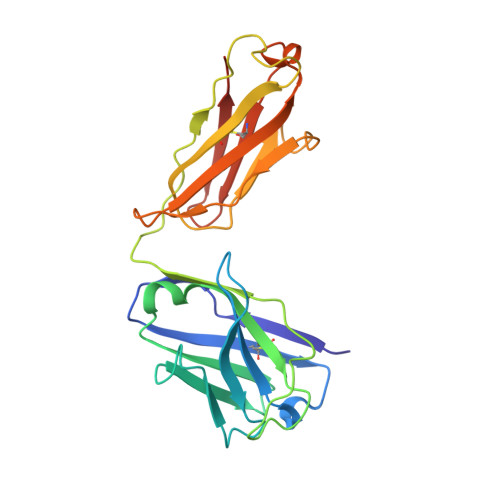
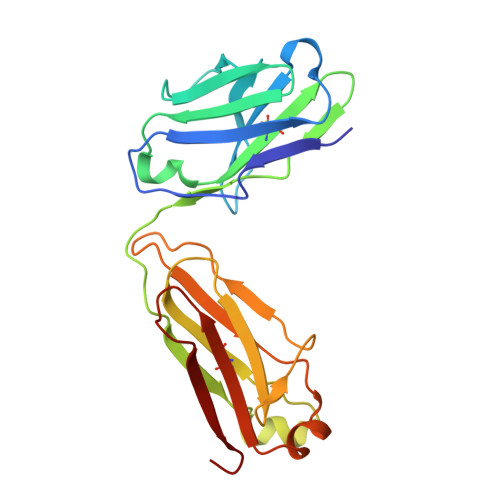
SARS-CoV-2 Spike (2P) in complex with C12C9 Fab (NTD local reconstruction)


Experimental Data Snapshot

  • Method: ELECTRON MICROSCOPY
  • Resolution: 4.00 Å
  • Aggregation State: PARTICLE 
  • Reconstruction Method: SINGLE PARTICLE 

Starting Models: experimental
View more details

wwPDB Validation 3D Report Full Report

Validation slider image for 7N62

This is version 1.1 of the entry. See complete history. 

Literature

Memory B cell repertoire for recognition of evolving SARS-CoV-2 spike.

Tong, P., Gautam, A., Windsor, I., Travers, M., Chen, Y., Garcia, N., Whiteman, N.B., McKay, L.G.A., Lelis, F.J.N., Habibi, S., Cai, Y., Rennick, L.J., Duprex, W.P., McCarthy, K.R., Lavine, C.L., Zuo, T., Lin, J., Zuiani, A., Feldman, J., MacDonald, E.A., Hauser, B.M., Griffths, A., Seaman, M.S., Schmidt, A.G., Chen, B., Neuberg, D., Bajic, G., Harrison, S.C., Wesemann, D.R.

(2021) bioRxiv 

  • DOI: https://doi.org/10.1101/2021.03.10.434840
  • Primary Citation Related Structures: 
    7N62, 7N64

  • PubMed Abstract: 

    Memory B cell reserves can generate protective antibodies against repeated SARS-CoV-2 infections, but with an unknown reach from original infection to antigenically drifted variants. We charted memory B cell receptor-encoded monoclonal antibodies (mAbs) from 19 COVID-19 convalescent subjects against SARS-CoV-2 spike (S) and found 7 major mAb competition groups against epitopes recurrently targeted across individuals. Inclusion of published and newly determined structures of mAb-S complexes identified corresponding epitopic regions. Group assignment correlated with cross-CoV-reactivity breadth, neutralization potency, and convergent antibody signatures. mAbs that competed for binding the original S isolate bound differentially to S variants, suggesting the protective importance of otherwise-redundant recognition. The results furnish a global atlas of the S-specific memory B cell repertoire and illustrate properties conferring robustness against emerging SARS-CoV-2 variants.


  • Organizational Affiliation: 
    • Department of Medicine, Division of Allergy and Immunology, Division of Genetics, Brigham and Women's Hospital, Harvard Medical School, Boston, MA 02115, USA.

Macromolecule Content 

  • Total Structure Weight: 190.2 kDa 
  • Atom Count: 5,613 
  • Modeled Residue Count: 712 
  • Deposited Residue Count: 1,715 
  • Unique protein chains: 3

Macromolecules

Find similar proteins by:|  3D Structure
Entity ID: 1
MoleculeChains  Sequence LengthOrganismDetailsImage
Spike glycoprotein1,273Severe acute respiratory syndrome coronavirus 2Mutation(s): 0 
Gene Names: S, 2
UniProt
Find proteins for P0DTC2 (Severe acute respiratory syndrome coronavirus 2)
Explore P0DTC2 
Go to UniProtKB:  P0DTC2
Entity Groups
Sequence Clusters30% Identity50% Identity70% Identity90% Identity95% Identity100% Identity
UniProt GroupP0DTC2
Glycosylation
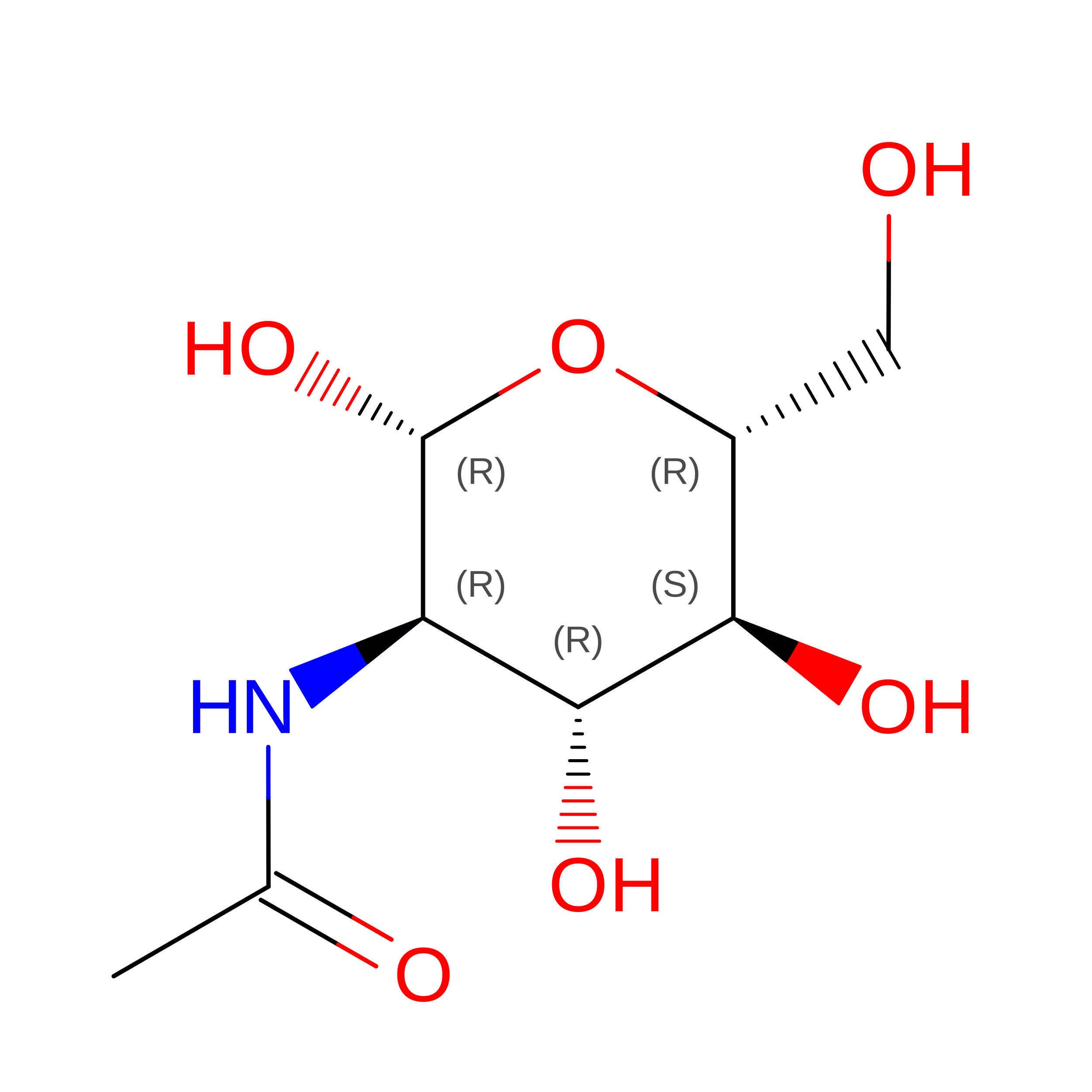
Glycosylation Sites: 5Go to GlyGen: P0DTC2-1
Sequence Annotations
Expand
Reference Sequence
Find similar proteins by:|  3D Structure
Entity ID: 2
MoleculeChains  Sequence LengthOrganismDetailsImage
C12C9 Fab heavy chainB [auth H]228Homo sapiensMutation(s): 0 
Entity Groups
Sequence Clusters30% Identity50% Identity70% Identity90% Identity95% Identity100% Identity
Sequence Annotations
Expand
Reference Sequence
Find similar proteins by:|  3D Structure
Entity ID: 3
MoleculeChains  Sequence LengthOrganismDetailsImage
C12C9 Fab light chainC [auth L]214Homo sapiensMutation(s): 0 
Entity Groups
Sequence Clusters30% Identity50% Identity70% Identity90% Identity95% Identity100% Identity
Sequence Annotations
Expand
Reference Sequence

Experimental Data & Validation

Experimental Data

  • Method: ELECTRON MICROSCOPY
  • Resolution: 4.00 Å
  • Aggregation State: PARTICLE 
  • Reconstruction Method: SINGLE PARTICLE 
EM Software:
TaskSoftware PackageVersion
RECONSTRUCTIONRELION3.1
MODEL REFINEMENTPHENIX1.18.2-3874

Structure Validation

View Full Validation Report


Entry History 

Deposition Data

Revision History  (Full details and data files)

  • Version 1.0: 2021-08-04
    Type: Initial release
  • Version 1.1: 2024-11-13
    Changes: Data collection, Database references, Refinement description, Structure summary