7ZC1 | pdb_00007zc1

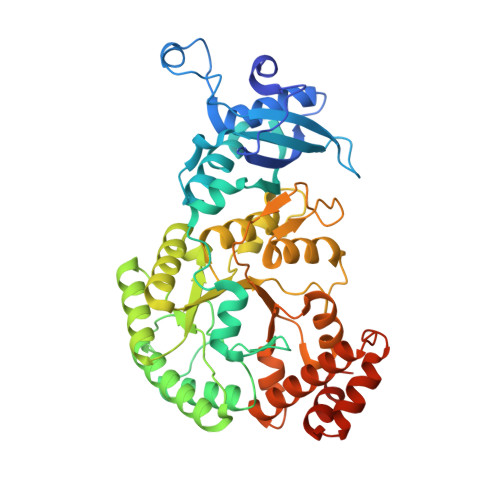
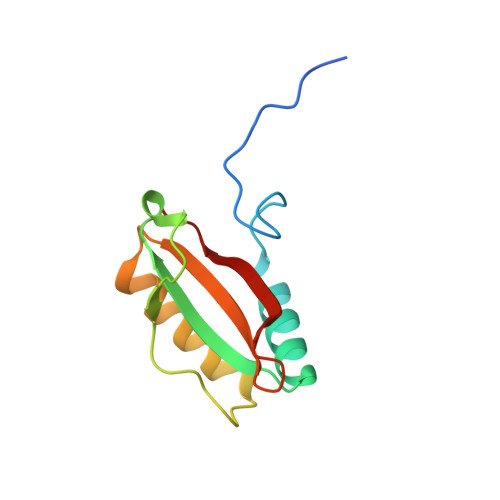
Subtomogram averaging of Rubisco from Cyanobium carboxysome


Experimental Data Snapshot

  • Method: ELECTRON MICROSCOPY
  • Resolution: 3.80 Å
  • Aggregation State: PARTICLE 
  • Reconstruction Method: SUBTOMOGRAM AVERAGING 

wwPDB Validation 3D Report Full Report

Validation slider image for 7ZC1

This is version 1.3 of the entry. See complete history

Literature

Structure and assembly of cargo Rubisco in two native alpha-carboxysomes.

Ni, T.Sun, Y.Burn, W.Al-Hazeem, M.M.J.Zhu, Y.Yu, X.Liu, L.N.Zhang, P.

(2022) Nat Commun 13: 4299-4299

  • DOI: https://doi.org/10.1038/s41467-022-32004-w
  • Primary Citation Related Structures: 
    7ZBT, 7ZC1

  • PubMed Abstract: 

    Carboxysomes are a family of bacterial microcompartments in cyanobacteria and chemoautotrophs. They encapsulate Ribulose 1,5-bisphosphate carboxylase/oxygenase (Rubisco) and carbonic anhydrase catalyzing carbon fixation inside a proteinaceous shell. How Rubisco complexes pack within the carboxysomes is unknown. Using cryo-electron tomography, we determine the distinct 3D organization of Rubisco inside two distant α-carboxysomes from a marine α-cyanobacterium Cyanobium sp. PCC 7001 where Rubiscos are organized in three concentric layers, and from a chemoautotrophic bacterium Halothiobacillus neapolitanus where they form intertwining spirals. We further resolve the structures of native Rubisco as well as its higher-order assembly at near-atomic resolutions by subtomogram averaging. The structures surprisingly reveal that the authentic intrinsically disordered linker protein CsoS2 interacts with Rubiscos in native carboxysomes but functions distinctively in the two α-carboxysomes. In contrast to the uniform Rubisco-CsoS2 association in the Cyanobium α-carboxysome, CsoS2 binds only to the Rubiscos close to the shell in the Halo α-carboxysome. Our findings provide critical knowledge of the assembly principles of α-carboxysomes, which may aid in the rational design and repurposing of carboxysome structures for new functions.


  • Organizational Affiliation
    • Division of Structural Biology, Wellcome Centre for Human Genetics, University of Oxford, Oxford, UK.

Macromolecule Content 

  • Total Structure Weight: 523.95 kDa 
  • Atom Count: 34,864 
  • Modeled Residue Count: 4,416 
  • Deposited Residue Count: 4,664 
  • Unique protein chains: 2

Macromolecules

Find similar proteins by:|  3D Structure
Entity ID: 1
MoleculeChains  Sequence LengthOrganismDetailsImage
Ribulose bisphosphate carboxylase large chain470Cyanobium sp. PCC 7001Mutation(s): 0 
Gene Names: rbcLcbbLCPCC7001_1083
EC: 4.1.1.39
UniProt
Find proteins for A5CKD0 (Cyanobium sp. PCC 7001)
Explore A5CKD0 
Go to UniProtKB:  A5CKD0
Entity Groups
Sequence Clusters30% Identity50% Identity70% Identity90% Identity95% Identity100% Identity
UniProt GroupA5CKD0
Sequence Annotations
Expand
Reference Sequence
Find similar proteins by:|  3D Structure
Entity ID: 2
MoleculeChains  Sequence LengthOrganismDetailsImage
Ribulose bisphosphate carboxylase, small subunit113Cyanobium sp. PCC 7001Mutation(s): 0 
Gene Names: CPCC7001_1801
UniProt
Find proteins for A0ACD6B9P0 (Cyanobium sp. PCC 7001)
Explore A0ACD6B9P0 
Go to UniProtKB:  A0ACD6B9P0
Entity Groups
Sequence Clusters30% Identity50% Identity70% Identity90% Identity95% Identity100% Identity
UniProt GroupA0ACD6B9P0
Sequence Annotations
Expand
Reference Sequence

Experimental Data & Validation

Experimental Data

  • Method: ELECTRON MICROSCOPY
  • Resolution: 3.80 Å
  • Aggregation State: PARTICLE 
  • Reconstruction Method: SUBTOMOGRAM AVERAGING 
EM Software:
TaskSoftware PackageVersion
RECONSTRUCTIONemClarity
RECONSTRUCTIONcisTEM
MODEL REFINEMENTPHENIX

Structure Validation

View Full Validation Report


Entry History 

& Funding Information

Deposition Data


Funding OrganizationLocationGrant Number
Wellcome TrustUnited Kingdom--
Biotechnology and Biological Sciences Research Council (BBSRC)United Kingdom--
European Research Council (ERC)European Union--

Revision History  (Full details and data files)

  • Version 1.0: 2022-07-06
    Type: Initial release
  • Version 1.1: 2023-01-18
    Changes: Database references
  • Version 1.2: 2024-07-24
    Changes: Data collection
  • Version 1.3: 2025-07-09
    Changes: Data collection, Structure summary