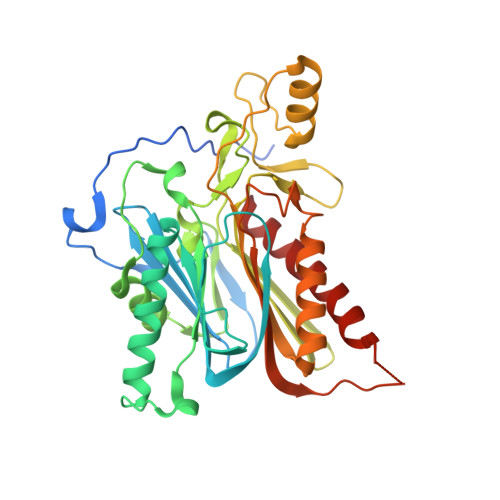
7YU1 | pdb_00007yu1

Structure of 6-aminohexanoate-oligomer hydrolase NylC precursor, D122G/H130Y/T267C mutant

  • Classification: HYDROLASE
  • Organism(s): Arthrobacter
  • Expression System: Escherichia coli
  • Mutation(s): Yes 

  • Deposited: 2022-08-16 Released: 2023-03-01 
  • Deposition Author(s): Negoro, S., Higuchi, Y.
  • Funding Organization(s): Ministry of Education, Culture, Sports, Science and Technology (Japan)

Experimental Data Snapshot

  • Method: X-RAY DIFFRACTION
  • Resolution: 1.13 Å
  • R-Value Free: 
    0.155 (Depositor), 0.149 (DCC) 
  • R-Value Work: 
    0.129 (Depositor), 0.125 (DCC) 

Starting Model: experimental
View more details

wwPDB Validation 3D Report Full Report

Validation slider image for 7YU1

This is version 1.2 of the entry. See complete history. 

Literature

X-ray crystallographic and mutational analysis of the NylC precursor: catalytic mechanism of autocleavage and substrate hydrolysis of nylon hydrolase.

Negoro, S., Shibata, N., Kato, D.I., Tanaka, Y., Yasuhira, K., Nagai, K., Oshima, S., Furuno, Y., Yokoyama, R., Miyazaki, K., Takeo, M., Hengphasatporn, K., Shigeta, Y., Lee, Y.H., Higuchi, Y.

(2023) FEBS J 290: 3400-3421

  • DOI: https://doi.org/10.1111/febs.16755
  • Primary Citation Related Structures: 
    7YU0, 7YU1, 7YU2

  • PubMed Abstract: 

    Nylon hydrolase (NylC), a member of the N-terminal nucleophile (Ntn) hydrolase superfamily, is responsible for the degradation of various aliphatic nylons, including nylon-6 and nylon-66. NylC is initially expressed as an inactive precursor (36 kDa), but the precursor is autocatalytically cleaved at Asn266/Thr267 to generate an active enzyme composed of 27 and 9 kDa subunits. We isolated various mutants with amino acid changes at the catalytic centre. X-ray crystallographic analysis revealed that the NylC precursor forms a doughnut-shaped quaternary structure composed of four monomers (molecules A-D) with D2 symmetry. Catalytic residues in the precursor are covered by loop regions at the A/B interface (equivalent to the C/D interface). However, the catalytic residues are exposed to the solvent environment through autocleavage followed by movements of the loop regions. T267A, D306A and D308A mutations resulted in a complete loss of autocleavage. By contrast, in the T267S mutant, autocleavage proceeded slowly at a constant reaction rate (k = 2.8 × 10 -5  s -1 ) until complete conversion, but the reaction was inhibited by K189A and N219A mutations. Based on the crystallographic and molecular dynamic simulation analyses, we concluded that the Asp308-Asp306-Thr267 triad, resembling the Glu-Ser-Ser triad conserved in Ntn-hydrolase family enzymes, is responsible for autocleavage and that hydrogen-bonding networks connecting Thr267 with Lys189 and Asn219 are required for increasing the nucleophilicity of Thr267-OH in both the water accessible and water inaccessible systems. Furthermore, we determined that NylC employs the Asp308-Asp306-Thr267 triad as catalytic residues for substrate hydrolysis, but the reaction requires Lys189 and Tyr146 as additional catalytic/substrate-binding residues specific for nylon hydrolysis.


  • Organizational Affiliation: 
    • Department of Applied Chemistry, Graduate School of Engineering, University of Hyogo, Himeji, Japan.

Macromolecule Content 

  • Total Structure Weight: 74.73 kDa 
  • Atom Count: 5,774 
  • Modeled Residue Count: 664 
  • Deposited Residue Count: 710 
  • Unique protein chains: 1

Macromolecules

Find similar proteins by:|  3D Structure
Entity ID: 1
MoleculeChains  Sequence LengthOrganismDetailsImage
6-aminohexanoate-oligomer endohydrolase
A, B
355ArthrobacterMutation(s): 3 
Gene Names: nylC
EC: 3.5.1.117
UniProt
Find proteins for Q79F77 (Paenarthrobacter ureafaciens)
Explore Q79F77 
Go to UniProtKB:  Q79F77
Entity Groups
Sequence Clusters30% Identity50% Identity70% Identity90% Identity95% Identity100% Identity
UniProt GroupQ79F77
Sequence Annotations
Expand
Reference Sequence

Small Molecules

Ligands 3 Unique
IDChains Name / Formula / InChI Key2D Diagram3D Interactions
SO4

Query on SO4


Download:Ideal Coordinates CCD File
J [auth B],
K [auth B],
L [auth B]
SULFATE ION
O4 S
QAOWNCQODCNURD-UHFFFAOYSA-L
GOL

Query on GOL


Download:Ideal Coordinates CCD File
C [auth A]
D [auth A]
E [auth A]
F [auth A]
H [auth B]
C [auth A],
D [auth A],
E [auth A],
F [auth A],
H [auth B],
I [auth B]
GLYCEROL
C3 H8 O3
PEDCQBHIVMGVHV-UHFFFAOYSA-N
NA

Query on NA


Download:Ideal Coordinates CCD File
G [auth A],
M [auth B],
N [auth B]
SODIUM ION
Na
FKNQFGJONOIPTF-UHFFFAOYSA-N

Experimental Data & Validation

Experimental Data

  • Method: X-RAY DIFFRACTION
  • Resolution: 1.13 Å
  • R-Value Free:  0.155 (Depositor), 0.149 (DCC) 
  • R-Value Work:  0.129 (Depositor), 0.125 (DCC) 
Space Group: C 2 2 21
Unit Cell:
Length ( Å )Angle ( ˚ )
a = 69.879α = 90
b = 144.004β = 90
c = 129.284γ = 90
Software Package:
Software NamePurpose
REFMACrefinement
HKL-2000data reduction
HKL-2000data scaling
PHASERphasing

Structure Validation

View Full Validation Report


Entry History 

& Funding Information

Deposition Data


Funding OrganizationLocationGrant Number
Ministry of Education, Culture, Sports, Science and Technology (Japan)Japan26289317

Revision History  (Full details and data files)

  • Version 1.0: 2023-03-01
    Type: Initial release
  • Version 1.1: 2023-07-19
    Changes: Data collection, Database references
  • Version 1.2: 2023-11-29
    Changes: Data collection, Refinement description