7YLF | pdb_00007ylf

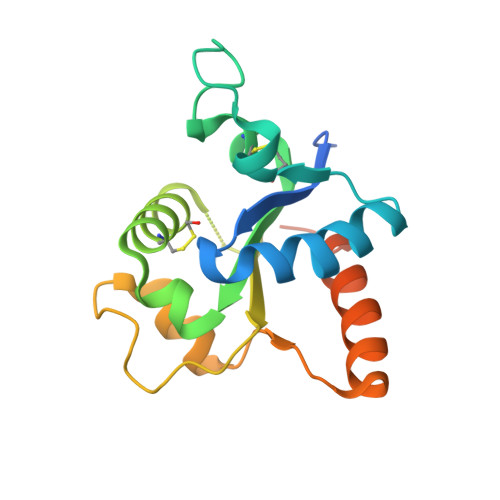
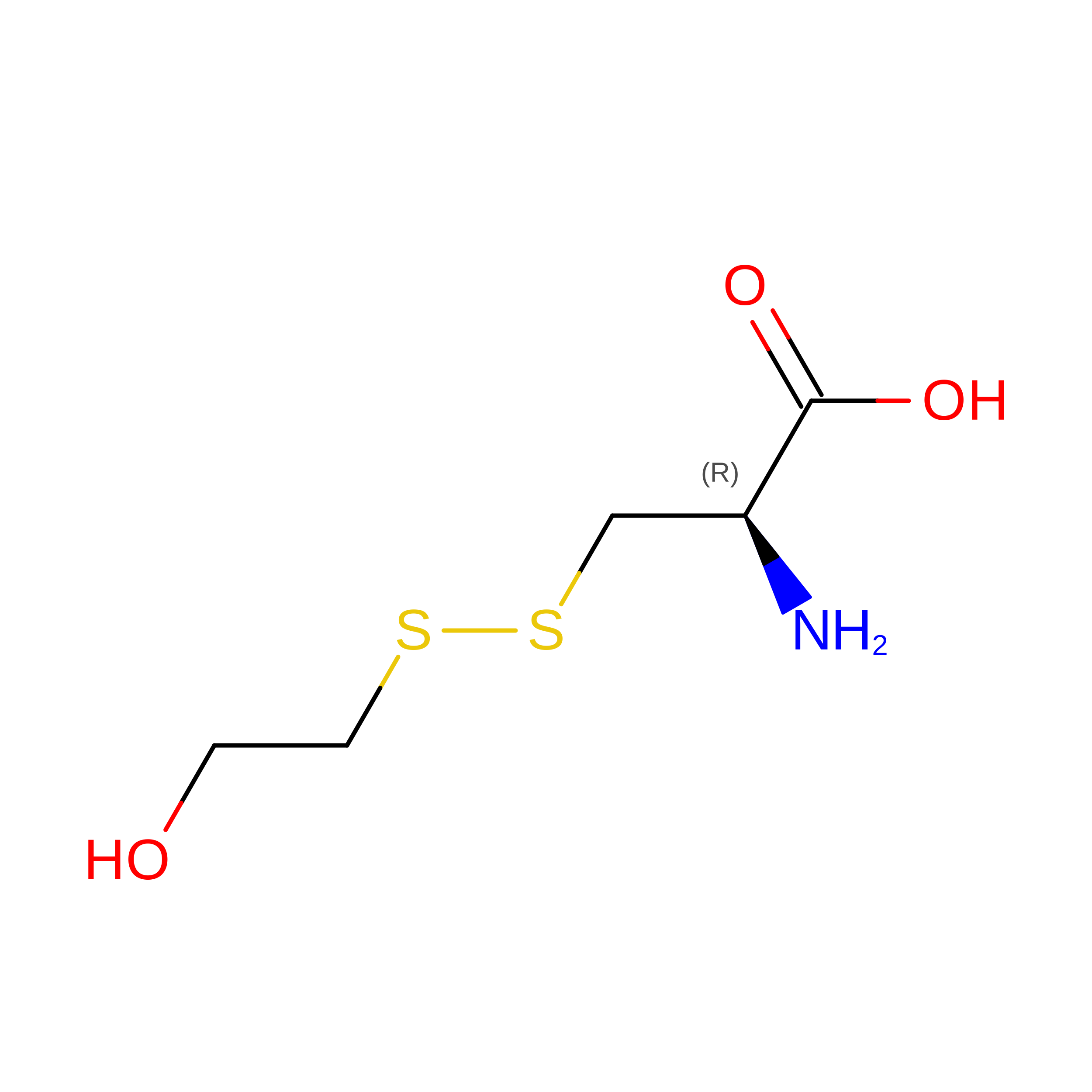
Crystal structure of the chicken Toll-like receptor 15 TIR domain (2-mercaptoethanol adduct)


Experimental Data Snapshot

  • Method: X-RAY DIFFRACTION
  • Resolution: 1.90 Å
  • R-Value Free: 
    0.233 (Depositor), 0.234 (DCC) 
  • R-Value Work: 
    0.201 (Depositor), 0.203 (DCC) 
  • R-Value Observed: 
    0.203 (Depositor) 

Starting Model: experimental
View more details

wwPDB Validation 3D Report Full Report

Validation slider image for 7YLF

This is version 1.2 of the entry. See complete history

Literature

Structural analysis of the Toll-like receptor 15 TIR domain.

Ko, K.Y.Song, W.S.Park, J.Lee, G.S.Yoon, S.I.

(2023) IUCrJ 10: 352-362

  • DOI: https://doi.org/10.1107/S2052252523002956
  • Primary Citation Related Structures: 
    7YLF, 7YLG

  • PubMed Abstract: 

    Toll-like receptors (TLRs) activate innate immunity in response to pathogen-associated molecular patterns (PAMPs). The ectodomain of a TLR directly senses a PAMP and the intracellular TIR domain dimerizes to initiate a signaling cascade. The TIR domains of TLR6 and TLR10, which belong to the TLR1 subfamily, have been structurally characterized in a dimer, whereas those of other subfamilies, including TLR15, have not been explored at the structural or molecular level. TLR15 is a TLR unique to birds and reptiles that responds to virulence-associated fungal and bacterial proteases. To reveal how the TLR15 TIR domain (TLR15 TIR ) triggers signaling, the crystal structure of TLR15 TIR was determined in a dimeric form and a mutational study was performed. TLR15 TIR forms a one-domain structure in which a five-stranded β-sheet is decorated by α-helices, as shown for TLR1 subfamily members. TLR15 TIR exhibits substantial structural differences from other TLRs at the BB and DD loops and αC2 helix that are involved in dimerization. As a result, TLR15 TIR is likely to form a dimeric structure that is unique in its intersubunit orientation and the contribution of each dimerizing region. Further comparative analysis of TIR structures and sequences provides insights into the recruitment of a signaling adaptor protein by TLR15 TIR .


  • Organizational Affiliation
    • Division of Biomedical Convergence, Kangwon National University, Chuncheon, 24341, Republic of Korea.

Macromolecule Content 

  • Total Structure Weight: 21.19 kDa 
  • Atom Count: 1,256 
  • Modeled Residue Count: 143 
  • Deposited Residue Count: 176 
  • Unique protein chains: 1

Macromolecules

Find similar proteins by:|  3D Structure
Entity ID: 1
MoleculeChains  Sequence LengthOrganismDetailsImage
Toll-like receptor 15176Gallus gallusMutation(s): 0 
Gene Names: TLR15
UniProt
Find proteins for E5L3Q3 (Gallus gallus)
Explore E5L3Q3 
Go to UniProtKB:  E5L3Q3
Entity Groups
Sequence Clusters30% Identity50% Identity70% Identity90% Identity95% Identity100% Identity
UniProt GroupE5L3Q3
Sequence Annotations
Expand
Reference Sequence

Experimental Data & Validation

Experimental Data

  • Method: X-RAY DIFFRACTION
  • Resolution: 1.90 Å
  • R-Value Free:  0.233 (Depositor), 0.234 (DCC) 
  • R-Value Work:  0.201 (Depositor), 0.203 (DCC) 
  • R-Value Observed: 0.203 (Depositor) 
Space Group: P 32 2 1
Unit Cell:
Length ( Å )Angle ( ˚ )
a = 64.299α = 90
b = 64.299β = 90
c = 95.782γ = 120
Software Package:
Software NamePurpose
PHENIXrefinement
HKL-2000data reduction
HKL-2000data scaling
PHASERphasing

Structure Validation

View Full Validation Report


Entry History 

& Funding Information

Deposition Data


Funding OrganizationLocationGrant Number
National Research Foundation (NRF, Korea)Korea, Republic Of2019R1A2C1002100

Revision History  (Full details and data files)

  • Version 1.0: 2023-05-31
    Type: Initial release
  • Version 1.1: 2023-11-29
    Changes: Data collection, Refinement description
  • Version 1.2: 2024-10-23
    Changes: Structure summary