7XY4 | pdb_00007xy4

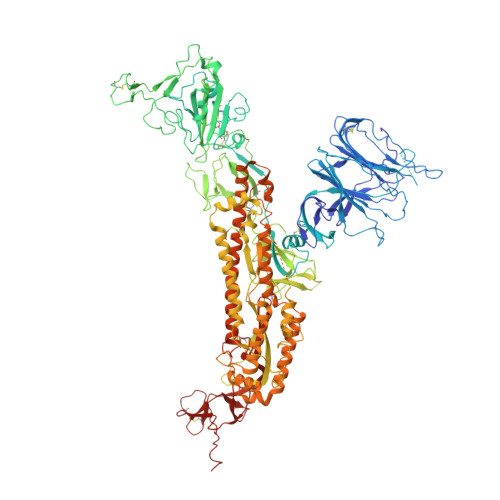
Cryo-EM structure of SARS-CoV-2 spike in complex with VHH21


Experimental Data Snapshot

  • Method: ELECTRON MICROSCOPY
  • Resolution: 3.30 Å
  • Aggregation State: PARTICLE 
  • Reconstruction Method: SINGLE PARTICLE 

wwPDB Validation   3D Report Full Report


This is version 1.3 of the entry. See complete history


Literature

Identification of a nanobody able to catalyze the destruction of the spike-trimer of SARS-CoV-2.

Wang, K.Cao, D.Liu, L.Fan, X.Lin, Y.He, W.Zhai, Y.Xu, P.Yan, X.Wang, H.Zhang, X.Yang, P.

(2025) Front Med 19: 493-506

  • DOI: https://doi.org/10.1007/s11684-025-1128-4
  • Primary Citation of Related Structures:  
    7XY4

  • PubMed Abstract: 

    Neutralizing antibodies have been designed to specifically target and bind to the receptor binding domain (RBD) of spike (S) protein to block severe acute respiratory syndrome coronavirus 2 (SARS-CoV-2) virus from attaching to angiotensin converting enzyme 2 (ACE2). This study reports a distinctive nanobody, designated as VHH21, that directly catalyzes the S-trimer into an irreversible transition state through postfusion conformational changes. Derived from camels immunized with multiple antigens, a set of nanobodies with high affinity for the S1 protein displays abilities to neutralize pseudovirion infections with a broad resistance to variants of concern of SARS-CoV-2, including SARS-CoV and BatRaTG13. Importantly, a super-resolution screening and analysis platform based on visual fluorescence probes was designed and applied to monitor single proteins and protein subunits. A spontaneously occurring dimeric form of VHH21 was obtained to rapidly destroy the S-trimer. Structural analysis via cryogenic electron microscopy revealed that VHH21 targets specific conserved epitopes on the S protein, distinct from the ACE2 binding site on the RBD, which destabilizes the fusion process. This research highlights the potential of VHH21 as an abzyme-like nanobody (nanoabzyme) possessing broad-spectrum binding capabilities and highly effective anti-viral properties and offers a promising strategy for combating coronavirus outbreaks.


  • Organizational Affiliation
    • Key Laboratory of Epigenetic Regulation and Intervention, Institute of Biophysics, Chinese Academy of Sciences, Beijing, 100101, China.

Macromolecules
Find similar proteins by:  (by identity cutoff)  |  3D Structure
Entity ID: 1
MoleculeChains Sequence LengthOrganismDetailsImage
Spike glycoprotein
A, B, C
1,132Severe acute respiratory syndrome coronavirus 2Mutation(s): 0 
Gene Names: S2
UniProt
Find proteins for P0DTC2 (Severe acute respiratory syndrome coronavirus 2)
Explore P0DTC2 
Go to UniProtKB:  P0DTC2
Entity Groups  
Sequence Clusters30% Identity50% Identity70% Identity90% Identity95% Identity100% Identity
UniProt GroupP0DTC2
Glycosylation
Glycosylation Sites: 14Go to GlyGen: P0DTC2-1
Sequence Annotations
Expand
  • Reference Sequence
Find similar proteins by:  (by identity cutoff)  |  3D Structure
Entity ID: 2
MoleculeChains Sequence LengthOrganismDetailsImage
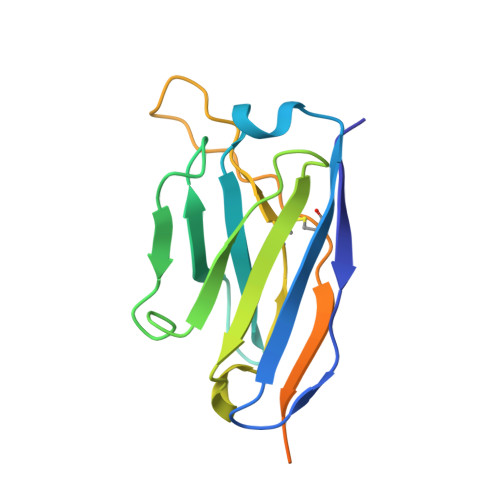
VHH21
D, E
151Camelus bactrianusMutation(s): 0 
Entity Groups  
Sequence Clusters30% Identity50% Identity70% Identity90% Identity95% Identity100% Identity
Sequence Annotations
Expand
  • Reference Sequence
Small Molecules
Ligands 1 Unique
IDChains Name / Formula / InChI Key2D Diagram3D Interactions
NAG
Query on NAG

Download Ideal Coordinates CCD File 
AA [auth B]
BA [auth B]
CA [auth B]
DA [auth B]
EA [auth B]
AA [auth B],
BA [auth B],
CA [auth B],
DA [auth B],
EA [auth B],
F [auth A],
FA [auth C],
G [auth A],
GA [auth C],
H [auth A],
HA [auth C],
I [auth A],
IA [auth C],
J [auth A],
JA [auth C],
K [auth A],
KA [auth C],
L [auth A],
LA [auth C],
M [auth A],
MA [auth C],
N [auth A],
NA [auth C],
O [auth A],
OA [auth C],
P [auth A],
PA [auth C],
Q [auth A],
QA [auth C],
R [auth A],
RA [auth C],
S [auth B],
SA [auth C],
T [auth B],
U [auth B],
V [auth B],
W [auth B],
X [auth B],
Y [auth B],
Z [auth B]
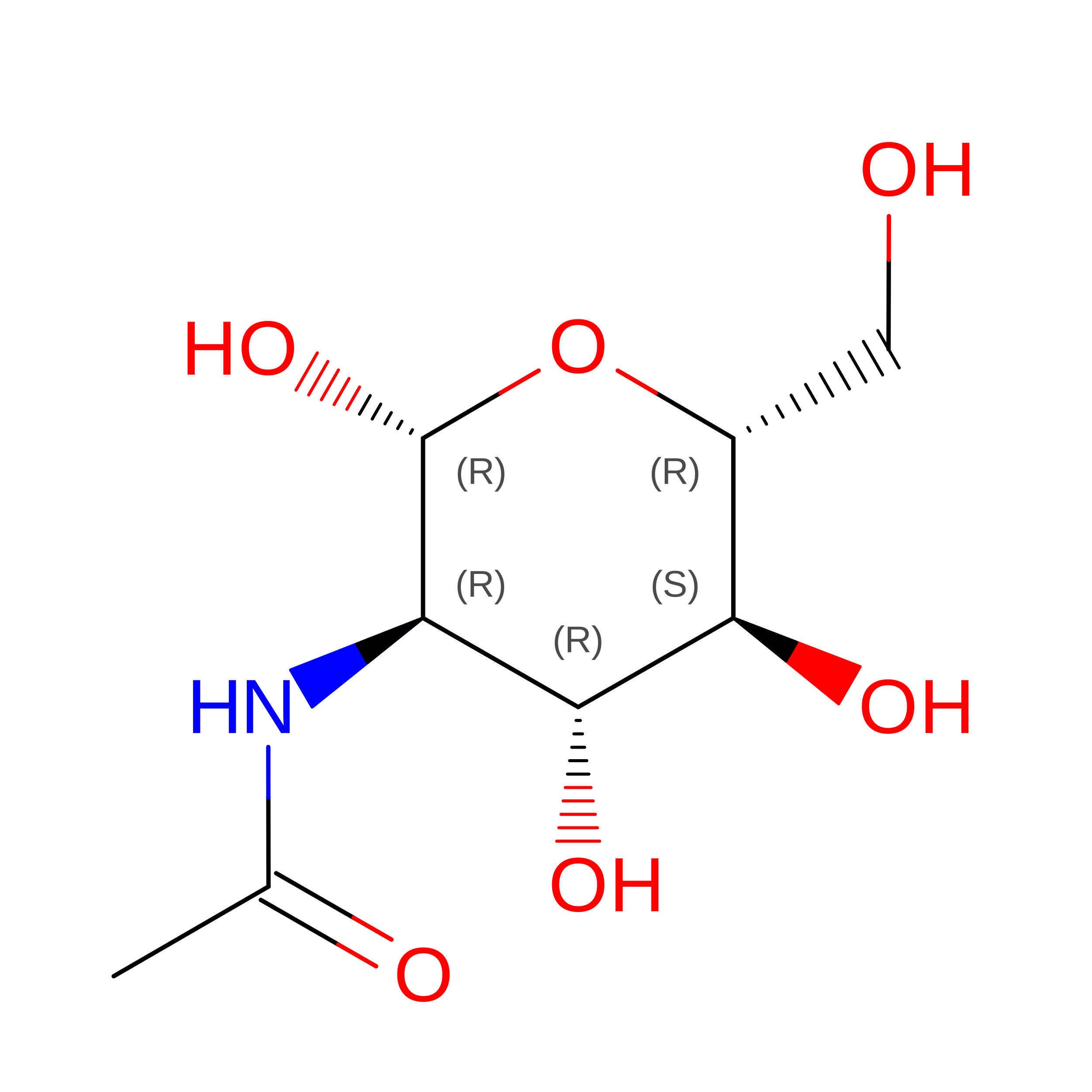
2-acetamido-2-deoxy-beta-D-glucopyranose
C8 H15 N O6
OVRNDRQMDRJTHS-FMDGEEDCSA-N
Experimental Data & Validation

Experimental Data

  • Method: ELECTRON MICROSCOPY
  • Resolution: 3.30 Å
  • Aggregation State: PARTICLE 
  • Reconstruction Method: SINGLE PARTICLE 
EM Software:
TaskSoftware PackageVersion
MODEL REFINEMENTPHENIX

Structure Validation

View Full Validation Report


Entry History & Funding Information

Deposition Data


Funding OrganizationLocationGrant Number
National Natural Science Foundation of China (NSFC)China31900871
National Natural Science Foundation of China (NSFC)China31570874

Revision History  (Full details and data files)

  • Version 1.0: 2023-09-13
    Type: Initial release
  • Version 1.1: 2024-11-06
    Changes: Data collection, Structure summary
  • Version 1.2: 2025-07-02
    Changes: Data collection
  • Version 1.3: 2025-09-03
    Changes: Data collection, Database references