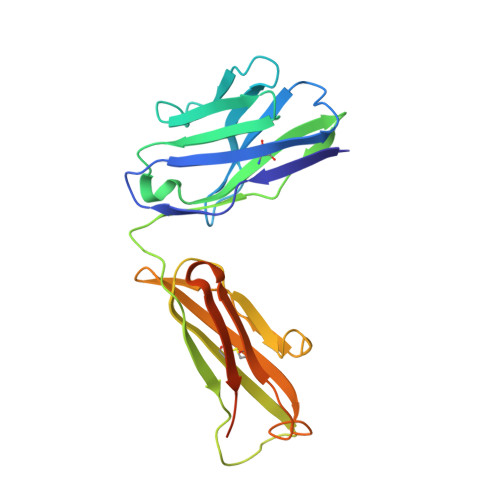
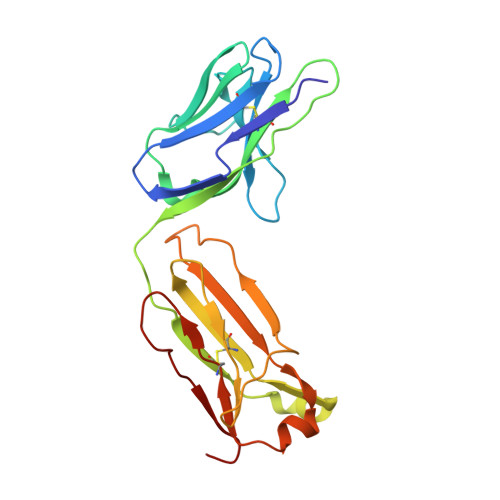
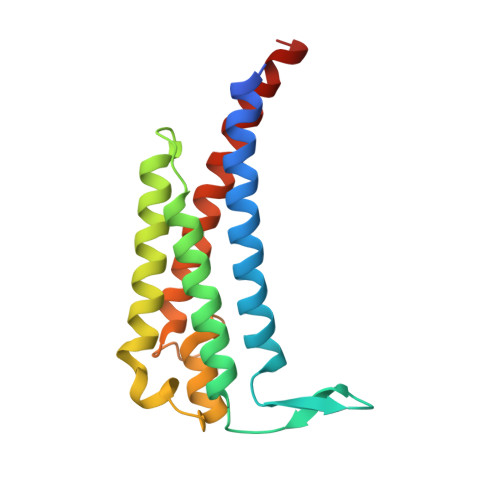
7UIJ | pdb_00007uij

Structural studies of B5-OspC complex


Experimental Data Snapshot

  • Method: X-RAY DIFFRACTION
  • Resolution: 2.70 Å
  • R-Value Free: 
    0.256 (Depositor), 0.261 (DCC) 
  • R-Value Work: 
    0.204 (Depositor), 0.208 (DCC) 
  • R-Value Observed: 
    0.206 (Depositor) 

Starting Models: experimental
View more details

wwPDB Validation 3D Report Full Report

Validation slider image for 7UIJ

This is version 1.3 of the entry. See complete history. 

Literature

Structural Elucidation of a Protective B Cell Epitope on Outer Surface Protein C (OspC) of the Lyme Disease Spirochete, Borreliella burgdorferi.

Rudolph, M.J., Davis, S.A., Haque, H.M.E., Weis, D.D., Vance, D.J., Piazza, C.L., Ejemel, M., Cavacini, L., Wang, Y., Mbow, M.L., Gilmore, R.D., Mantis, N.J.

(2023) mBio 14: e0298122-e0298122

  • DOI: https://doi.org/10.1128/mbio.02981-22
  • Primary Citation Related Structures: 
    7UIJ, 7UJ2, 7UJ6

  • PubMed Abstract: 

    Outer surface protein C (OspC) plays a pivotal role in mediating tick-to-host transmission and infectivity of the Lyme disease spirochete, Borreliella burgdorferi. OspC is a helical-rich homodimer that interacts with tick salivary proteins, as well as components of the mammalian immune system. Several decades ago, it was shown that the OspC-specific monoclonal antibody, B5, was able to passively protect mice from experimental tick-transmitted infection by B. burgdorferi strain B31. However, B5's epitope has never been elucidated, despite widespread interest in OspC as a possible Lyme disease vaccine antigen. Here, we report the crystal structure of B5 antigen-binding fragments (Fabs) in complex with recombinant OspC type A (OspC A ). Each OspC monomer within the homodimer was bound by a single B5 Fab in a side-on orientation, with contact points along OspC's α-helix 1 and α-helix 6, as well as interactions with the loop between α-helices 5 and 6. In addition, B5's complementarity-determining region (CDR) H3 bridged the OspC-OspC' homodimer interface, revealing the quaternary nature of the protective epitope. To provide insight into the molecular basis of B5 serotype specificity, we solved the crystal structures of recombinant OspC types B and K and compared them to OspC A . This study represents the first structure of a protective B cell epitope on OspC and will aid in the rational design of OspC-based vaccines and therapeutics for Lyme disease. IMPORTANCE The spirochete Borreliella burgdorferi is a causative agent of Lyme disease, the most common tickborne disease in the United States. The spirochete is transmitted to humans during the course of a tick taking a bloodmeal. After B. burgdorferi is deposited into the skin of a human host, it replicates locally and spreads systemically, often resulting in clinical manifestations involving the central nervous system, joints, and/or heart. Antibodies directed against B. burgdorferi's outer surface protein C (OspC) are known to block tick-to-host transmission, as well as dissemination of the spirochete within a mammalian host. In this report, we reveal the first atomic structure of one such antibody in complex with OspC. Our results have implications for the design of a Lyme disease vaccine capable of interfering with multiple stages in B. burgdorferi infection.


  • Organizational Affiliation: 
    • New York Structural Biology Center, New York, New York, USA.

Macromolecule Content 

  • Total Structure Weight: 132.86 kDa 
  • Atom Count: 8,861 
  • Modeled Residue Count: 1,160 
  • Deposited Residue Count: 1,228 
  • Unique protein chains: 3

Macromolecules

Find similar proteins by:|  3D Structure
Entity ID: 1
MoleculeChains  Sequence LengthOrganismDetailsImage
Monoclonal B5 Fab Heavy ChainA [auth H],
C [auth A]
236Mus musculusMutation(s): 0 
Entity Groups
Sequence Clusters30% Identity50% Identity70% Identity90% Identity95% Identity100% Identity
Sequence Annotations
Expand
Reference Sequence
Find similar proteins by:|  3D Structure
Entity ID: 2
MoleculeChains  Sequence LengthOrganismDetailsImage
Monoclonal B5 Fab Light ChainB [auth L],
D [auth B]
214Mus musculusMutation(s): 0 
Entity Groups
Sequence Clusters30% Identity50% Identity70% Identity90% Identity95% Identity100% Identity
Sequence Annotations
Expand
Reference Sequence
Find similar proteins by:|  3D Structure
Entity ID: 3
MoleculeChains  Sequence LengthOrganismDetailsImage
Outer surface protein CE [auth C],
F [auth D]
164Borreliella burgdorferi B31Mutation(s): 0 
Gene Names: ospC, BB_B19
UniProt
Find proteins for Q07337 (Borreliella burgdorferi (strain ATCC 35210 / DSM 4680 / CIP 102532 / B31))
Explore Q07337 
Go to UniProtKB:  Q07337
Entity Groups
Sequence Clusters30% Identity50% Identity70% Identity90% Identity95% Identity100% Identity
UniProt GroupQ07337
Sequence Annotations
Expand
Reference Sequence

Small Molecules

Ligands 1 Unique
IDChains Name / Formula / InChI Key2D Diagram3D Interactions
EDO

Query on EDO


Download:Ideal Coordinates CCD File
G [auth H]1,2-ETHANEDIOL
C2 H6 O2
LYCAIKOWRPUZTN-UHFFFAOYSA-N

Experimental Data & Validation

Experimental Data

  • Method: X-RAY DIFFRACTION
  • Resolution: 2.70 Å
  • R-Value Free:  0.256 (Depositor), 0.261 (DCC) 
  • R-Value Work:  0.204 (Depositor), 0.208 (DCC) 
  • R-Value Observed: 0.206 (Depositor) 
Space Group: P 2 21 21
Unit Cell:
Length ( Å )Angle ( ˚ )
a = 54.729α = 90
b = 139.858β = 90
c = 205.669γ = 90
Software Package:
Software NamePurpose
PHENIXrefinement
SCALEPACKdata scaling
PDB_EXTRACTdata extraction
HKL-2000data reduction
PHASERphasing

Structure Validation

View Full Validation Report


Entry History 

& Funding Information

Deposition Data


Funding OrganizationLocationGrant Number
National Institutes of Health/National Institute Of Allergy and Infectious Diseases (NIH/NIAID)United States75N9301900040

Revision History  (Full details and data files)

  • Version 1.0: 2023-04-05
    Type: Initial release
  • Version 1.1: 2023-10-18
    Changes: Data collection, Database references
  • Version 1.2: 2023-10-25
    Changes: Refinement description
  • Version 1.3: 2024-11-20
    Changes: Structure summary