7TAS | pdb_00007tas

SARS-CoV-2 spike in complex with the S2K146 neutralizing antibody Fab fragment (local refinement of the RBD and S2K146)


Experimental Data Snapshot

  • Method: ELECTRON MICROSCOPY
  • Resolution: 3.20 Å
  • Aggregation State: PARTICLE 
  • Reconstruction Method: SINGLE PARTICLE 

wwPDB Validation 3D Report Full Report

Validation slider image for 7TAS

This is version 1.3 of the entry. See complete history

Literature

Antibody-mediated broad sarbecovirus neutralization through ACE2 molecular mimicry.

Park, Y.J.De Marco, A.Starr, T.N.Liu, Z.Pinto, D.Walls, A.C.Zatta, F.Zepeda, S.K.Bowen, J.E.Sprouse, K.R.Joshi, A.Giurdanella, M.Guarino, B.Noack, J.Abdelnabi, R.Foo, S.C.Rosen, L.E.Lempp, F.A.Benigni, F.Snell, G.Neyts, J.Whelan, S.P.J.Virgin, H.W.Bloom, J.D.Corti, D.Pizzuto, M.S.Veesler, D.

(2022) Science 375: 449-454

  • DOI: https://doi.org/10.1126/science.abm8143
  • Primary Citation Related Structures: 
    7TAS, 7TAT

  • PubMed Abstract: 

    Understanding broadly neutralizing sarbecovirus antibody responses is key to developing countermeasures against SARS-CoV-2 variants and future zoonotic sarbecoviruses. We describe the isolation and characterization of a human monoclonal antibody, designated S2K146, that broadly neutralizes viruses belonging to SARS-CoV- and SARS-CoV-2-related sarbecovirus clades which use ACE2 as an entry receptor. Structural and functional studies show that most of the virus residues that directly bind S2K146 are also involved in binding to ACE2. This allows the antibody to potently inhibit receptor attachment. S2K146 protects against SARS-CoV-2 Beta challenge in hamsters and viral passaging experiments reveal a high barrier for emergence of escape mutants, making it a good candidate for clinical development. The conserved ACE2-binding residues present a site of vulnerability that might be leveraged for developing vaccines eliciting broad sarbecovirus immunity.


  • Organizational Affiliation
    • Department of Biochemistry, University of Washington, Seattle, WA 98195, USA.

Macromolecule Content 

  • Total Structure Weight: 167.66 kDa 
  • Atom Count: 3,147 
  • Modeled Residue Count: 417 
  • Deposited Residue Count: 1,519 
  • Unique protein chains: 3

Macromolecules

Find similar proteins by:|  3D Structure
Entity ID: 1
MoleculeChains  Sequence LengthOrganismDetailsImage
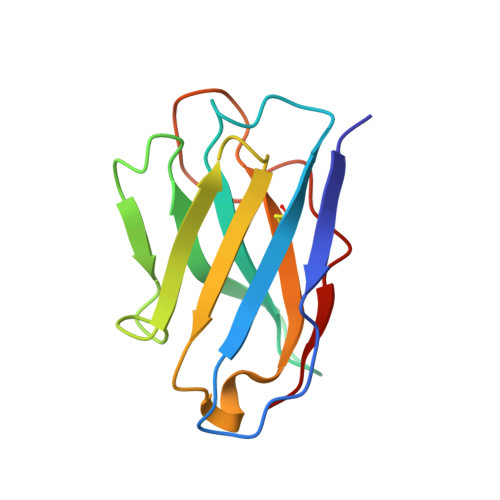
S2K146 Fab heavy chainA [auth H]122Homo sapiensMutation(s): 0 
Find similar proteins by:|  3D Structure
Entity ID: 2
MoleculeChains  Sequence LengthOrganismDetailsImage
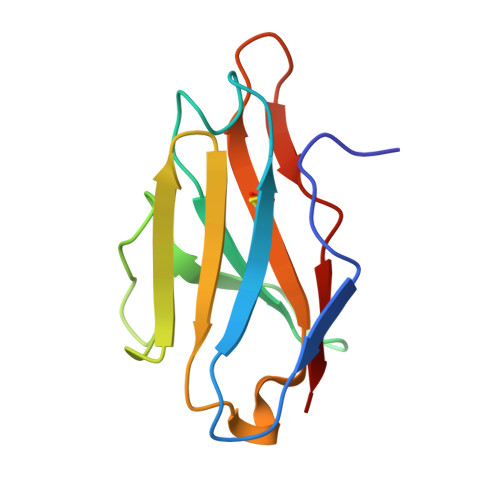
S2K146 Fab light chainB [auth L]109Homo sapiensMutation(s): 0 
Find similar proteins by:|  3D Structure
Entity ID: 3
MoleculeChains  Sequence LengthOrganismDetailsImage
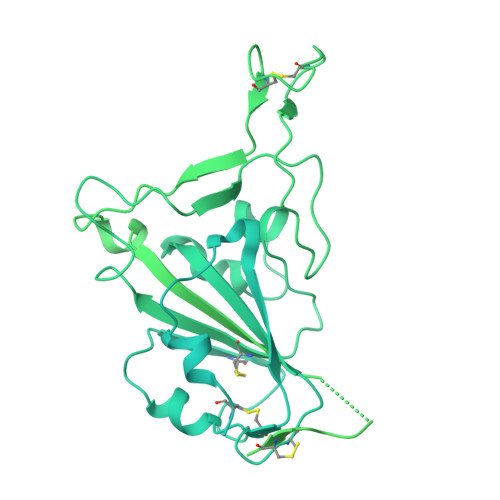
Spike glycoproteinC [auth E]1,288Severe acute respiratory syndrome coronavirus 2Mutation(s): 9 
Gene Names: S2
UniProt
Find proteins for P0DTC2 (Severe acute respiratory syndrome coronavirus 2)
Explore P0DTC2 
Go to UniProtKB:  P0DTC2
Entity Groups
Sequence Clusters30% Identity50% Identity70% Identity90% Identity95% Identity100% Identity
UniProt GroupP0DTC2
Glycosylation
Glycosylation Sites: 1Go to GlyGen: P0DTC2-1
Sequence Annotations
Expand
Reference Sequence

Oligosaccharides

Help  
Entity ID: 4
MoleculeChains Length2D Diagram GlycosylationD Interactions
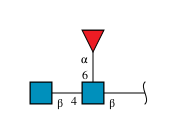
2-acetamido-2-deoxy-beta-D-glucopyranose-(1-4)-[alpha-L-fucopyranose-(1-6)]2-acetamido-2-deoxy-beta-D-glucopyranoseD [auth A]3N-Glycosylation
Glycosylation Resources
GlyTouCan: G21290RB
GlyCosmos: G21290RB
GlyGen: G21290RB

Experimental Data & Validation

Experimental Data

  • Method: ELECTRON MICROSCOPY
  • Resolution: 3.20 Å
  • Aggregation State: PARTICLE 
  • Reconstruction Method: SINGLE PARTICLE 
EM Software:
TaskSoftware PackageVersion
RECONSTRUCTIONcryoSPARC

Structure Validation

View Full Validation Report


Entry History 

& Funding Information

Deposition Data


Funding OrganizationLocationGrant Number
National Institutes of Health/National Institute of General Medical Sciences (NIH/NIGMS)United StatesR01GM120553

Revision History  (Full details and data files)

  • Version 1.0: 2022-01-12
    Type: Initial release
  • Version 1.1: 2022-01-19
    Changes: Database references
  • Version 1.2: 2022-02-09
    Changes: Database references
  • Version 1.3: 2024-10-09
    Changes: Data collection, Structure summary