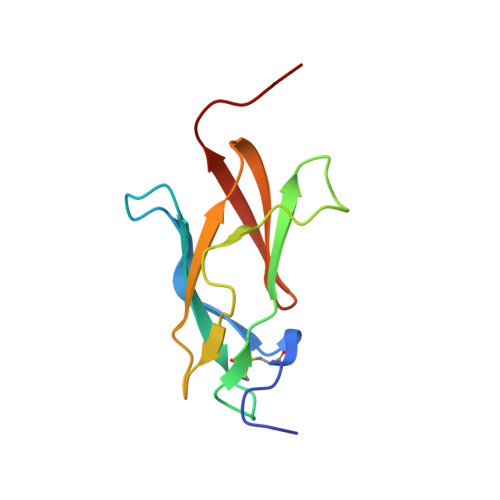
7SGT | pdb_00007sgt

Domain III (EDIII) of the POWV E glycoprotein

  • Classification: VIRAL PROTEIN
  • Organism(s): Tick-borne powassan virus (strain lb)
  • Expression System: Escherichia coli BL21(DE3)
  • Mutation(s): No 

  • Deposited: 2021-10-07 Released: 2022-05-18 
  • Deposition Author(s): Harris, R., Cahill, S.M., Cowburn, D.
  • Funding Organization(s): National Institutes of Health/National Institute Of Allergy and Infectious Diseases (NIH/NIAID), National Institutes of Health/Office of the Director, National Institutes of Health/National Cancer Institute (NIH/NCI), National Institutes of Health/National Institute of General Medical Sciences (NIH/NIGMS)

Experimental Data Snapshot

  • Method: SOLUTION NMR
  • Conformers Calculated: 100 
  • Conformers Submitted: 20 
  • Selection Criteria: structures with the lowest energy 

wwPDB Validation 3D Report Full Report

Validation slider image for 7SGT

This is version 1.2 of the entry. See complete history

Literature

A Powassan virus domain III nanoparticle immunogen elicits neutralizing and protective antibodies in mice.

Malonis, R.J.Georgiev, G.I.Haslwanter, D.VanBlargan, L.A.Fallon, G.Vergnolle, O.Cahill, S.M.Harris, R.Cowburn, D.Chandran, K.Diamond, M.S.Lai, J.R.

(2022) PLoS Pathog 18: e1010573-e1010573

  • DOI: https://doi.org/10.1371/journal.ppat.1010573
  • Primary Citation Related Structures: 
    7SGT

  • PubMed Abstract: 

    Powassan virus (POWV) is an emerging tick borne flavivirus (TBFV) that causes severe neuroinvasive disease. Currently, there are no approved treatments or vaccines to combat POWV infection. Here, we generated and characterized a nanoparticle immunogen displaying domain III (EDIII) of the POWV E glycoprotein. Immunization with POWV EDIII presented on nanoparticles resulted in significantly higher serum neutralizing titers against POWV than immunization with monomeric POWV EDIII. Furthermore, passive transfer of EDIII-reactive sera protected against POWV challenge in vivo. We isolated and characterized a panel of EDIII-specific monoclonal antibodies (mAbs) and identified several that potently inhibit POWV infection and engage distinct epitopes within the lateral ridge and C-C' loop of the EDIII. By creating a subunit-based nanoparticle immunogen with vaccine potential that elicits antibodies with protective activity against POWV infection, our findings enhance our understanding of the molecular determinants of antibody-mediated neutralization of TBFVs.


  • Organizational Affiliation
    • Department of Biochemistry, Albert Einstein College of Medicine, Bronx, New York, United States of America.

Macromolecule Content 

  • Total Structure Weight: 11.18 kDa 
  • Atom Count: 783 
  • Modeled Residue Count: 102 
  • Deposited Residue Count: 102 
  • Unique protein chains: 1

Macromolecules

Find similar proteins by:|  3D Structure
Entity ID: 1
MoleculeChains  Sequence LengthOrganismDetailsImage
Envelope protein E102Tick-borne powassan virus (strain lb)Mutation(s): 0 
UniProt
Find proteins for Q04538 (Tick-borne powassan virus (strain LB))
Explore Q04538 
Go to UniProtKB:  Q04538
Entity Groups
Sequence Clusters30% Identity50% Identity70% Identity90% Identity95% Identity100% Identity
UniProt GroupQ04538
Sequence Annotations
Expand
Reference Sequence

Experimental Data & Validation

Experimental Data

  • Method: SOLUTION NMR
  • Conformers Calculated: 100 
  • Conformers Submitted: 20 
  • Selection Criteria: structures with the lowest energy 

Structure Validation

View Full Validation Report


Entry History 

& Funding Information

Deposition Data


Funding OrganizationLocationGrant Number
National Institutes of Health/National Institute Of Allergy and Infectious Diseases (NIH/NIAID)United StatesR21 AI164047
National Institutes of Health/Office of the DirectorUnited StatesS10DO16305
National Institutes of Health/National Cancer Institute (NIH/NCI)United StatesP30CA01330
National Institutes of Health/National Institute of General Medical Sciences (NIH/NIGMS)United StatesP41GM1111135

Revision History  (Full details and data files)

  • Version 1.0: 2022-05-18
    Type: Initial release
  • Version 1.1: 2022-06-22
    Changes: Database references
  • Version 1.2: 2024-10-16
    Changes: Data collection, Database references, Structure summary