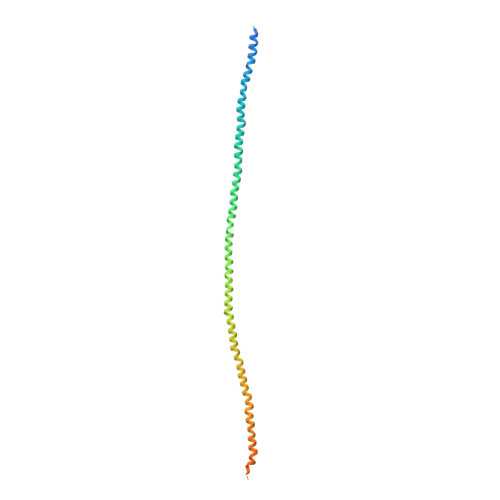
7S5U | pdb_00007s5u

Extended bipolar assembly domain of kinesin-5 minifilament


Experimental Data Snapshot

  • Method: X-RAY DIFFRACTION
  • Resolution: 4.41 Å
  • R-Value Free: 
    0.310 (Depositor), 0.313 (DCC) 
  • R-Value Work: 
    0.274 (Depositor), 0.279 (DCC) 
  • R-Value Observed: 
    0.277 (Depositor) 

Starting Model: experimental
View more details

wwPDB Validation 3D Report Full Report

Validation slider image for 7S5U

This is version 1.2 of the entry. See complete history. 

Literature

The kinesin-5 tail and bipolar miniflament domains are the origin of its microtubule crosslinking and sliding activity.

Nithianantham, S., Iwanski, M.K., Gaska, I., Pandey, H., Bodrug, T., Inagaki, S., Major, J., Brouhard, G.J., Gheber, L., Rosenfeld, S.S., Forth, S., Hendricks, A.G., Al-Bassam, J.

(2023) Mol Biol Cell : mbcE23070287-mbcE23070287

  • DOI: https://doi.org/10.1091/mbc.E23-07-0287
  • Primary Citation Related Structures: 
    7S5U

  • PubMed Abstract: 

    Kinesin-5 crosslinks and slides apart microtubules to assemble, elongate, and maintain the mitotic spindle. Kinesin-5 is a tetramer, where two N-terminal motor domains are positioned at each end of the motor, and the coiled-coil stalk domains are organized into a tetrameric bundle through the bipolar assembly (BASS) domain. To dissect the function of the individual structural elements of the motor, we constructed a minimal kinesin-5 tetramer (mini-tetramer). We determined the x-ray structure of the extended, 34-nm BASS domain. Guided by these structural studies, we generated active bipolar kinesin-5 mini-tetramer motors from Drosophila melanogastor and human orthologues which are half the length of native kinesin-5. We then used these kinesin-5 mini-tetramers to examine the role of two unique structural adaptations of kinesin-5: 1) the length and flexibility of the tetramer, and 2) the C-terminal tails which interact with the motor domains to coordinate their ATPase activity. The C-terminal domain causes frequent pausing and clustering of kinesin-5. By comparing microtubule crosslinking and sliding by mini-tetramer and full-length kinesin-5, we find that both the length and flexibility of kinesin-5 and the C-terminal tails govern its ability to crosslink microtubules. Once crosslinked, stiffer mini-tetramers slide antiparallel microtubules more efficiently than full-length motors.


  • Organizational Affiliation: 
    • Department of Molecular and Cellular Biology, University of California, Davis, CA 95616.

Macromolecule Content 

  • Total Structure Weight: 113.73 kDa 
  • Atom Count: 5,023 
  • Modeled Residue Count: 702 
  • Deposited Residue Count: 992 
  • Unique protein chains: 1

Macromolecules

Find similar proteins by:|  3D Structure
Entity ID: 1
MoleculeChains  Sequence LengthOrganismDetailsImage
Kinesin-like protein Klp61FA,
B,
C [auth D],
D [auth C]
248Drosophila melanogasterMutation(s): 0 
Gene Names: Klp61F, KLP2, CG9191
UniProt
Find proteins for P46863 (Drosophila melanogaster)
Explore P46863 
Go to UniProtKB:  P46863
Entity Groups
Sequence Clusters30% Identity50% Identity70% Identity90% Identity95% Identity100% Identity
UniProt GroupP46863
Sequence Annotations
Expand
Reference Sequence

Experimental Data & Validation

Experimental Data

  • Method: X-RAY DIFFRACTION
  • Resolution: 4.41 Å
  • R-Value Free:  0.310 (Depositor), 0.313 (DCC) 
  • R-Value Work:  0.274 (Depositor), 0.279 (DCC) 
  • R-Value Observed: 0.277 (Depositor) 
Space Group: C 1 2 1
Unit Cell:
Length ( Å )Angle ( ˚ )
a = 253.18α = 90
b = 84.89β = 91.44
c = 96.77γ = 90
Software Package:
Software NamePurpose
SCALAdata scaling
PHENIXrefinement
PDB_EXTRACTdata extraction
XDSdata reduction
PHASERphasing

Structure Validation

View Full Validation Report


Entry History 

& Funding Information

Deposition Data


Funding OrganizationLocationGrant Number
National Institutes of Health/National Institute of General Medical Sciences (NIH/NIGMS)United StatesGM110283
National Science Foundation (NSF, United States)United States1615991

Revision History  (Full details and data files)

  • Version 1.0: 2023-03-15
    Type: Initial release
  • Version 1.1: 2023-09-06
    Changes: Data collection, Database references, Refinement description
  • Version 1.2: 2023-10-25
    Changes: Refinement description