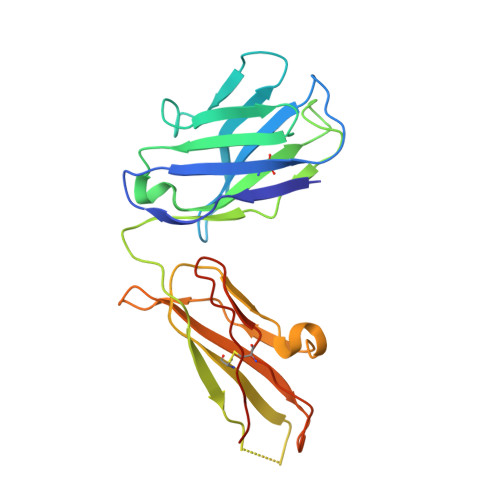
7RQP | pdb_00007rqp

Structure of PfCSP NPNV binding antibody L9


Experimental Data Snapshot

  • Method: X-RAY DIFFRACTION
  • Resolution: 2.98 Å
  • R-Value Free: 
    0.250 (Depositor), 0.249 (DCC) 
  • R-Value Work: 
    0.199 (Depositor), 0.203 (DCC) 
  • R-Value Observed: 
    0.204 (Depositor) 

Starting Model: experimental
View more details

wwPDB Validation 3D Report Full Report

Validation slider image for 7RQP

This is version 1.2 of the entry. See complete history

Literature

The light chain of the L9 antibody is critical for binding circumsporozoite protein minor repeats and preventing malaria.

Wang, L.T.Hurlburt, N.K.Schon, A.Flynn, B.J.Flores-Garcia, Y.Pereira, L.S.Kiyuka, P.K.Dillon, M.Bonilla, B.Zavala, F.Idris, A.H.Francica, J.R.Pancera, M.Seder, R.A.

(2022) Cell Rep 38: 110367-110367

  • DOI: https://doi.org/10.1016/j.celrep.2022.110367
  • Primary Citation Related Structures: 
    7RQP, 7RQQ, 7RQR

  • PubMed Abstract: 

    L9 is a potent human monoclonal antibody (mAb) that preferentially binds two adjacent NVDP minor repeats and cross-reacts with NANP major repeats of the Plasmodium falciparum circumsporozoite protein (PfCSP) on malaria-infective sporozoites. Understanding this mAb's ontogeny and mechanisms of binding PfCSP will facilitate vaccine development. Here, we isolate mAbs clonally related to L9 and show that this B cell lineage has baseline NVDP affinity and evolves to acquire NANP reactivity. Pairing the L9 kappa light chain (L9κ) with clonally related heavy chains results in chimeric mAbs that cross-link two NVDPs, cross-react with NANP, and more potently neutralize sporozoites in vivo compared with their original light chain. Structural analyses reveal that the chimeric mAbs bound minor repeats in a type-1 β-turn seen in other repeat-specific antibodies. These data highlight the importance of L9κ in binding NVDP on PfCSP to neutralize sporozoites and suggest that PfCSP-based immunogens might be improved by presenting ≥2 NVDPs.


  • Organizational Affiliation
    • Vaccine Research Center, National Institute of Allergy and Infectious Diseases, National Institutes of Health, Bethesda, MD 20892, USA.

Macromolecule Content 

  • Total Structure Weight: 48.07 kDa 
  • Atom Count: 3,232 
  • Modeled Residue Count: 425 
  • Deposited Residue Count: 441 
  • Unique protein chains: 2

Macromolecules

Find similar proteins by:|  3D Structure
Entity ID: 1
MoleculeChains  Sequence LengthOrganismDetailsImage
L9 Heavy Chain227Homo sapiensMutation(s): 0 
Find similar proteins by:|  3D Structure
Entity ID: 2
MoleculeChains  Sequence LengthOrganismDetailsImage
L9 Kappa Chain214Homo sapiensMutation(s): 0 

Experimental Data & Validation

Experimental Data

  • Method: X-RAY DIFFRACTION
  • Resolution: 2.98 Å
  • R-Value Free:  0.250 (Depositor), 0.249 (DCC) 
  • R-Value Work:  0.199 (Depositor), 0.203 (DCC) 
  • R-Value Observed: 0.204 (Depositor) 
Space Group: I 2 2 2
Unit Cell:
Length ( Å )Angle ( ˚ )
a = 67.964α = 90
b = 117.67β = 90
c = 143.665γ = 90
Software Package:
Software NamePurpose
PHENIXrefinement
Aimlessdata scaling
PDB_EXTRACTdata extraction
XDSdata reduction
PHENIXphasing

Structure Validation

View Full Validation Report


Entry History 

& Funding Information

Deposition Data


Funding OrganizationLocationGrant Number
Bill & Melinda Gates FoundationUnited States--

Revision History  (Full details and data files)

  • Version 1.0: 2022-03-02
    Type: Initial release
  • Version 1.1: 2023-10-18
    Changes: Data collection, Refinement description
  • Version 1.2: 2024-11-13
    Changes: Structure summary