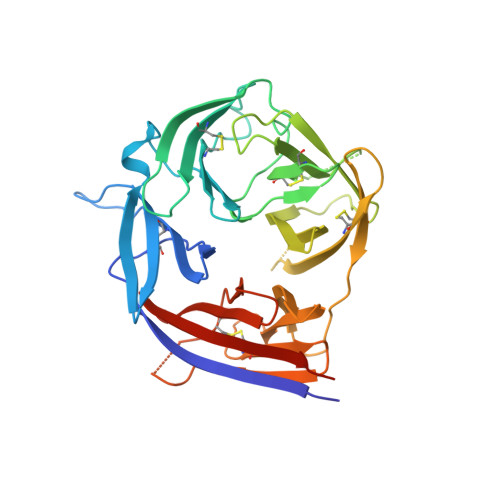
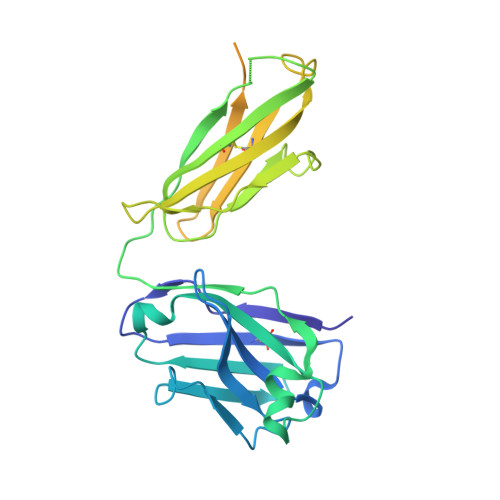
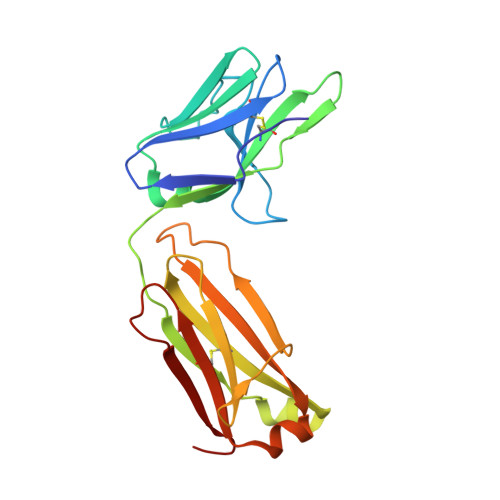
7PHW | pdb_00007phw

PfCyRPA bound to monoclonal antibody Cy.004 Fab fragment


Experimental Data Snapshot

  • Method: X-RAY DIFFRACTION
  • Resolution: 2.79 Å
  • R-Value Free: 
    0.277 (Depositor), 0.266 (DCC) 
  • R-Value Work: 
    0.239 (Depositor), 0.225 (DCC) 
  • R-Value Observed: 
    0.241 (Depositor) 

Starting Model: experimental
View more details

wwPDB Validation 3D Report Full Report

Validation slider image for 7PHW

This is version 1.3 of the entry. See complete history

Literature

Heterotypic interactions drive antibody synergy against a malaria vaccine candidate.

Ragotte, R.J.Pulido, D.Lias, A.M.Quinkert, D.Alanine, D.G.W.Jamwal, A.Davies, H.Nacer, A.Lowe, E.D.Grime, G.W.Illingworth, J.J.Donat, R.F.Garman, E.F.Bowyer, P.W.Higgins, M.K.Draper, S.J.

(2022) Nat Commun 13: 933-933

  • DOI: https://doi.org/10.1038/s41467-022-28601-4
  • Primary Citation Related Structures: 
    7PHU, 7PHV, 7PHW, 7PI2, 7PI3, 7PI7

  • PubMed Abstract: 

    Understanding mechanisms of antibody synergy is important for vaccine design and antibody cocktail development. Examples of synergy between antibodies are well-documented, but the mechanisms underlying these relationships often remain poorly understood. The leading blood-stage malaria vaccine candidate, CyRPA, is essential for invasion of Plasmodium falciparum into human erythrocytes. Here we present a panel of anti-CyRPA monoclonal antibodies that strongly inhibit parasite growth in in vitro assays. Structural studies show that growth-inhibitory antibodies bind epitopes on a single face of CyRPA. We also show that pairs of non-competing inhibitory antibodies have strongly synergistic growth-inhibitory activity. These antibodies bind to neighbouring epitopes on CyRPA and form lateral, heterotypic interactions which slow antibody dissociation. We predict that such heterotypic interactions will be a feature of many immune responses. Immunogens which elicit such synergistic antibody mixtures could increase the potency of vaccine-elicited responses to provide robust and long-lived immunity against challenging disease targets.


  • Organizational Affiliation
    • Department of Biochemistry, University of Oxford, Oxford, UK.

Macromolecule Content 

  • Total Structure Weight: 193.77 kDa 
  • Atom Count: 11,683 
  • Modeled Residue Count: 1,494 
  • Deposited Residue Count: 1,746 
  • Unique protein chains: 3

Macromolecules

Find similar proteins by:|  3D Structure
Entity ID: 1
MoleculeChains  Sequence LengthOrganismDetailsImage
Cysteine-rich protective antigen
A, D
343Plasmodium falciparum 3D7Mutation(s): 0 
Gene Names: CyRPApfd1130wPF3D7_0423800
UniProt
Find proteins for Q8IFM8 (Plasmodium falciparum (isolate 3D7))
Explore Q8IFM8 
Go to UniProtKB:  Q8IFM8
Entity Groups
Sequence Clusters30% Identity50% Identity70% Identity90% Identity95% Identity100% Identity
UniProt GroupQ8IFM8
Sequence Annotations
Expand
Reference Sequence
Find similar proteins by:|  3D Structure
Entity ID: 2
MoleculeChains  Sequence LengthOrganismDetailsImage
Monoclonal antibody Cy.004 heavy chain
B, E
321Gallus gallusMutation(s): 0 
Find similar proteins by:|  3D Structure
Entity ID: 3
MoleculeChains  Sequence LengthOrganismDetailsImage
Monoclonal antibody Cy.004 light chain
C, F
209Gallus gallusMutation(s): 0 

Experimental Data & Validation

Experimental Data

  • Method: X-RAY DIFFRACTION
  • Resolution: 2.79 Å
  • R-Value Free:  0.277 (Depositor), 0.266 (DCC) 
  • R-Value Work:  0.239 (Depositor), 0.225 (DCC) 
  • R-Value Observed: 0.241 (Depositor) 
Space Group: P 1 21 1
Unit Cell:
Length ( Å )Angle ( ˚ )
a = 103.057α = 90
b = 80.316β = 115.23
c = 114.91γ = 90
Software Package:
Software NamePurpose
BUSTERrefinement
PDB_EXTRACTdata extraction
XDSdata reduction
XDSdata scaling
PHASERphasing

Structure Validation

View Full Validation Report


Entry History 

& Funding Information

Deposition Data


Funding OrganizationLocationGrant Number
Wellcome TrustUnited Kingdom--

Revision History  (Full details and data files)

  • Version 1.0: 2022-02-09
    Type: Initial release
  • Version 1.1: 2022-08-24
    Changes: Database references
  • Version 1.2: 2024-01-31
    Changes: Data collection, Refinement description
  • Version 1.3: 2024-11-20
    Changes: Structure summary