7P3Z | pdb_00007p3z

Homology model of the full-length AP-3 complex in a stretched open conformation


Experimental Data Snapshot

  • Method: ELECTRON MICROSCOPY
  • Resolution: 10.5 Å
  • Aggregation State: PARTICLE 
  • Reconstruction Method: SINGLE PARTICLE 

wwPDB Validation 3D Report Full Report

Validation slider image for 7P3Z

This is version 1.4 of the entry. See complete history. 

Literature

Flexible open conformation of the AP-3 complex explains its role in cargo recruitment at the Golgi.

Schoppe, J., Schubert, E., Apelbaum, A., Yavavli, E., Birkholz, O., Stephanowitz, H., Han, Y., Perz, A., Hofnagel, O., Liu, F., Piehler, J., Raunser, S., Ungermann, C.

(2021) J Biol Chem 297: 101334-101334

  • DOI: https://doi.org/10.1016/j.jbc.2021.101334
  • Primary Citation Related Structures: 
    7P3X, 7P3Y, 7P3Z

  • PubMed Abstract: 

    Vesicle formation at endomembranes requires the selective concentration of cargo by coat proteins. Conserved adapter protein complexes at the Golgi (AP-3), the endosome (AP-1), or the plasma membrane (AP-2) with their conserved core domain and flexible ear domains mediate this function. These complexes also rely on the small GTPase Arf1 and/or specific phosphoinositides for membrane binding. The structural details that influence these processes, however, are still poorly understood. Here we present cryo-EM structures of the full-length stable 300 kDa yeast AP-3 complex. The structures reveal that AP-3 adopts an open conformation in solution, comparable to the membrane-bound conformations of AP-1 or AP-2. This open conformation appears to be far more flexible than AP-1 or AP-2, resulting in compact, intermediate, and stretched subconformations. Mass spectrometrical analysis of the cross-linked AP-3 complex further indicates that the ear domains are flexibly attached to the surface of the complex. Using biochemical reconstitution assays, we also show that efficient AP-3 recruitment to the membrane depends primarily on cargo binding. Once bound to cargo, AP-3 clustered and immobilized cargo molecules, as revealed by single-molecule imaging on polymer-supported membranes. We conclude that its flexible open state may enable AP-3 to bind and collect cargo at the Golgi and could thus allow coordinated vesicle formation at the trans-Golgi upon Arf1 activation.


  • Organizational Affiliation: 
    • Department of Biology/Chemistry, Biochemistry Section, Osnabrück University, Osnabrück, Germany.

Macromolecule Content 

  • Total Structure Weight: 279.47 kDa 
  • Atom Count: 14,041 
  • Modeled Residue Count: 1,756 
  • Deposited Residue Count: 2,450 
  • Unique protein chains: 4

Macromolecules

Find similar proteins by:|  3D Structure
Entity ID: 1
MoleculeChains  Sequence LengthOrganismDetailsImage
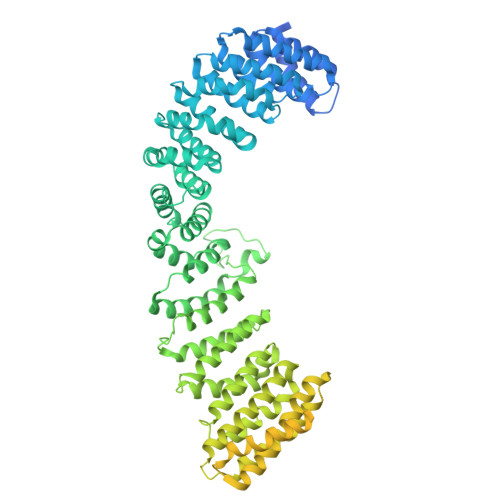
AP-3 complex subunit delta964Saccharomyces cerevisiaeMutation(s): 0 
Gene Names: PACBIOSEQ_LOCUS5975
UniProt
Find proteins for Q08951 (Saccharomyces cerevisiae (strain ATCC 204508 / S288c))
Explore Q08951 
Go to UniProtKB:  Q08951
Entity Groups
Sequence Clusters30% Identity50% Identity70% Identity90% Identity95% Identity100% Identity
UniProt GroupQ08951
Sequence Annotations
Expand
Reference Sequence
Find similar proteins by:|  3D Structure
Entity ID: 2
MoleculeChains  Sequence LengthOrganismDetailsImage
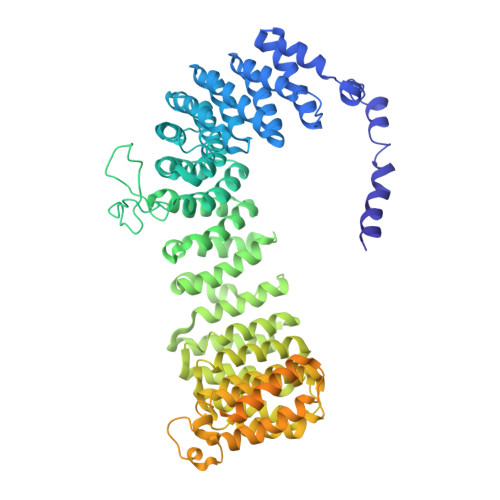
Y55_G0035830.mRNA.1.CDS.1809Saccharomyces cerevisiaeMutation(s): 0 
Gene Names: PACBIOSEQ_LOCUS2762
UniProt
Find proteins for P46682 (Saccharomyces cerevisiae (strain ATCC 204508 / S288c))
Explore P46682 
Go to UniProtKB:  P46682
Entity Groups
Sequence Clusters30% Identity50% Identity70% Identity90% Identity95% Identity100% Identity
UniProt GroupP46682
Sequence Annotations
Expand
Reference Sequence
Find similar proteins by:|  3D Structure
Entity ID: 3
MoleculeChains  Sequence LengthOrganismDetailsImage
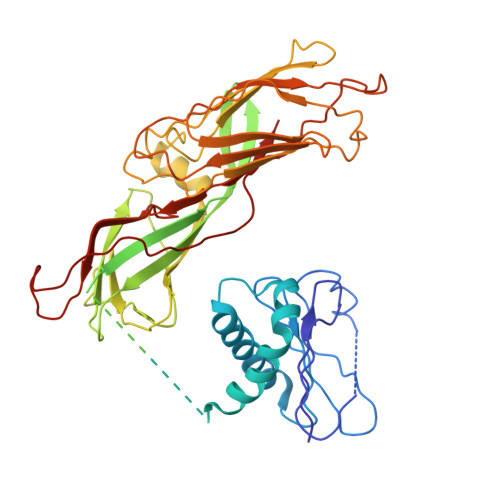
AP-3 complex subunit muC [auth M]483Saccharomyces cerevisiaeMutation(s): 0 
UniProt
Find proteins for P38153 (Saccharomyces cerevisiae (strain ATCC 204508 / S288c))
Explore P38153 
Go to UniProtKB:  P38153
Entity Groups
Sequence Clusters30% Identity50% Identity70% Identity90% Identity95% Identity100% Identity
UniProt GroupP38153
Sequence Annotations
Expand
Reference Sequence
Find similar proteins by:|  3D Structure
Entity ID: 4
MoleculeChains  Sequence LengthOrganismDetailsImage
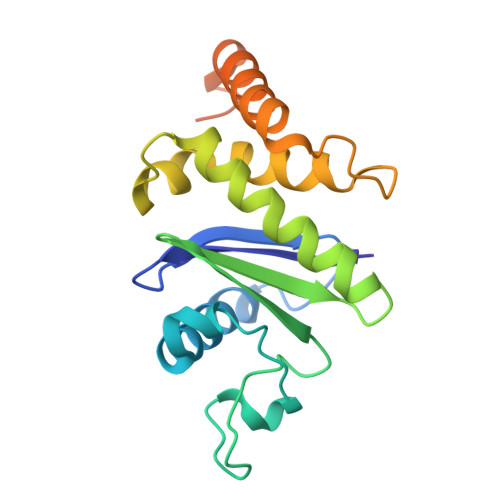
AP complex subunit sigmaD [auth S]194Saccharomyces cerevisiaeMutation(s): 0 
Gene Names: PACBIOSEQ_LOCUS3239, PACBIOSEQ_LOCUS3310, SCNYR20_0009016500, SCP684_0009016000
UniProt
Find proteins for P47064 (Saccharomyces cerevisiae (strain ATCC 204508 / S288c))
Explore P47064 
Go to UniProtKB:  P47064
Entity Groups
Sequence Clusters30% Identity50% Identity70% Identity90% Identity95% Identity100% Identity
UniProt GroupP47064
Sequence Annotations
Expand
Reference Sequence

Experimental Data & Validation

Experimental Data

  • Method: ELECTRON MICROSCOPY
  • Resolution: 10.5 Å
  • Aggregation State: PARTICLE 
  • Reconstruction Method: SINGLE PARTICLE 
EM Software:
TaskSoftware PackageVersion
RECONSTRUCTIONSPHIRE1.3

Structure Validation

View Full Validation Report


Entry History 

& Funding Information

Deposition Data


Funding OrganizationLocationGrant Number
German Research Foundation (DFG)GermanyRA1781/2-4

Revision History  (Full details and data files)

  • Version 1.0: 2021-09-29
    Type: Initial release
  • Version 1.1: 2021-10-13
    Changes: Data collection, Database references
  • Version 1.2: 2021-11-17
    Changes: Data collection, Database references
  • Version 1.3: 2021-12-08
    Changes: Database references
  • Version 1.4: 2024-11-20
    Changes: Data collection, Structure summary