Download Mendeley
Network-based allosteric analysis of galectin-7: Key residues dictate functional communication and stability.
Pham, N.T.H., Pare, A., Letourneau, M., Fortier, M., Chatenet, D., St-Pierre, Y., Lague, P., Calmettes, C., Doucet, N.(2026) Protein Sci 35: e70502-e70502
- PubMed: 41700699 Search on PubMedSearch on PubMed Central
- DOI: https://doi.org/10.1002/pro.70502
- Primary Citation Related Structures:
7N4O, 7N57, 7N6C, 7N8D, 7N8G, 7N96, 7RDG - PubMed Abstract:
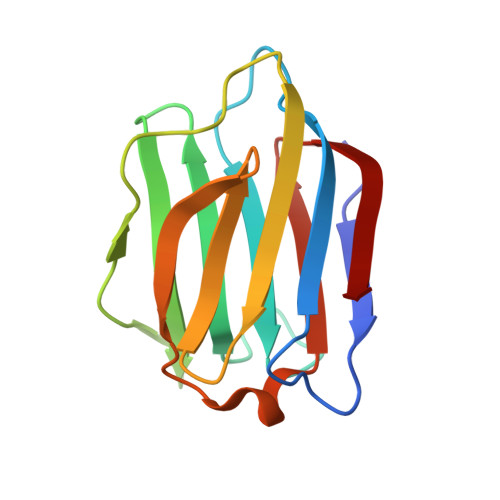
Allosteric modulation enables precise control of protein activity but remains difficult to harness for selective inhibitor design. Traditional high-throughput screening for allosteric modulators is still costly and time-consuming, underscoring the need for predictive computational approaches. Here, we combined network and shortest-path analyses to predict interprotomer communication nodes that regulate the pro-apoptotic activity of human galectin-7 (GAL-7). We identify a minimal electrostatic network (R20-R22-D103) as a key allosteric node controlling dimer stability and signal transmission between the two distant glycan binding sites. Our predictions guided the engineering of four variants (R20A, R22A, D103A, and R20A-R22A), all of which impaired GAL-7-induced apoptosis in human T cells. Biophysical and structural analyses confirmed that disrupting the R20-D103 interaction weakens interprotomer communication and destabilizes the dimer, while compensatory edges partially restore connectivity. These results demonstrate that residue-network fingerprinting enables predictive mapping of global communication pathways and reveal R20, R22, and D103 as key allosteric determinants of GAL-7 function. The integrative framework introduced here can be extended to identify and exploit allosteric communication pathways in other homodimeric proteins, offering a generalizable strategy for rational modulator design.
- Centre Armand-Frappier Santé Biotechnologie, Institut National de la Recherche Scientifique (INRS), Université du Québec, Laval, Québec, Canada.
Organizational Affiliation: