Download Mendeley
An evolution-inspired strategy to design disulfide-rich peptides tolerant to extensive sequence manipulation.
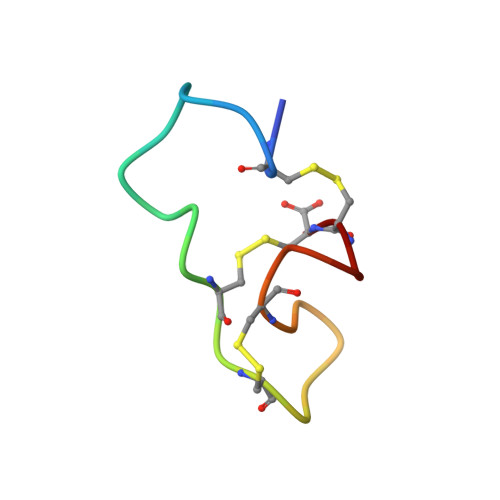
Zha, J., Li, J., Fan, S., Duan, Z., Zhao, Y., Wu, C.(2021) Chem Sci 12: 11464-11472
- PubMed: 34567500 Search on PubMedSearch on PubMed Central
- DOI: https://doi.org/10.1039/d1sc02952e
- Primary Citation Related Structures:
7ELY - PubMed Abstract:
Natural disulfide-rich peptides (DRPs) are valuable scaffolds for the development of new bioactive molecules and therapeutics. However, there are only a limited number of topologically distinct DRP folds in nature, and most of them suffer from the problem of in vitro oxidative folding. Thus, strategies to design DRPs with new constrained topologies beyond the scope of natural folds are desired. Herein we report a general evolution-inspired strategy to design new DRPs with diverse disulfide frameworks, which relies on the incorporation of two cysteine residues and a random peptide sequence into a precursor disulfide-stabilized fold. These peptides can spontaneously fold in redox buffers to the expected tricyclic topologies with high yields. Moreover, we demonstrated that these DRPs can be used as templates for the construction of phage-displayed peptide libraries, enabling the discovery of new DRP ligands from fully randomized sequences. This study thus paves the way for the development of new DRP ligands and therapeutics with structures not derived from natural DRPs.
- Department of Chemistry, College of Chemistry and Chemical Engineering, The MOE Key Laboratory of Spectrochemical Analysis and Instrumentation, State Key Laboratory of Physical Chemistry of Solid Surfaces, Xiamen University Xiamen 361005 P.R. China chlwu@xmu.edu.cn.
Organizational Affiliation: