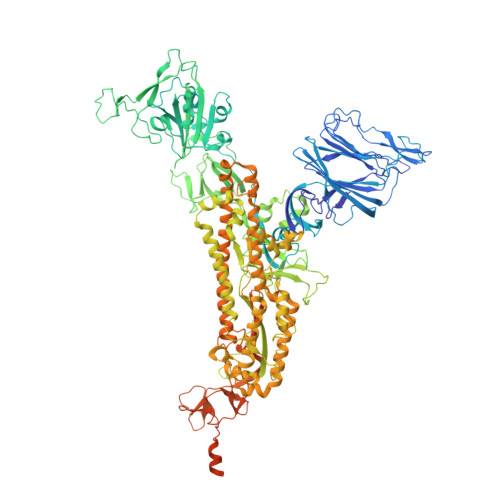
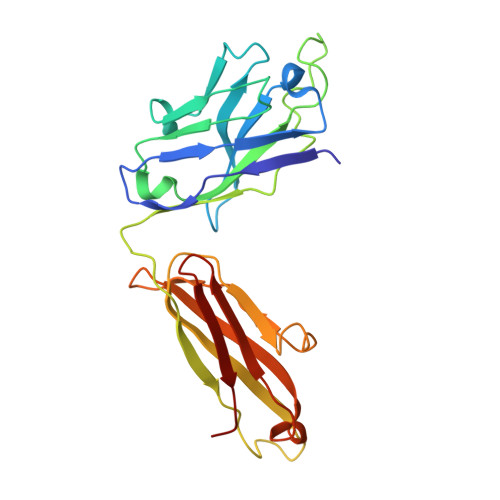
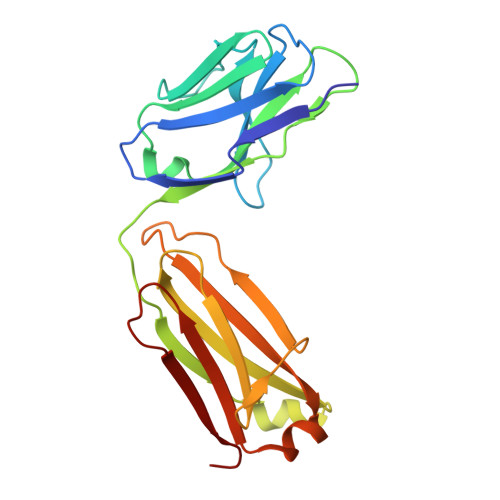
Find PDB structures and Computed Structure Models (CSM) by combining queries from tools in this suite: Attribute Search, Sequence Similarity, Sequence Motif, 3D Similarity, and 3D Motif with 'AND' logic.
Funding Organization(s): Japan Agency for Medical Research and Development (AMED), Ministry of Education, Culture, Sports, Science and Technology (Japan), Japan Society for the Promotion of Science (JSPS)
Primary Citation Related Structures: 7DZW, 7DZX, 7DZY
PubMed Abstract:
Antibodies against the receptor-binding domain (RBD) of the SARS-CoV-2 spike protein prevent SARS-CoV-2 infection. However, the effects of antibodies against other spike protein domains are largely unknown. Here, we screened a series of anti-spike monoclonal antibodies from coronavirus disease 2019 (COVID-19) patients and found that some of antibodies against the N-terminal domain (NTD) induced the open conformation of RBD and thus enhanced the binding capacity of the spike protein to ACE2 and infectivity of SARS-CoV-2. Mutational analysis revealed that all of the infectivity-enhancing antibodies recognized a specific site on the NTD. Structural analysis demonstrated that all infectivity-enhancing antibodies bound to NTD in a similar manner. The antibodies against this infectivity-enhancing site were detected at high levels in severe patients. Moreover, we identified antibodies against the infectivity-enhancing site in uninfected donors, albeit at a lower frequency. These findings demonstrate that not only neutralizing antibodies but also enhancing antibodies are produced during SARS-CoV-2 infection.
Organizational Affiliation:
Department of Immunochemistry, Research Institute for Microbial Diseases, Osaka University, Osaka 565-0871, Japan; Laboratory of Immunochemistry, World Premier International Immunology Frontier Research Centre, Osaka University, Osaka 565-0871, Japan.
Laboratory of Immunochemistry, World Premier International Immunology Frontier Research Centre, Osaka University, Osaka 565-0871, Japan.
Laboratory for CryoEM Structural Biology, Institute for Protein Research, Osaka University, Osaka 565-0871, Japan.
Department of Viral Infections, Research Institute for Microbial Diseases, Osaka University, Osaka 565-0871, Japan.
Department of Genome Informatics, Research Institute for Microbial Diseases, Osaka University, Osaka 565-0871, Japan.
Department of Immunoparasitology, Research Institute for Microbial Diseases, Osaka University, Osaka 565-0871, Japan.
Institute for Advanced Co-Creation Studies, Research Institute for Microbial Diseases, Osaka University, Osaka 565-0871, Japan.
Department of Immunochemistry, Research Institute for Microbial Diseases, Osaka University, Osaka 565-0871, Japan.
Department Oncogene Research, Research Institute for Microbial Diseases, Osaka University, Osaka 565-0871, Japan.
Department Oncogene Research, Research Institute for Microbial Diseases, Osaka University, Osaka 565-0871, Japan; Laboratory for Supramolecular Crystallography, Institute for Protein Research, Osaka University, Osaka 565-0871, Japan.
Laboratory of Virus Control, Research Institute for Microbial Diseases, Osaka University, Osaka 565-0871, Japan.
Department of Dermatology, Graduate school of Medicine, Osaka University, Osaka 565-0871, Japan.
Department of Respiratory Medicine, Kobe City Medical Center General Hospital, Hyogo 650-0047, Japan.
Drug Discovery Research Center, HuLA immune, Inc., Osaka 565-0871, Japan.
Department of Rheumatology, Kobe City Medical Center General Hospital, Hyogo 650-0047, Japan.
Department of Clinical Research, Osaka Minami Medical Center, Kawachinagano, Osaka 586-8521, Japan.
Institute for Advanced Co-Creation Studies, Research Institute for Microbial Diseases, Osaka University, Osaka 565-0871, Japan; Center for Infectious Disease Education and Research, Osaka University, Osaka 565-0871, Japan.
Department of Immunoparasitology, Research Institute for Microbial Diseases, Osaka University, Osaka 565-0871, Japan; Center for Infectious Disease Education and Research, Osaka University, Osaka 565-0871, Japan.
Department of Health Development and Medicine, Graduate school of Medicine, Osaka University, Osaka 565-0871, Japan.
Laboratory of Virus Control, Research Institute for Microbial Diseases, Osaka University, Osaka 565-0871, Japan; Center for Infectious Disease Education and Research, Osaka University, Osaka 565-0871, Japan.
Laboratory for Supramolecular Crystallography, Institute for Protein Research, Osaka University, Osaka 565-0871, Japan.
Department Oncogene Research, Research Institute for Microbial Diseases, Osaka University, Osaka 565-0871, Japan; Center for Infectious Disease Education and Research, Osaka University, Osaka 565-0871, Japan.
Department of Genome Informatics, Research Institute for Microbial Diseases, Osaka University, Osaka 565-0871, Japan; Center for Infectious Disease Education and Research, Osaka University, Osaka 565-0871, Japan.
Department of Viral Infections, Research Institute for Microbial Diseases, Osaka University, Osaka 565-0871, Japan; Center for Infectious Disease Education and Research, Osaka University, Osaka 565-0871, Japan.
Department of Immunochemistry, Research Institute for Microbial Diseases, Osaka University, Osaka 565-0871, Japan; Laboratory of Immunochemistry, World Premier International Immunology Frontier Research Centre, Osaka University, Osaka 565-0871, Japan; Center for Infectious Disease Education and Research, Osaka University, Osaka 565-0871, Japan. Electronic address: arase@biken.osaka-u.ac.jp.

 Download Mendeley