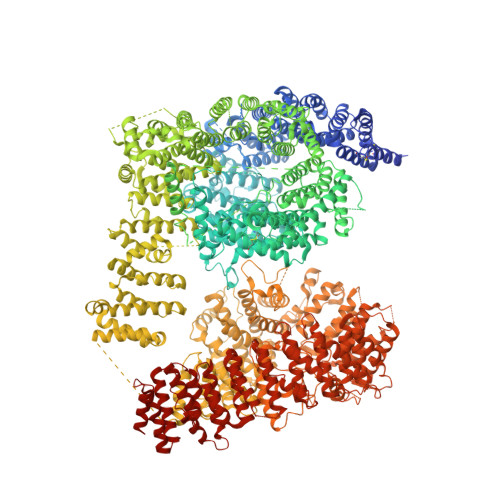
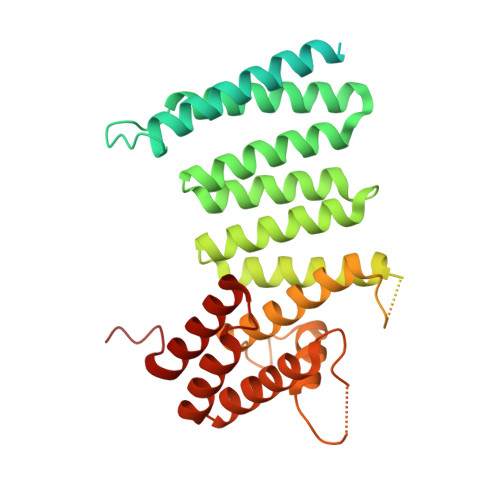
6X9O | pdb_00006x9o

High resolution cryoEM structure of huntingtin in complex with HAP40


Experimental Data Snapshot

  • Method: ELECTRON MICROSCOPY
  • Resolution: 2.60 Å
  • Aggregation State: PARTICLE 
  • Reconstruction Method: SINGLE PARTICLE 

wwPDB Validation 3D Report Full Report

Validation slider image for 6X9O

This is version 1.3 of the entry. See complete history

Literature

Huntingtin structure is orchestrated by HAP40 and shows a polyglutamine expansion-specific interaction with exon 1.

Harding, R.J.Deme, J.C.Hevler, J.F.Tamara, S.Lemak, A.Cantle, J.P.Szewczyk, M.M.Begeja, N.Goss, S.Zuo, X.Loppnau, P.Seitova, A.Hutchinson, A.Fan, L.Truant, R.Schapira, M.Carroll, J.B.Heck, A.J.R.Lea, S.M.Arrowsmith, C.H.

(2021) Commun Biol 4: 1374-1374

  • DOI: https://doi.org/10.1038/s42003-021-02895-4
  • Primary Citation Related Structures: 
    6X9O

  • PubMed Abstract: 

    Huntington's disease results from expansion of a glutamine-coding CAG tract in the huntingtin (HTT) gene, producing an aberrantly functioning form of HTT. Both wildtype and disease-state HTT form a hetero-dimer with HAP40 of unknown functional relevance. We demonstrate in vivo and in cell models that HTT and HAP40 cellular abundance are coupled. Integrating data from a 2.6 Å cryo-electron microscopy structure, cross-linking mass spectrometry, small-angle X-ray scattering, and modeling, we provide a near-atomic-level view of HTT, its molecular interaction surfaces and compacted domain architecture, orchestrated by HAP40. Native mass spectrometry reveals a remarkably stable hetero-dimer, potentially explaining the cellular inter-dependence of HTT and HAP40. The exon 1 region of HTT is dynamic but shows greater conformational variety in the polyglutamine expanded mutant than wildtype exon 1. Our data provide a foundation for future functional and drug discovery studies targeting Huntington's disease and illuminate the structural consequences of HTT polyglutamine expansion.


  • Organizational Affiliation
    • Structural Genomics Consortium, University of Toronto, Toronto, ON, M5G 1L7, Canada. Rachel.Harding@utoronto.ca.

Macromolecule Content 

  • Total Structure Weight: 390.81 kDa 
  • Atom Count: 20,899 
  • Modeled Residue Count: 2,669 
  • Deposited Residue Count: 3,545 
  • Unique protein chains: 2

Macromolecules

Find similar proteins by:|  3D Structure
Entity ID: 1
MoleculeChains  Sequence LengthOrganismDetailsImage
Huntingtin3,156Homo sapiensMutation(s): 2 
Gene Names: HTTHDIT15
UniProt & NIH Common Fund Data Resources
Find proteins for P42858 (Homo sapiens)
Explore P42858 
Go to UniProtKB:  P42858
PHAROS:  P42858
GTEx:  ENSG00000197386 
Entity Groups
Sequence Clusters30% Identity50% Identity70% Identity90% Identity95% Identity100% Identity
UniProt GroupP42858
Sequence Annotations
Expand
Reference Sequence
Find similar proteins by:|  3D Structure
Entity ID: 2
MoleculeChains  Sequence LengthOrganismDetailsImage
40-kDa huntingtin-associated protein389Homo sapiensMutation(s): 0 
Gene Names: F8A1F8A2F8A3
UniProt & NIH Common Fund Data Resources
Find proteins for P23610 (Homo sapiens)
Explore P23610 
Go to UniProtKB:  P23610
GTEx:  ENSG00000277150 
Entity Groups
Sequence Clusters30% Identity50% Identity70% Identity90% Identity95% Identity100% Identity
UniProt GroupP23610
Sequence Annotations
Expand
Reference Sequence

Experimental Data & Validation

Experimental Data

  • Method: ELECTRON MICROSCOPY
  • Resolution: 2.60 Å
  • Aggregation State: PARTICLE 
  • Reconstruction Method: SINGLE PARTICLE 
EM Software:
TaskSoftware PackageVersion
MODEL REFINEMENTPHENIX
RECONSTRUCTIONRELION3.1

Structure Validation

View Full Validation Report


Entry History 

Deposition Data

Revision History  (Full details and data files)

  • Version 1.0: 2020-06-17
    Type: Initial release
  • Version 1.1: 2022-03-30
    Changes: Database references
  • Version 1.2: 2024-10-23
    Changes: Data collection, Structure summary
  • Version 1.3: 2025-05-28
    Changes: Data collection