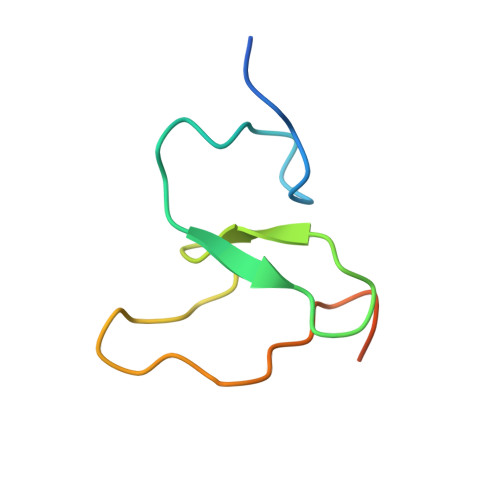
6WXK | pdb_00006wxk

PHF23 PHD Domain Apo


Experimental Data Snapshot

  • Method: X-RAY DIFFRACTION
  • Resolution: 2.90 Å
  • R-Value Free: 
    0.294 (Depositor), 0.266 (DCC) 
  • R-Value Work: 
    0.241 (Depositor) 

Starting Model: experimental
View more details

wwPDB Validation 3D Report Full Report

Validation slider image for 6WXK

This is version 1.2 of the entry. See complete history

Literature

Mechanistic insights into chromatin targeting by leukemic NUP98-PHF23 fusion.

Zhang, Y.Guo, Y.Gough, S.M.Zhang, J.Vann, K.R.Li, K.Cai, L.Shi, X.Aplan, P.D.Wang, G.G.Kutateladze, T.G.

(2020) Nat Commun 11: 3339-3339

  • DOI: https://doi.org/10.1038/s41467-020-17098-4
  • Primary Citation Related Structures: 
    6WXK

  • PubMed Abstract: 

    Chromosomal NUP98-PHF23 translocation is associated with an aggressive form of acute myeloid leukemia (AML) and poor survival rate. Here, we report the molecular mechanisms by which NUP98-PHF23 recognizes the histone mark H3K4me3 and is inhibited by small molecule compounds, including disulfiram that directly targets the PHD finger of PHF23 (PHF23PHD). Our data support a critical role for the PHD fingers of NUP98-PHF23, and related NUP98-KDM5A and NUP98-BPTF fusions in driving leukemogenesis, and demonstrate that blocking this interaction in NUP98-PHF23 expressing AML cells leads to cell death through necrotic and late apoptosis pathways. An overlap of NUP98-KDM5A oncoprotein binding sites and H3K4me3-positive loci at the Hoxa/b gene clusters and Meis1 in ChIP-seq, together with NMR analysis of the H3K4me3-binding sites of the PHD fingers from PHF23, KDM5A and BPTF, suggests a common PHD finger-dependent mechanism that promotes leukemogenesis by this type of NUP98 fusions. Our findings highlight the direct correlation between the abilities of NUP98-PHD finger fusion chimeras to associate with H3K4me3-enriched chromatin and leukemic transformation.


  • Organizational Affiliation
    • Department of Pharmacology, University of Colorado School of Medicine, Aurora, CO, 80045, USA.

Macromolecule Content 

  • Total Structure Weight: 35.62 kDa 
  • Atom Count: 1,963 
  • Modeled Residue Count: 248 
  • Deposited Residue Count: 305 
  • Unique protein chains: 1

Macromolecules

Find similar proteins by:|  3D Structure
Entity ID: 1
MoleculeChains  Sequence LengthOrganismDetailsImage
PHD finger protein 23
A, B, C, D, E
61Homo sapiensMutation(s): 0 
Gene Names: PHF23
UniProt & NIH Common Fund Data Resources
Find proteins for Q9BUL5 (Homo sapiens)
Explore Q9BUL5 
Go to UniProtKB:  Q9BUL5
PHAROS:  Q9BUL5
GTEx:  ENSG00000040633 
Entity Groups
Sequence Clusters30% Identity50% Identity70% Identity90% Identity95% Identity100% Identity
UniProt GroupQ9BUL5
Sequence Annotations
Expand
Reference Sequence

Small Molecules

Ligands 1 Unique
IDChains Name / Formula / InChI Key2D Diagram3D Interactions
ZN

Query on ZN


Download:Ideal Coordinates CCD File
F [auth A]
G [auth A]
H [auth B]
I [auth B]
J [auth C]
F [auth A],
G [auth A],
H [auth B],
I [auth B],
J [auth C],
K [auth C],
L [auth D],
M [auth D],
N [auth E],
O [auth E]
ZINC ION
Zn
PTFCDOFLOPIGGS-UHFFFAOYSA-N

Experimental Data & Validation

Experimental Data

  • Method: X-RAY DIFFRACTION
  • Resolution: 2.90 Å
  • R-Value Free:  0.294 (Depositor), 0.266 (DCC) 
  • R-Value Work:  0.241 (Depositor) 
Space Group: P 41 21 2
Unit Cell:
Length ( Å )Angle ( ˚ )
a = 66.916α = 90
b = 66.916β = 90
c = 151.048γ = 90
Software Package:
Software NamePurpose
PHENIXrefinement
HKL-3000data reduction
HKL-3000data scaling
PHASERphasing

Structure Validation

View Full Validation Report


Entry History 

Deposition Data

Revision History  (Full details and data files)

  • Version 1.0: 2020-07-15
    Type: Initial release
  • Version 1.1: 2023-10-18
    Changes: Advisory, Data collection, Database references, Refinement description
  • Version 1.2: 2024-10-23
    Changes: Structure summary