6UVE | pdb_00006uve

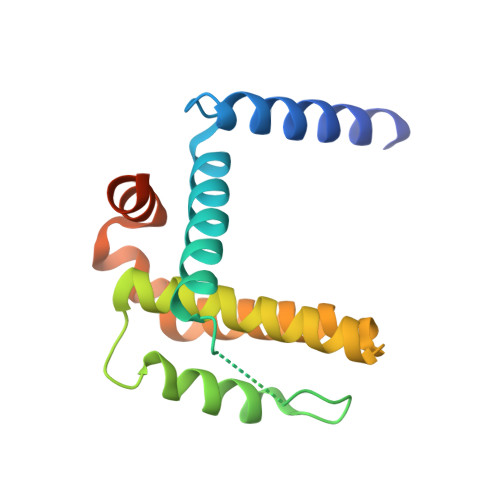
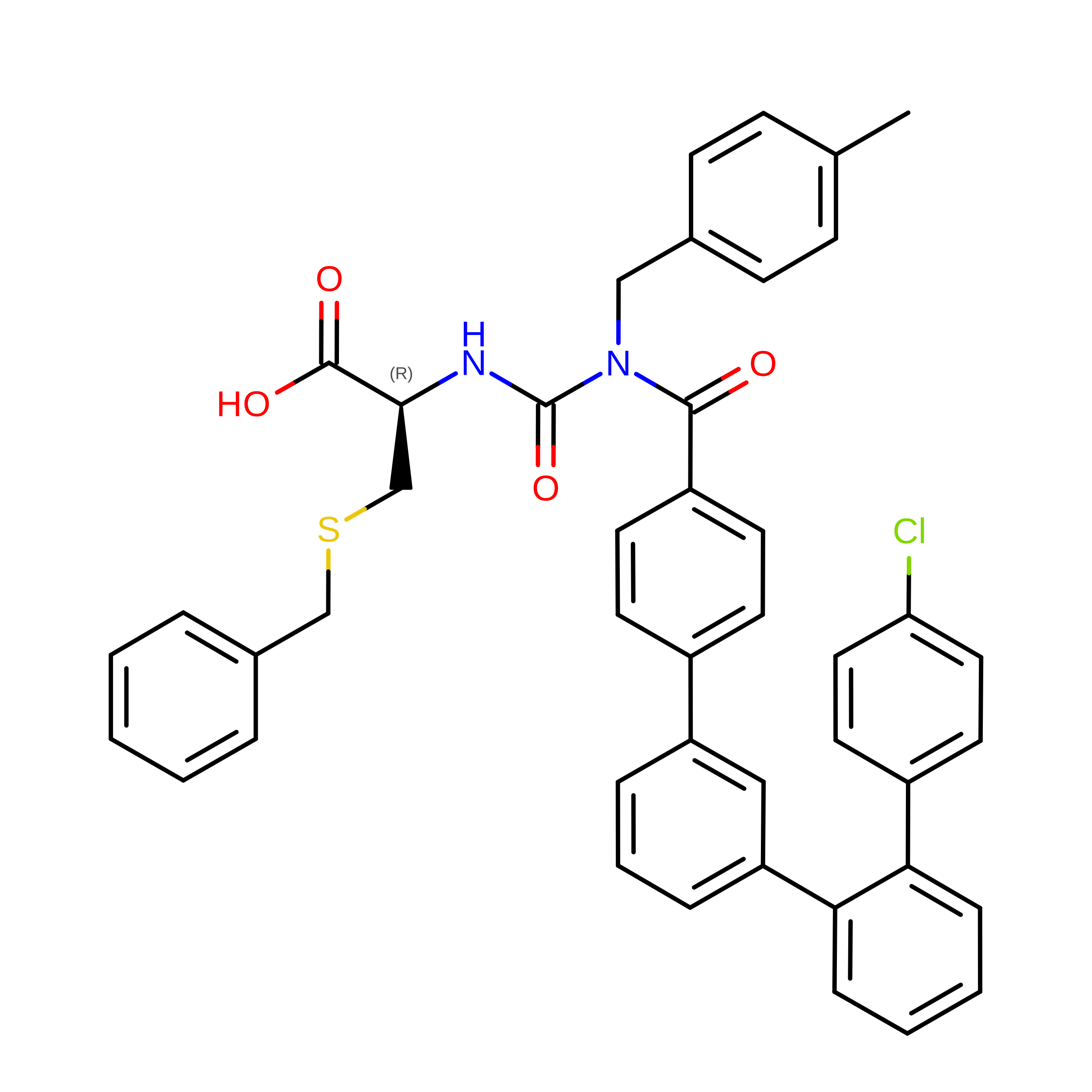
Crystal structure of BCL-XL bound to compound 7: (R)-3-(Benzylthio)-2-(3-(4-chloro-[1,1':2',1'':3'',1'''-quaterphenyl]-4'''-carbonyl)-3-(4-methylbenzyl)ureido)propanoic acid


Experimental Data Snapshot

  • Method: X-RAY DIFFRACTION
  • Resolution: 2.87 Å
  • R-Value Free: 
    0.254 (Depositor), 0.274 (DCC) 
  • R-Value Work: 
    0.213 (Depositor), 0.227 (DCC) 
  • R-Value Observed: 
    0.215 (Depositor) 

Starting Model: experimental
View more details

wwPDB Validation 3D Report Full Report

Validation slider image for 6UVE

Ligand Structure Quality Assessment 


This is version 1.3 of the entry. See complete history

Literature

Structure-Guided Development of Potent Benzoylurea Inhibitors of BCL-X L and BCL-2.

Roy, M.J.Vom, A.Okamoto, T.Smith, B.J.Birkinshaw, R.W.Yang, H.Abdo, H.White, C.A.Segal, D.Huang, D.C.S.Baell, J.B.Colman, P.M.Czabotar, P.E.Lessene, G.

(2021) J Med Chem 64: 5447-5469

  • DOI: https://doi.org/10.1021/acs.jmedchem.0c01771
  • Primary Citation Related Structures: 
    6UVC, 6UVD, 6UVE, 6UVF, 6UVG, 6UVH

  • PubMed Abstract: 

    The BCL-2 family of proteins (including the prosurvival proteins BCL-2, BCL-X L , and MCL-1) is an important target for the development of novel anticancer therapeutics. Despite the challenges of targeting protein-protein interaction (PPI) interfaces with small molecules, a number of inhibitors (called BH3 mimetics) have entered the clinic and the BCL-2 inhibitor, ABT-199/venetoclax, is already proving transformative. For BCL-X L , new validated chemical series are desirable. Here, we outline the crystallography-guided development of a structurally distinct series of BCL-X L /BCL-2 inhibitors based on a benzoylurea scaffold, originally proposed as α-helix mimetics. We describe structure-guided exploration of a cryptic "p5" pocket identified in BCL-X L . This work yields novel inhibitors with submicromolar binding, with marked selectivity toward BCL-X L . Extension into the hydrophobic p2 pocket yielded the most potent inhibitor in the series, binding strongly to BCL-X L and BCL-2 (nanomolar-range half-maximal inhibitory concentration (IC 50 )) and displaying mechanism-based killing in cells engineered to depend on BCL-X L for survival.


  • Organizational Affiliation
    • The Walter and Eliza Hall Institute of Medical Research, 1G Royal Parade, Parkville, VIC 3052, Australia.

Macromolecule Content 

  • Total Structure Weight: 55.99 kDa 
  • Atom Count: 3,412 
  • Modeled Residue Count: 415 
  • Deposited Residue Count: 474 
  • Unique protein chains: 1

Macromolecules

Find similar proteins by:|  3D Structure
Entity ID: 1
MoleculeChains  Sequence LengthOrganismDetailsImage
Bcl-2-like protein 1
A, B, C
158Homo sapiensMutation(s): 0 
Gene Names: BCL2L1BCL2LBCLX
UniProt & NIH Common Fund Data Resources
Find proteins for Q07817 (Homo sapiens)
Explore Q07817 
Go to UniProtKB:  Q07817
PHAROS:  Q07817
GTEx:  ENSG00000171552 
Entity Groups
Sequence Clusters30% Identity50% Identity70% Identity90% Identity95% Identity100% Identity
UniProt GroupQ07817
Sequence Annotations
Expand
Reference Sequence

Experimental Data & Validation

Experimental Data

  • Method: X-RAY DIFFRACTION
  • Resolution: 2.87 Å
  • R-Value Free:  0.254 (Depositor), 0.274 (DCC) 
  • R-Value Work:  0.213 (Depositor), 0.227 (DCC) 
  • R-Value Observed: 0.215 (Depositor) 
Space Group: P 43 21 2
Unit Cell:
Length ( Å )Angle ( ˚ )
a = 148.571α = 90
b = 148.571β = 90
c = 57.448γ = 90
Software Package:
Software NamePurpose
XDSdata reduction
XSCALEdata scaling
PHASERphasing
BUSTERrefinement
PDB_EXTRACTdata extraction

Structure Validation

View Full Validation Report


Ligand Structure Quality Assessment 


Entry History 

& Funding Information

Deposition Data


Funding OrganizationLocationGrant Number
National Health and Medical Research Council (NHMRC, Australia)Australia--

Revision History  (Full details and data files)

  • Version 1.0: 2021-05-05
    Type: Initial release
  • Version 1.1: 2021-05-12
    Changes: Database references
  • Version 1.2: 2021-05-26
    Changes: Database references
  • Version 1.3: 2023-10-11
    Changes: Data collection, Database references, Refinement description