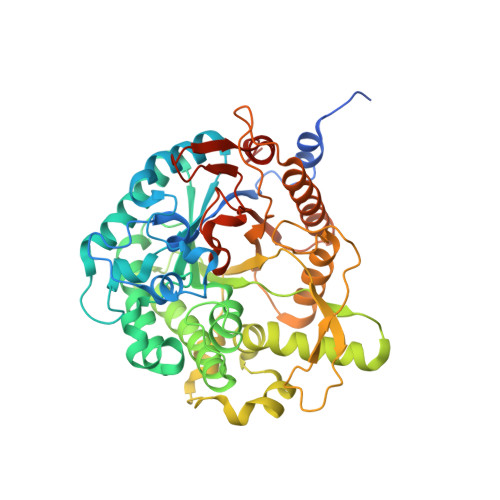
6RJK | pdb_00006rjk

Structure of virulence factor SghA from Agrobacterium tumefaciens


Experimental Data Snapshot

  • Method: X-RAY DIFFRACTION
  • Resolution: 1.92 Å
  • R-Value Free: 
    0.210 (Depositor), 0.211 (DCC) 
  • R-Value Work: 
    0.174 (Depositor) 
  • R-Value Observed: 
    0.176 (Depositor) 

Starting Model: experimental
View more details

wwPDB Validation 3D Report Full Report

Validation slider image for 6RJK

This is version 1.3 of the entry. See complete history

Literature

Agrobacteria reprogram virulence gene expression by controlled release of host-conjugated signals.

Wang, C.Ye, F.Chang, C.Liu, X.Wang, J.Wang, J.Yan, X.F.Fu, Q.Zhou, J.Chen, S.Gao, Y.G.Zhang, L.H.

(2019) Proc Natl Acad Sci U S A 116: 22331-22340

  • DOI: https://doi.org/10.1073/pnas.1903695116
  • Primary Citation Related Structures: 
    6RJK, 6RJM, 6RJO, 6RK2

  • PubMed Abstract: 

    It is highly intriguing how bacterial pathogens can quickly shut down energy-costly infection machinery once successful infection is established. This study depicts that mutation of repressor SghR increases the expression of hydrolase SghA in Agrobacterium tumefaciens , which releases plant defense signal salicylic acid (SA) from its storage form SA β-glucoside (SAG). Addition of SA substantially reduces gene expression of bacterial virulence. Bacterial vir genes and sghA are differentially transcribed at early and later infection stages, respectively. Plant metabolite sucrose is a signal ligand that inactivates SghR and consequently induces sghA expression. Disruption of sghA leads to increased vir expression in planta and enhances tumor formation whereas mutation of sghR decreases vir expression and tumor formation. These results depict a remarkable mechanism by which A. tumefaciens taps on the reserved pool of plant signal SA to reprogram its virulence upon establishment of infection.


  • Organizational Affiliation
    • Guangdong Province Key Laboratory of Microbial Signals and Disease Control, Integrative Microbiology Research Centre, South China Agricultural University, 510642 Guangzhou, China.

Macromolecule Content 

  • Total Structure Weight: 109.75 kDa 
  • Atom Count: 8,089 
  • Modeled Residue Count: 903 
  • Deposited Residue Count: 980 
  • Unique protein chains: 1

Macromolecules

Find similar proteins by:|  3D Structure
Entity ID: 1
MoleculeChains  Sequence LengthOrganismDetailsImage
Beta-glucosidase
A, B
490Agrobacterium tumefaciens A6Mutation(s): 0 
Gene Names: sghA
EC: 3.2.1.21
UniProt
Find proteins for A0A2I4PGZ0 (Agrobacterium tumefaciens A6)
Explore A0A2I4PGZ0 
Go to UniProtKB:  A0A2I4PGZ0
Entity Groups
Sequence Clusters30% Identity50% Identity70% Identity90% Identity95% Identity100% Identity
UniProt GroupA0A2I4PGZ0
Sequence Annotations
Expand
Reference Sequence

Experimental Data & Validation

Experimental Data

  • Method: X-RAY DIFFRACTION
  • Resolution: 1.92 Å
  • R-Value Free:  0.210 (Depositor), 0.211 (DCC) 
  • R-Value Work:  0.174 (Depositor) 
  • R-Value Observed: 0.176 (Depositor) 
Space Group: P 21 21 21
Unit Cell:
Length ( Å )Angle ( ˚ )
a = 64.24α = 90
b = 80.39β = 90
c = 184.62γ = 90
Software Package:
Software NamePurpose
PHENIXrefinement
XDSdata reduction
XDSdata scaling
PHASERphasing
Cootmodel building

Structure Validation

View Full Validation Report


Entry History 

& Funding Information

Deposition Data


Funding OrganizationLocationGrant Number
National Research Foundation (Singapore)SingaporeNRF-RF2009-RF001-267
National Basic Research Program of China (973 Program)China2015CB150600

Revision History  (Full details and data files)

  • Version 1.0: 2019-10-09
    Type: Initial release
  • Version 1.1: 2019-10-23
    Changes: Data collection, Database references
  • Version 1.2: 2019-11-06
    Changes: Data collection, Database references
  • Version 1.3: 2024-01-24
    Changes: Author supporting evidence, Data collection, Database references, Refinement description