6PHG | pdb_00006phg

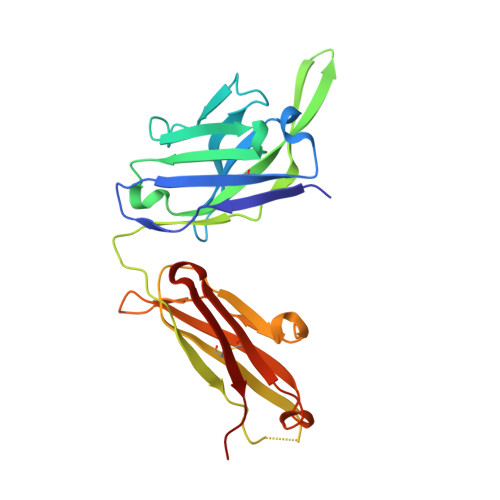
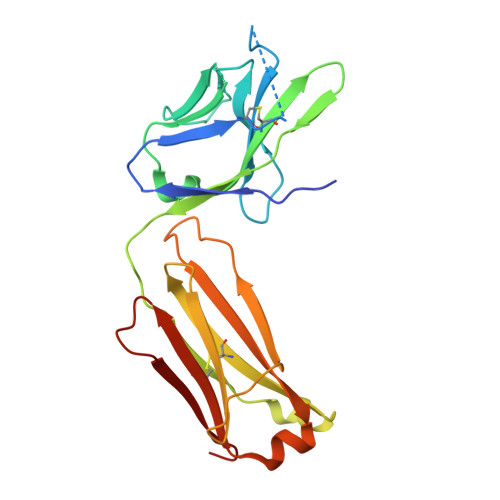
Predicted germline variant of human transmission blocking antibody 2544


Experimental Data Snapshot

  • Method: X-RAY DIFFRACTION
  • Resolution: 2.00 Å
  • R-Value Free: 
    0.228 (Depositor), 0.231 (DCC) 
  • R-Value Work: 
    0.182 (Depositor), 0.184 (DCC) 
  • R-Value Observed: 
    0.185 (Depositor) 

Starting Model: other
View more details

wwPDB Validation 3D Report Full Report

Validation slider image for 6PHG

This is version 1.3 of the entry. See complete history

Literature

Potent antibody lineage against malaria transmission elicited by human vaccination with Pfs25.

McLeod, B.Miura, K.Scally, S.W.Bosch, A.Nguyen, N.Shin, H.Kim, D.Volkmuth, W.Ramisch, S.Chichester, J.A.Streatfield, S.Woods, C.Schief, W.R.Emerling, D.King, C.R.Julien, J.P.

(2019) Nat Commun 10: 4328-4328

  • DOI: https://doi.org/10.1038/s41467-019-11980-6
  • Primary Citation Related Structures: 
    6PHB, 6PHC, 6PHD, 6PHF, 6PHG, 6PHH

  • PubMed Abstract: 

    Transmission-blocking vaccines have the potential to be key contributors to malaria elimination. Such vaccines elicit antibodies that inhibit parasites during their development in Anopheles mosquitoes, thus breaking the cycle of transmission. To date, characterization of humoral responses to Plasmodium falciparum transmission-blocking vaccine candidate Pfs25 has largely been conducted in pre-clinical models. Here, we present molecular analyses of human antibody responses generated in a clinical trial evaluating Pfs25 vaccination. From a collection of monoclonal antibodies with transmission-blocking activity, we identify the most potent transmission-blocking antibody yet described against Pfs25; 2544. The interactions of 2544 and three other antibodies with Pfs25 are analyzed by crystallography to understand structural requirements for elicitation of human transmission-blocking responses. Our analyses provide insights into Pfs25 immunogenicity and epitope potency, and detail an affinity maturation pathway for a potent transmission-blocking antibody in humans. Our findings can be employed to guide the design of improved malaria transmission-blocking vaccines.


  • Organizational Affiliation
    • Program in Molecular Medicine, The Hospital for Sick Children Research Institute, 686 Bay Street, Toronto, ON, M5G 0A4, Canada.

Macromolecule Content 

  • Total Structure Weight: 48.42 kDa 
  • Atom Count: 3,434 
  • Modeled Residue Count: 427 
  • Deposited Residue Count: 446 
  • Unique protein chains: 2

Macromolecules

Find similar proteins by:|  3D Structure
Entity ID: 1
MoleculeChains  Sequence LengthOrganismDetailsImage
Germline 2544 Antibody Fab, Heavy Chain228Homo sapiensMutation(s): 0 
Find similar proteins by:|  3D Structure
Entity ID: 2
MoleculeChains  Sequence LengthOrganismDetailsImage
Germline 2544 Antibody Fab, Light Chain218Homo sapiensMutation(s): 0 

Small Molecules

Ligands 1 Unique
IDChains Name / Formula / InChI Key2D Diagram3D Interactions
GOL

Query on GOL


Download:Ideal Coordinates CCD File
C [auth B]GLYCEROL
C3 H8 O3
PEDCQBHIVMGVHV-UHFFFAOYSA-N

Experimental Data & Validation

Experimental Data

  • Method: X-RAY DIFFRACTION
  • Resolution: 2.00 Å
  • R-Value Free:  0.228 (Depositor), 0.231 (DCC) 
  • R-Value Work:  0.182 (Depositor), 0.184 (DCC) 
  • R-Value Observed: 0.185 (Depositor) 
Space Group: C 1 2 1
Unit Cell:
Length ( Å )Angle ( ˚ )
a = 130.843α = 90
b = 60.557β = 113.62
c = 61.079γ = 90
Software Package:
Software NamePurpose
PHENIXrefinement
XDSdata reduction
XDSdata scaling
PHENIXphasing

Structure Validation

View Full Validation Report


Entry History 

& Funding Information

Deposition Data


Funding OrganizationLocationGrant Number
Bill & Melinda Gates FoundationCanadaOPP1108403

Revision History  (Full details and data files)

  • Version 1.0: 2019-10-02
    Type: Initial release
  • Version 1.1: 2019-10-09
    Changes: Data collection, Database references
  • Version 1.2: 2024-04-03
    Changes: Data collection, Database references, Refinement description
  • Version 1.3: 2024-11-20
    Changes: Structure summary