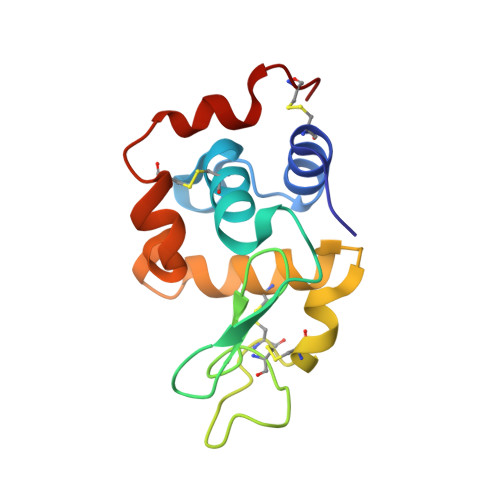
6MQV | pdb_00006mqv

Structure of HEWL from LCP injector using synchrotron radiation


Experimental Data Snapshot

  • Method: X-RAY DIFFRACTION
  • Resolution: 2.00 Å
  • R-Value Free: 
    0.249 (Depositor), 0.242 (DCC) 
  • R-Value Work: 
    0.195 (Depositor), 0.200 (DCC) 
  • R-Value Observed: 
    0.198 (Depositor) 

Starting Model: experimental
View more details

wwPDB Validation 3D Report Full Report

Validation slider image for 6MQV

This is version 1.3 of the entry. See complete history

Literature

The serial millisecond crystallography instrument at the Australian Synchrotron incorporating the "Lipidico" injector.

Berntsen, P.Hadian Jazi, M.Kusel, M.Martin, A.V.Ericsson, T.Call, M.J.Trenker, R.Roque, F.G.Darmanin, C.Abbey, B.

(2019) Rev Sci Instrum 90: 085110-085110

  • DOI: https://doi.org/10.1063/1.5104298
  • Primary Citation Related Structures: 
    6MQV

  • PubMed Abstract: 

    A serial millisecond crystallography (SMX) facility has recently been implemented at the macromolecular crystallography beamline, MX2 at the Australian Synchrotron. The setup utilizes a combination of an EIGER X 16M detector system and an in-house developed high-viscosity injector, "Lipidico." Lipidico uses a syringe needle to extrude the microcrystal-containing viscous media and it is compatible with commercially available syringes. The combination of sample delivery via protein crystals suspended in a viscous mixture and a millisecond frame rate detector enables high-throughput serial crystallography at the Australian Synchrotron. A hit-finding algorithm, based on the principles of "robust-statistics," is employed to rapidly process the data. Here we present the first SMX experimental results with a detector frame rate of 100 Hz (10 ms exposures) and the Lipidico injector using a mixture of lysozyme microcrystals embedded in high vacuum silicon grease. Details of the experimental setup, sample injector, and data analysis pipeline are designed and developed as part of the Australian Synchrotron SMX instrument and are reviewed here.


  • Organizational Affiliation
    • Australian Research Council Centre of Excellence in Advanced Molecular Imaging, Department of Chemistry and Physics, La Trobe Institute for Molecular Science, La Trobe University, Melbourne 3086, Australia.

Macromolecule Content 

  • Total Structure Weight: 14.35 kDa 
  • Atom Count: 1,059 
  • Modeled Residue Count: 129 
  • Deposited Residue Count: 129 
  • Unique protein chains: 1

Macromolecules

Find similar proteins by:|  3D Structure
Entity ID: 1
MoleculeChains  Sequence LengthOrganismDetailsImage
Lysozyme C129Gallus gallusMutation(s): 0 
EC: 3.2.1.17
UniProt
Find proteins for P00698 (Gallus gallus)
Explore P00698 
Go to UniProtKB:  P00698
Entity Groups
Sequence Clusters30% Identity50% Identity70% Identity90% Identity95% Identity100% Identity
UniProt GroupP00698
Sequence Annotations
Expand
Reference Sequence

Small Molecules

Ligands 1 Unique
IDChains Name / Formula / InChI Key2D Diagram3D Interactions
NA

Query on NA


Download:Ideal Coordinates CCD File
B [auth A]SODIUM ION
Na
FKNQFGJONOIPTF-UHFFFAOYSA-N

Experimental Data & Validation

Experimental Data

  • Method: X-RAY DIFFRACTION
  • Resolution: 2.00 Å
  • R-Value Free:  0.249 (Depositor), 0.242 (DCC) 
  • R-Value Work:  0.195 (Depositor), 0.200 (DCC) 
  • R-Value Observed: 0.198 (Depositor) 
Space Group: P 43 21 2
Unit Cell:
Length ( Å )Angle ( ˚ )
a = 78.68α = 90
b = 78.68β = 90
c = 38.48γ = 90
Software Package:
Software NamePurpose
BUSTERrefinement
CrystFELdata reduction
CrystFELdata scaling
PHASERphasing

Structure Validation

View Full Validation Report


Entry History 

& Funding Information

Deposition Data


Funding OrganizationLocationGrant Number
Australian Research Council (ARC)AustraliaARC Centre of Excellence in Advanced Molecular Imaging

Revision History  (Full details and data files)

  • Version 1.0: 2019-09-11
    Type: Initial release
  • Version 1.1: 2020-01-01
    Changes: Author supporting evidence
  • Version 1.2: 2023-10-11
    Changes: Data collection, Database references, Refinement description
  • Version 1.3: 2024-10-30
    Changes: Structure summary