6L27 | pdb_00006l27

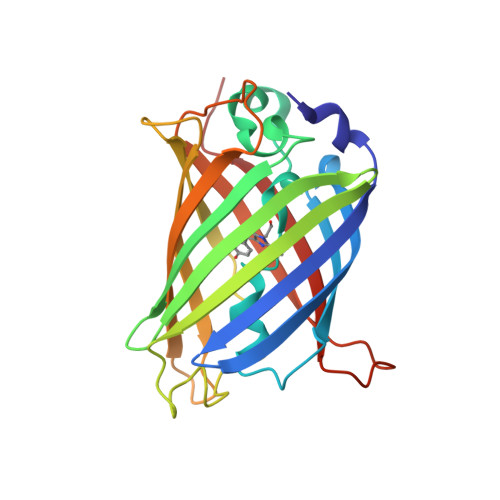
X-ray crystal structure of the mutant green fluorescent protein


Experimental Data Snapshot

  • Method: X-RAY DIFFRACTION
  • Resolution: 0.77 Å
  • R-Value Free: 
    0.124 (Depositor), 0.125 (DCC) 
  • R-Value Work: 
    0.118 (Depositor), 0.119 (DCC) 
  • R-Value Observed: 
    0.119 (Depositor) 

wwPDB Validation 3D Report Full Report

Validation slider image for 6L27

This is version 3.0 of the entry. See complete history

Literature

Direct Observation of the Protonation States in the Mutant Green Fluorescent Protein.

Shibazaki, C.Shimizu, R.Kagotani, Y.Ostermann, A.Schrader, T.E.Adachi, M.

(2020) J Phys Chem Lett 11: 492-496

  • DOI: https://doi.org/10.1021/acs.jpclett.9b03252
  • Primary Citation Related Structures: 
    6L26, 6L27

  • PubMed Abstract: 

    Neutron crystallography has been used to elucidate the protonation states for the enhanced green fluorescent protein, which has revolutionized imaging technologies. The structure has a deprotonated hydroxyl group in the fluorescent chromophore. Also, the protonation states of His148 and Thr203, as well as the orientation of a critical water molecule in direct contact with the chromophore, could be determined. The results demonstrate that the deprotonated hydroxyl group in the chromophore and the nitrogen atom ND1 in His148 are charged negatively and positively, respectively, forming an ion pair. The position of the two deuterium atoms in the critical water molecule appears to be displaced slightly toward the acceptor oxygen atoms according to their omit maps. This displacement implies the formation of an intriguing electrostatic potential realized inside of the protein. Our findings provide new insights into future protein design strategies along with developments in quantum chemical calculations.


  • Organizational Affiliation
    • Institute for Quantum Life Science , National Institutes for Quantum and Radiological Science and Technology (QST) , 2-4 Shirakata , Tokai , Ibaraki 319-1106 , Japan.

Macromolecule Content 

  • Total Structure Weight: 25.83 kDa 
  • Atom Count: 2,543 
  • Modeled Residue Count: 227 
  • Deposited Residue Count: 227 
  • Unique protein chains: 1

Macromolecules

Find similar proteins by:|  3D Structure
Entity ID: 1
MoleculeChains  Sequence LengthOrganismDetailsImage
Green fluorescent protein227Aequorea victoriaMutation(s): 1 
Gene Names: GFP
UniProt
Find proteins for P42212 (Aequorea victoria)
Explore P42212 
Go to UniProtKB:  P42212
Entity Groups
Sequence Clusters30% Identity50% Identity70% Identity90% Identity95% Identity100% Identity
UniProt GroupP42212
Sequence Annotations
Expand
Reference Sequence

Small Molecules

Modified Residues  1 Unique
IDChains TypeFormula2D DiagramParent
GYS
Query on GYS
A
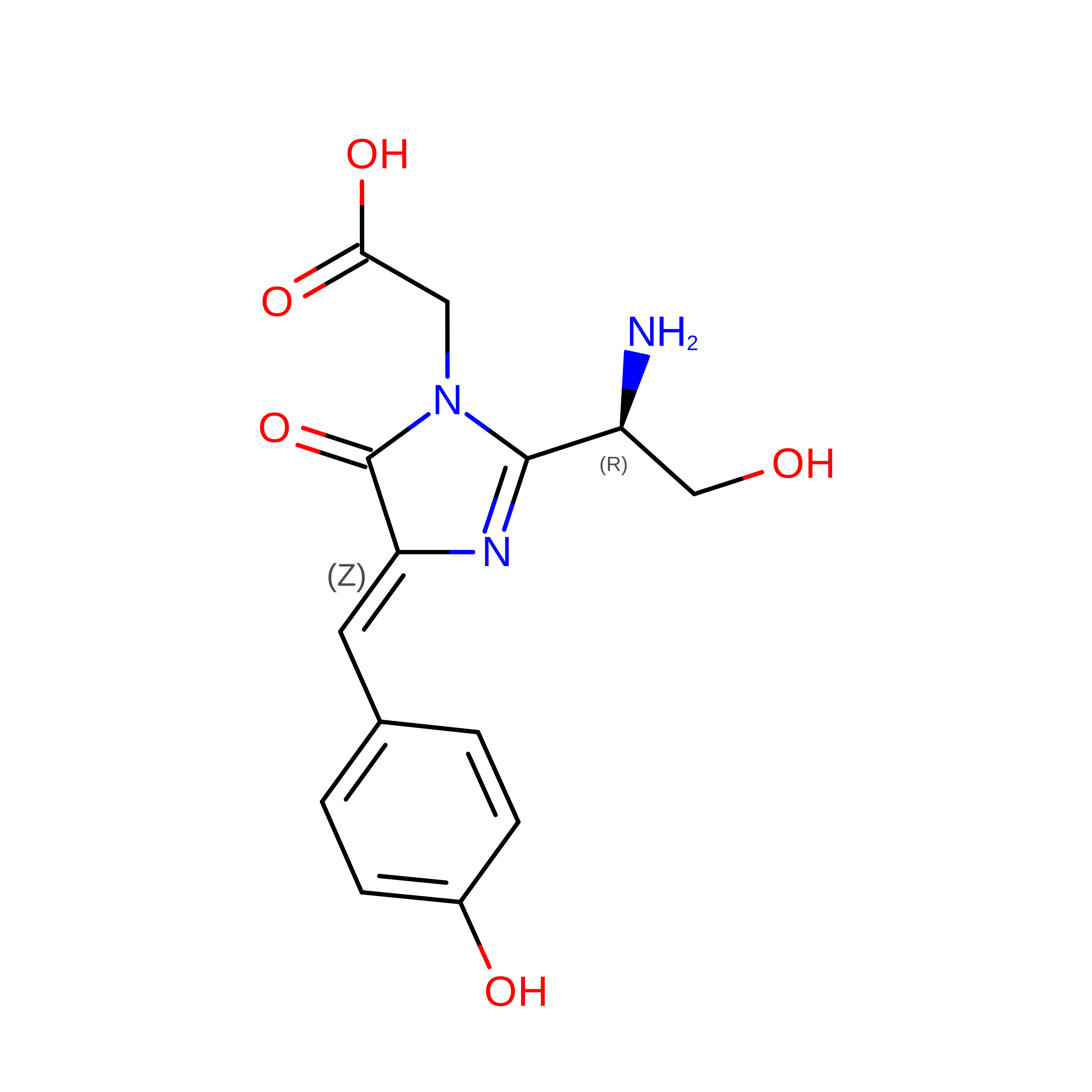
L-PEPTIDE LINKINGC14 H15 N3 O5SER, TYR, GLY

Experimental Data & Validation

Experimental Data

  • Method: X-RAY DIFFRACTION
  • Resolution: 0.77 Å
  • R-Value Free:  0.124 (Depositor), 0.125 (DCC) 
  • R-Value Work:  0.118 (Depositor), 0.119 (DCC) 
  • R-Value Observed: 0.119 (Depositor) 
Space Group: P 21 21 21
Unit Cell:
Length ( Å )Angle ( ˚ )
a = 50.875α = 90
b = 62.561β = 90
c = 68.76γ = 90
Software Package:
Software NamePurpose
PHENIXrefinement
PDB_EXTRACTdata extraction
HKL-2000data reduction
SCALEPACKdata scaling
PHENIXphasing

Structure Validation

View Full Validation Report


Entry History 

& Funding Information

Deposition Data


Funding OrganizationLocationGrant Number
Ministry of Education, Culture, Sports, Science and Technology (Japan)JapanJP16KT0063

Revision History  (Full details and data files)

  • Version 1.0: 2020-04-01
    Type: Initial release
  • Version 2.0: 2023-11-15
    Changes: Atomic model, Data collection, Database references, Derived calculations
  • Version 2.1: 2024-11-06
    Changes: Structure summary
  • Version 3.0: 2026-03-18
    Changes: Polymer sequence