Download Mendeley
Structural basis for the selective addition of an oxygen atom to cyclic ketones by Baeyer-Villiger monooxygenase from Parvibaculum lavamentivorans.
Nguyen, T.D., Choi, G.E., Gu, D.H., Seo, P.W., Kim, J.W., Park, J.B., Kim, J.S.(2019) Biochem Biophys Res Commun 512: 564-570
- PubMed: 30914200 Search on PubMed
- DOI: https://doi.org/10.1016/j.bbrc.2019.03.114
- Primary Citation Related Structures:
6JDK - PubMed Abstract:
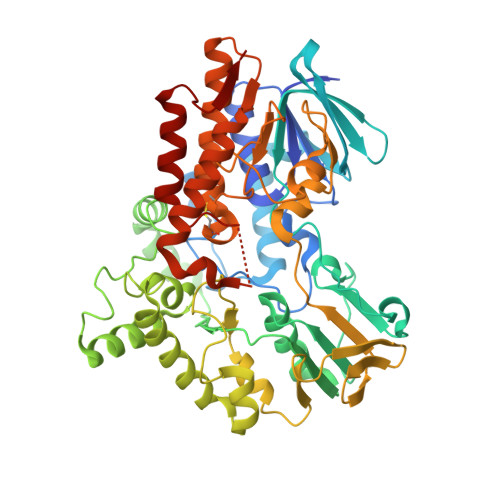
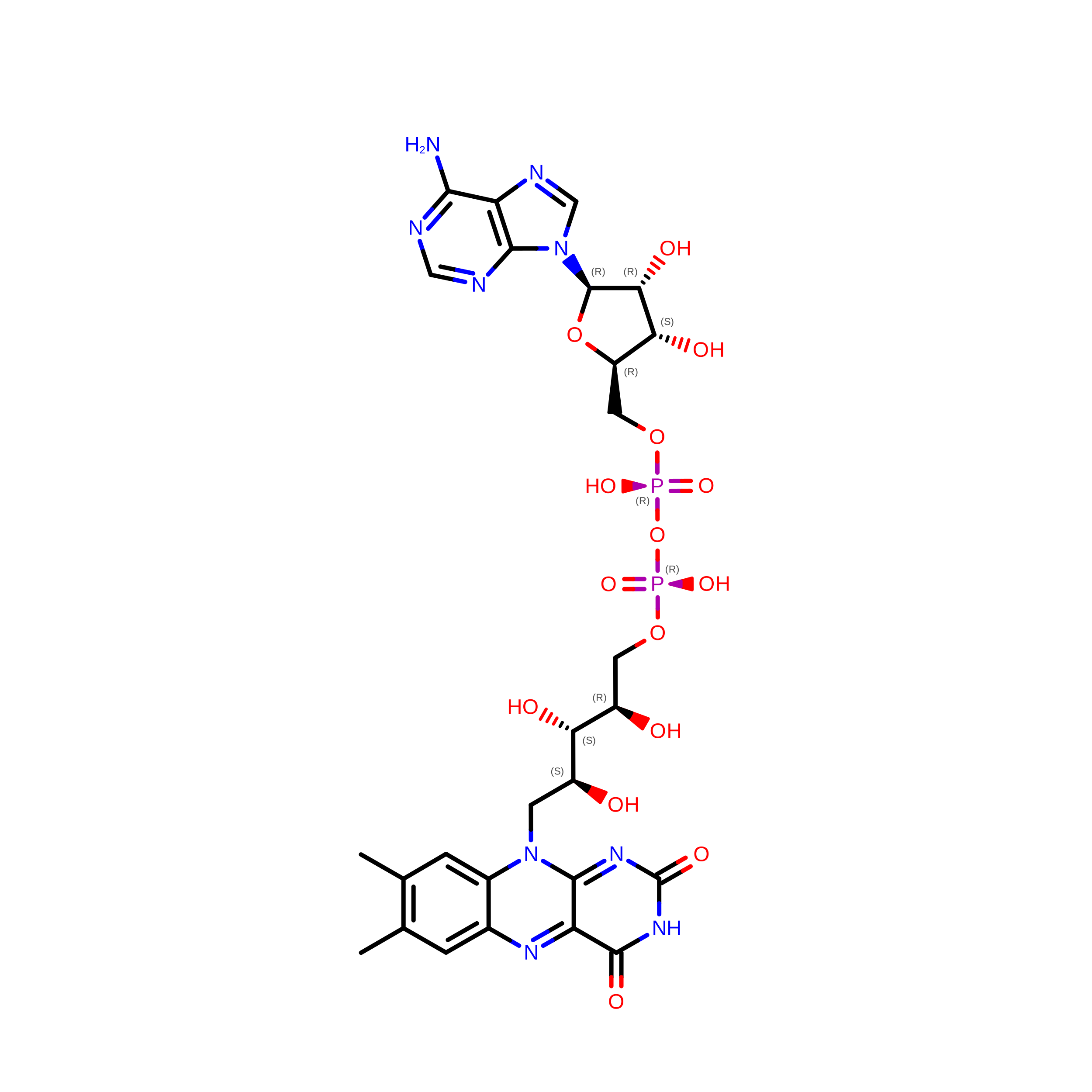
Baeyer-Villiger monooxygenase (BVMO) catalyzes insertion of an oxygen atom into aliphatic or cyclic ketones with high regioselectivity. The BVMOs from Parvibaculum lavamentivorans (BVMO Parvi ) and Oceanicola batsensis (BVMO Ocean ) are interesting because of their homologies, with >40% sequence identity, and reaction with the same cyclic ketones with a methyl moiety to give different products. The revealed BVMO Parvi structure shows that BVMO Parvi forms a two-domain structure like other BVMOs. It has two inserted residues, compared with BVMO Ocean , that form a bulge near the bound flavin adenine dinucleotide in the active site. Furthermore, this bulge is linked to a nearby α-helix via a disulfide bond, probably restricting access of the bulky methyl group of the substrate to this bulge. Another sequence motif at the entrance of the active site (Ala-Ser in BVMO Parvi and Ser-Thr in BVMO Ocean ) allows a large volume in BVMO Parvi . These minute differences may discriminate a substrate orientation in both BVMOs from the initial substrate binding pocket to the final oxygenation site, resulting in the inserted oxygen atom being in different positions of the same substrate.
- Department of Chemistry, Chonnam National University, Gwangju, 61186, Republic of Korea.
Organizational Affiliation: